





200 years no gospels | 24 other thrones besides Jesus' | Jesus' problematic hyperboles: made sinful lawful and lawful sinful | Jesus was created | What's new | A-Z library (3300+ articles) | "Muslims" was the original title | Quran Search | Quran Moral Code (100s of them) | Quran: Bibles are filled with corrupt قول qaowl (doctrines of sayings and writings. See also Hafs vs. Warsh Quran) | "bar Allahin" in Daniel 3:25-26 means the chosen one of Allah | Jesus said he was powerless | Paul said he wasn't sure about Holy Spirit | Disciples called each other liars, satanic, false | Paul commanded women to not expose sex predators | Research & Blog | 9/11 Israel-lie | Youtube | 
 | Jesus replaced Satan: (Ezekiel 28:13-19)
Where was the promised Holy Spirit in the disciples' apostatizing of each other.
The Romans had to crucifixion fake his crucifixion due to Passover issues: [1]

Also Visit:
www.answering-christianity.com/blog/index.php/topic,797.0.html
www.answering-christianity.com/convert_christians.htm
Most of the articles on this page were sent to me by my two dear friends Rami Abdallah and Qais Ali; may Allah Almighty always be pleased with them. Most of them originally come from Brother Al-Kadhi's work, and the rest of them come from other brothers' and sisters' work which I mentioned their names on their articles. The sections that don't have author's name on them are Brother Al-Kadhi's work.
The following links are articles on this page combined together:
Is the entire Bible truely the Word of GOD?
The lie of 1 John 5:7.
The lie of 1 John 5:7 and Timothy 3:16.
The invalidity of the Trinity belief from the Theologians' views.
Who were the real authors of the Bible?
Is the Bible 100% faultless and untampered with by the Church?
Where did our modern Bibles come from? Some
examples of grave defects in the Bible (Luke 2:52: GOD forgave Jesus' sins and was "charitable" with him).
Where did the discarded verses come from in the first place?
How many books of the Bible are 'truly inspired'?
How did the Church handle the "differences in the Bibles"
problem?
Where did the King James Bible come from?
How did the Church explain all these centuries of tampering?
82% of the words of Jesus are not his.
Did mankind tamper with the Old Testament?
When is a book an 'inspired' book?
Ancient paganism and the dangers of compromise.
Is the entire Bible truely the word of GOD?
No credible Biblical scholar on this earth will claim that the Bible was written by Jesus himself. They all agree that the Bible was written after the departure of Jesus peace be upon him by his followers. So, if the authors of the Bible were people other than Jesus, then did they have Jesus or the Holy Spirit in them guiding their hands and dictating to them word for word what to write? As it happens, once again the answer is no. Who says so? The majority of today's credible Christian scholars do. For example:
Dr. W Graham Scroggie of the Moody Bible Institute, Chicago, a prestigious Christian evangelical mission, says:
"..Yes, the Bible is human, although some out of zeal which is not according to knowledge, have denied this. Those books have passed through the minds of men, are written in the language of men, were penned by the hands of men and bear in their style the characteristics of men...."
"It is Human, Yet Divine," W Graham Scroggie, p. 17
Another Christian scholar, Kenneth Cragg, the Anglican Bishop of Jerusalem, says:
"...Not so the New testament...There is condensation and editing; there is choice reproduction and witness. The Gospels have come through the mind of the church behind the authors. They represent experience and history..."
"The Call of the Minaret," Kenneth Cragg, p 277
For example, we read in the Bible the words of the author of "Luke":
"It seemed good to me (Luke) also, having had perfect understanding of all things from the very first, to write unto thee in order, most excellent Theophilus, (Luke 1:3)"
If you consider the Bible the word of GOD, well, it is quite obvious that Luke
decided to write his Gospel because he wanted to please the president or the
leader at that time Theophilus. This however has several problems: (1) It
compromises GOD because there is a biger purpose than GOD to write the Gospel, (2) It
shows that Luke wouldn't have written his Gospel if it wasn't for that leader, and (3)
Luke was not inpired when he wrote his Gospel because he said that he decided to write it
after he had full understanding of it, which means that he wrote it with his own human
words and thoughts and not GOD's.
For a closer look at reliability of the NT and its development dont forget to check out Is the NT really reliable ?
Its a nice direct answer to the highly visited "Christian Think Tank" site.
Is the Bible a Guideline for Human Morality?
The lie of 1 John 5:7 verse. It was later discovered to be a man made corruption inserted into the Bibles:
This section was forwarded to me by my brother in Islam Haleem, a new convert to Islam; may Allah Almighty always be pleased with him. This page is located at http://wings.buffalo.edu/sa/muslim/library/jesus-say/ch1.2.2.5.html1.2.2.5 1 John 5:7
The only verses in the whole Bible that explicitly ties God, Jesus, and the Holy Spirit
in one "Triune" being is the verse of 1 John 5:7
"For there are three that bear record in heaven, the Father, the Word, and the
Holy Ghost: and these three are one."
This is the type of clear, decisive, and to-the-point verse I have been
asking for. However, as I would later find out, this verse is now universally recognized
as being a later "insertion" of the Church and all recent versions of the Bible,
such as the Revised Standard Version the New Revised Standard Version, the New American
Standard Bible, the New English Bible, the Phillips Modern English Bible ...etc. have all
unceremoniously expunged this verse from their pages. Why is this? The scripture
translator Benjamin Wilson gives the following explanation for this action in his "Emphatic
Diaglott." Mr. Wilson says:
"This text concerning the heavenly witness is not contained in any Greek
manuscript which was written earlier than the fifteenth century. It is not cited by any of
the ecclesiastical writers; not by any of early Latin fathers even when the subjects upon
which they treated would naturally have lead them to appeal to it's authority. It is
therefore evidently spurious."
Others, such as the late Dr. Herbert W. Armstrong argued that this verse was added to
the Latin Vulgate edition of the Bible during the heat of the controversy between Rome,
Arius, and God's people. Whatever the reason, this verse is now universally recognized as
an insertion and discarded. Since the Bible contains no verses validating a "Trinity"
therefore, centuries after the departure of Jesus, God chose to inspire someone to insert
this verse in order to clarify the true nature of God as being a "Trinity."
Notice how mankind was being inspired as to how to "clarify" the Bible centuries
after the departure of Jesus (pbuh). People continued to put words in the mouths of Jesus,
his disciples, and even God himself with no reservations whatsoever. They were being
"inspired".
If these people were being "inspired" by God, I wondered, then why did they
need to put these words into other people's mouths (in our example, in the
mouth of John). Why did they not just openly say "God inspired me and I will add a
chapter to the Bible in my name"? Also, why did God need to wait till
after the departure of Jesus to "inspire" his "true" nature? Why not
let Jesus (pbuh) say it himself?
The great luminary of Western literature, Mr. Edward Gibbon, explains the reason for
the discardal of this verse from the pages of the Bible with the following words:
"Of all the manuscripts now extant, above fourscore in number, some of which are more than 1200 years old, the orthodox copies of the Vatican, of the Complutensian editors, of Robert Stephens are becoming invisible; and the two manuscripts of Dublin and Berlin are unworthy to form an exception...In the eleventh and twelfth centuries, the Bibles were corrected by LanFrank, Archbishop of Canterbury, and by Nicholas, a cardinal and librarian of the Roman church, secundum Ortodoxam fidem. Notwithstanding these corrections, the passage is still wanting in twenty-five Latin manuscripts, the oldest and fairest; two qualities seldom united, except in manuscripts....The three witnesses have been established in our Greek Testaments by the prudence of Erasmus; the honest bigotry of the Complutensian editors; the typographical fraud, or error, of Robert Stephens in the placing of a crotchet and the deliberate falsehood, or strange misapprehension, of Theodore Beza."
"Decline and fall of the Roman Empire," IV, Gibbon, p. 418.
Edward Gibbon was defended in his findings by his contemporary, the brilliant British
scholar Richard Porson who also proceeded to publish devastatingly conclusive proof that
the verse of 1 John 5:7 was only first inserted by the Church into the Bible in the year
400C.E.(Secrets of Mount Sinai, James Bentley, pp. 30-33).
Regarding Porson's most devastating proof, Mr. Gibbon later said
"His structures are founded in argument, enriched with learning, and enlivened
with wit, and his adversary neither deserves nor finds any quarter at his hands. The
evidence of the three heavenly witnesses would now be rejected in any court of justice;
but prejudice is blind, authority is deaf, and our vulgar Bibles will ever be polluted by
this spurious text."
To which Mr. Bentley responds:
"In fact, they are not. No modern Bible now contains the interpolation."
Mr. Bentley, however, is mistaken. Indeed, just as Mr. Gibbon had predicted, the simple
fact that the most learned scholars of Christianity now unanimously recognize this verse
to be a later interpolation of the Church has not prevented the preservation of this
fabricated text in our modern Bibles. To this day, the Bible in the hands of the majority
of Christians, the "King James" Bible, still unhesitantly includes this verse as
the "inspired" word of God without so much as a footnote to inform the reader
that all scholars of Christianity of note unanimously recognize it as a later fabrication.
Peake's Commentary on the Bible says
"The famous interpolation after 'three witnesses' is not printed even in RSVn,
and rightly. It cites the heavenly testimony of the Father, the logos, and the Holy
Spirit, but is never used in the early Trinitarian controversies. No respectable Greek MS
contains it. Appearing first in a late 4th-cent. Latin text, it entered the Vulgate and
finally the NT of Erasmus."
It was only the horrors of the great inquisitions which held back Sir Isaac Newton from
openly revealing these facts to all:
"In all the vehement universal and lasting controversy about the Trinity in Jerome's time and both before and long enough after it, the text of the 'three in heaven' was never once thought of. It is now in everybody's mouth and accounted the main text for the business and would assuredly have been so too with them, had it been in their books… Let them make good sense of it who are able. For my part I can make none. If it be said that we are not to determine what is scripture and what not by our private judgments, I confess it in places not controverted, but in disputed places I love to take up with what I can best understand. It is the temper of the hot and superstitious part of mankind in matters of religion ever to be fond of mysteries, and for that reason to like best what they understand least. Such men may use the Apostle John as they please, but I have that honor for him as to believe that he wrote good sense and therefore take that to be his which is the best"
Jesus, Prophet of Islam, Muhammad Ata' Ur-Rahim, p. 156
According to Newton, this verse first appeared for in the third edition of
Erasmus's (1466-1536) New Testament.
For all of the above reasons, we find that when thirty two biblical scholars backed
by fifty cooperating Christian denominations got together to compile the Revised
Standard Version of the Bible based upon the most ancient Biblical manuscripts available
to them today, they made some very extensive changes. Among these changes was the
unceremonious discardal of the verse of 1 John 5:7 as the fabricated insertion that it is.
For more on the compilation of the RSV Bible, please read the preface of any modern copy
of that Bible (Luke 2:52: GOD forgave Jesus' sins and was "charitable" with him).
Such comparatively unimportant matters as the description of Jesus (pbuh) riding an ass
(or was it a "colt", or was it an "ass and a colt"? see point 42 in
the table of section 2.2) into Jerusalem are spoken about in great details since they are
the fulfillment of a prophesy. For instance, in Mark 11:2-10 we read:
"And saith unto them, Go your way into the village over against you: and as
soon as ye be entered into it, ye shall find a colt tied, whereon never man sat; loose
him, and bring [him]. And if any man say unto you, Why do ye this? say ye that the Lord
hath need of him; and straightway he will send him hither. And they went their way, and
found the colt tied by the door without in a place where two ways met; and they loose him
And certain of them that stood there said unto them, What do ye, loosing the colt? And
they said unto them even as Jesus had commanded: and they let them go And they brought the
colt to Jesus, and cast their garments on him; and he sat upon him. And many spread their
garments in the way: and others cut down branches off the trees, and strawed [them] in the
way And they that went before, and they that followed, cried, saying, Hosanna; Blessed
[is] he that cometh in the name of the Lord: Blessed [be] the kingdom of our father David,
that cometh in the name of the Lord: Hosanna in the highest."
Also see Luke 19:30-38 which has a similar detailed description of this occurrence. On the other hand, the Bible is completely free of any description of the "Trinity" which is supposedly a description of the very nature of the one who rode this ass, who is claimed to be the only son of God, and who allegedly died for the sins of all of mankind. I found myself asking the question: If every aspect of Christian faith is described in such detail such that even the description of this ass is so vividly depicted for us, then why is the same not true for the description of the "Trinity"? Sadly, however, it is a question for which there is no logical answer.
More proofs on the lie of 1 John 5:7 and 1 Timothy 3:16:
The following section was sent to me by a Muslim; may Allah Almighty always be pleased
with him.
Sir Isaac Newton On The Bible
In 1690, Sir Isaac Newton (died 1727) wrote a manuscript on the corruption of the text of the New Testament concerning I John 5:7 and Timothy 3:16. It was entitled, "A Historical Account of Two Notable Corruptions of Scripture." Due to the prevailing environment against criticism, he felt it unwise to profess his beliefs openly and felt that printing it in England would be too dangerous. Newton sent a copy of this manuscript to John Locke requesting him to have it translated into French for publication in France. Two years later, Newton was informed of an attempt to publish a Latin translation of it anonymously. However, Newton did not approve of its availability in Latin and persuaded Locke to take steps to prevent this publication. Below are excerpts from "A Historical Account of Two Notable Corruptions of Scripture."
Newton on I John 5:7
Newton states that this verse appeared for the first time in the third edition of Erasmus's New Testament. When they got the Trinity; into his edition they threw by their manuscript, if they had one, as an almanac out of date. And can such shuffling dealings satisfy considering men?....It is rather a danger in religion than an advantage to make it now lean on a broken reed. In all the vehement universal and lasting controversy about the Trinity in Jerome's time and both before and long enough after it, this text of the "three in heaven" was never once thought of. It is now in everybody's mouth and accounted the main text for the business and would assuredly have been so too with them, had it been in their books. "Let them make good sense of it who are able. For my part, I can make none. If it be said that we are not to determine what is Scripture what not by our private judgments, I confess it in places not controverted, but in disputed places I love to take up with what I can best understand. It is the temper of the hot and superstitious art of mankind in matters of religion ever to be fond of mysteries, and for that reason to like best what they understand least. Such men may use the Apostle John as they please, but I have that honour for him as to believe that he wrote good sense and therefore take that to be his which is the best."
Newton on I Timothy 3:16
In all the times of the hot and lasting Arian controversy it never came into play . . . they that read "God manifested in the flesh" think it one of the most obvious and pertinent texts for the business. "The word Deity imports exercise of dominion over subordinate beings and the word God most frequently signifies Lord. Every lord is not God (Luke 2:52: GOD forgave Jesus' sins and was "charitable" with him). The exercise of dominion in a spiritual being constitutes a God (Luke 2:52: GOD forgave Jesus' sins and was "charitable" with him). If that dominion be real that being is the real God; if it be fictitious, a false God; if it be supreme, a supreme God." Newton also wrote a discussion on two other texts that Athanasius had attempted to corrupt. This work has not been preserved. He believed that not all the books of the Scriptures have the same authority.
Reference A. Wallace, "Anti-Trinitarian Biographies," Vol. III, 1850.
The Validity of the Trinity Belief:
Trinity doctrine doesn't have basic in either NT nor in OT. They depend on human
interpretation to form up this doctrine. It is totally pagan.
In the preface to Edward Gibbon's History of Christianity, we
read: "If Paganism was conquered by Christianity, it is equally
true that Christianity was corrupted by Paganism."
A Dictionary of Religious Knowledge notes that many say that the Trinity "is a corruption borrowed from the heathen religions, and engrafted
on the Christian faith." And The Paganism in Our Christianity declares: "The
origin of the [Trinity] is entirely pagan."
The Encyclopedia Americana comments: "Fourth century
Trinitarianism did not reflect accurately early Christian teaching regarding the nature of
God; it was, on the contrary, a deviation from this teaching."
Many of the fundamental beliefs of Christianity which have been for many centuries
taken on blind faith (those which differ from the beliefs of Muslims) are now beginning to
be challenged by some of the foremost scholars and religious leaders of Christianity
today.
An example of this can be found in the British newspaper the "Daily News"
25/6/84 under the heading "Shock survey of Anglican Bishops" We read that
a British television pole of 31 of the 39 Anglican Bishops in England found 19 to
believe that it is not necessary for Christians to believe that Jesus (peace be upon him)
is God, but only "His supreme agent" (his messenger) as
taught by Muslims for 1400 years now and testified to by John 17:3 "And this is life
eternal, that they might know thee the only true God, and Jesus Christ, whom you hast
sent."
Who were the authors of the Bible? Were they really the original Prophets and Desciples?
So, who then are the authors of the books of the Bible? Obviously the Church must know them very well since they are popularly believed to have received divine inspiration from God Himself. Right? Actually, they don't. For example, we will note that every Gospel begins with the introduction "According to....." such as "The Gospel according to Saint Matthew," "The Gospel according to Saint Luke," "The Gospel according to Saint Mark," "The Gospel according to Saint John." The obvious conclusion for the average man on the street is that these people are known to be the authors of the books attributed to them. This, however is not the case. Why? Because not one of the vaunted four thousand copies existent carries its author's signature. It has just been assumed that certain people were the authors. Recent discoveries, however, refute this belief. Even the internal evidence suggests that, for instance, Matthew did not write the Gospel attributed to him:
"...And as Jesus passed forth thence, HE (Jesus) saw a man, named Matthew, sitting at the receipt of custom: and HE (Jesus) saith unto HIM (Matthew), follow ME (Jesus) and HE (Matthew) arose, and followed HIM (Jesus). (Matthew 9:9)"
Did "Matthew" write this about himself? Why then didn't Matthew write for example: "he (Jesus) saw ME, and my name is Matthew. I was sitting at the receipt of custom…" etc.
Such evidence can be found in many places throughout the New Testament. Granted, it may be possible that an author sometimes may write in the third person, still, in light of the rest of the evidence that we shall see throughout this book, there is simply too much evidence against this hypothesis.
This observation is by no means limited to the New Testament. There is even similar evidence that at least parts of Deuteronomy were not written by their claimed author, prophet Moses . This can be seen in Deuteronomy 34:5-10 where we read
"So Moses....DIED... and he (God Almighty) BURIED HIM (Moses)... He was 120 years old WHEN HE DIED... and there arose not a prophet SINCE in Israel like unto Moses....(Deuteronomy 34:5-10)"
Did Moses write his own obituary? Similarly, Joshua too speaks in detail about his own death in Joshua 24:29-33.
"And it came to pass after these things, that Joshua the son of Nun, the servant of the Lord, DIED, … And they BURIED HIM … And Israel served the Lord all the days of Joshua, and all the days of the elders that overlived Joshua, and which had known all the works of the Lord, that he had done for Israel ….(Joshua 24:29-33)"
Such evidence is part of the large cache which has driven the Biblical scholars to come to the current recognition that most of the books of the Bible were not written by their supposed authors. For example, the authors of the Revised Standard Version of the Bible by Collins honestly say that the author of "Kings" is "Unknown." But if the author is unknown then why attribute it to God? How can it then be claimed to have been "inspired"? Continuing, we read that the book of Isaiah is "Mainly credited to Isaiah. Parts may have been written by others (See also Isaiah 1:9-17: Yahweh called Israel Sodom, because it spreads evil and is unjust)." Ecclesiastics: "Author. Doubtful, but commonly assigned to Solomon." Ruth: "Author. Not definitely known, perhaps Samuel." and on and on.
Let us have a slightly more detailed look at only one book of the New Testament, that of 'Hebrews':
"The author of the Book of Hebrews is unknown. Martin Luther suggested that Apollos was the author...Tertullian said that Hebrews was a letter of Barnabas...Adolf Harnack and J. Rendel Harris speculated that it was written by Priscilla (or Prisca). William Ramsey suggested that it was done by Philip. However, the traditional position is that the Apostle Paul wrote Hebrews...Eusebius believed that Paul wrote it, but Origen was not positive of Pauline authorship."
From the introduction to the King James Bible, New revised and updated sixth edition, the Hebrew/Greek Key Study, Red Letter Edition
and one book of the Old Testament:
"In tradition, [David] is credited with writing 73 of the Psalms; most scholars, however, consider this claim questionable."
Encarta Encyclopedia, under "David"
Is this how we define "inspired by God"?
I asked a reverand of the local church in my neighboorhod, on what gospel most often quoted and used, he quickly answered, the Gospel of St. John!
Let us examine the Contextual Problems of the Gospel of John - Highly Recommended!
Is the Bible 100% faultless and untampered with by the Church?
Well then, in spite of these facts are the records found in the New Testament known to be 100% completely and fully authentic such that no intentional nor unintentional changes have ever been made by the church to the text of the NT? Well, since our opinion in this matter might be biased, therefore, let us ask the Christian scholars themselves:
"It is well known that the primitive Christian Gospel was initially transmitted by word of mouth and that this oral tradition resulted in variant reporting of word and deed. It is equally true that when the Christian record was committed to writing it continued to be the subject of verbal variation. Involuntary and intentional, at the hands of scribes and editors"
Peake's Commentary on the Bible, p. 633
"Yet, as a matter of fact, every book of the New Testament with the exception of the four great Epistles of St. Paul is at present more or less the subject of controversy, and interpolations are asserted even in these."
Encyclopaedia Brittanica, 12th Ed. Vol. 3, p. 643
Dr. Lobegott Friedrich Konstantin Von Tischendorf, one of the most adamant conservative Christian defenders of the Trinity and one of the Church's foremost scholars of the Bible was himself driven to admit that:
"[the New Testament had] in many passages undergone such serious modification of meaning as to leave us in painful uncertainty as to what the Apostles had actually written"
Secrets of Mount Sinai, James Bentley, p. 117
After listing many examples of contradictory statements in the Bible, Dr. Frederic Kenyon says:
"Besides the larger discrepancies, such as these, there is scarcely a verse in which there is not some variation of phrase in some copies [of the ancient manuscripts from which the Bible has been collected]. No one can say that these additions or omissions or alterations are matters of mere indifference"
Our Bible and the Ancient Manuscripts, Dr. Frederic Kenyon, Eyre and Spottiswoode, p. 3
The Jehovah's Witnesses in their "AWAKE" Magazine dated 8th September 1957 published the following headline: "50,000 Errors in the Bible" wherein they say "..there are probably 50,000 errors in the Bible (Luke 2:52: GOD forgave Jesus' sins and was "charitable" with him)...errors which have crept into the Bible text...50,000 such serious errors..." After all of this, however, they go on to say: "...as a whole the Bible is accurate."
Throughout this book you will find countless other similar quotations from some of Christendom's leading scholars. Let us suffice with these for now.
More than just a list of contradictions, since there are detailed comments on each one. Nice reading!
So are all Christians evil and deceitful?
Does this mean that all Christians are conniving traitors to the words of God? Very definitely not! Like all groups of humanity, there is good and bad among their ranks. The Muslim's Qur'an indeed tells us that Christians, as a whole, posses many good and decent qualities. For example, the Noble Quran (The Muslims' Holy Scripture) says:
"...and nearest among them (humanity) in love to the believers ( Muslims) will you find those who say 'we are Christians': because amongst these are men devoted to learning and men who have renounced the world, and they are not arrogant. And when they listen to the revelation received by the messenger (Muhammad), you will see their eyes overflowing with tears for they recognize the truth: They pray: 'Our Lord! we believe; write us down among the witnesses'. (The Noble Quran, 5:82-83)"
Where then did our modern Bibles come from?
The Biblical world has in its possession a large collection of ancient manuscripts of the Bible (Luke 2:52: GOD forgave Jesus' sins and was "charitable" with him). These ancient copies of the Bible were written in different locations around the world and in different ages. We are told that in our current age there are up to 24,000 such ancient copies of the Bible (Luke 2:52: GOD forgave Jesus' sins and was "charitable" with him). These are the manuscripts that the scholars go to in order to produce our modern Bibles (such as the KJV, the RSV, the NIV, etc.). In most cases the most ancient copies of the Bible are the ones held in the highest regard and considered to be the most accurate. This, however, is not a hard and fast rule.
All biblical versions of the Bible prior to the revised version of 1881 were dependent upon the "Ancient copies" (those dated at about five to six hundred years after Jesus). The revisers of the Revised Standard Version (RSV) 1952 were the first biblical scholars to have access to the "Most ancient copies" which date roughly four hundred years after Christ. It is only logical for us to concur that the closer a document is to the source the more authentic it is. Upon discovering these "most" ancient copies of the Bible, what did the scholars of the Bible learn about their "King James Version" (KJV) of the Bible? In the preface of the RSV 1971 we find the following:
"...Yet the King James Version has GRAVE DEFECTS.."
They go on to caution us that:
"...That these defects are SO MANY AND SO SERIOUS as to call for revision"
The New Revised Standard Version of the Bible by Oxford Press has the following to say in its preface:
"Yet the King James Version has serious defects. By the middle of the nineteenth century, the development of biblical studies and the discovery of many biblical manuscripts more ancient than those on which the King James Version was based made it apparent that these defects were so many as to call for revision."
Who says so? Who are these people who claim that the Bible in the hands of the majority of today's Christians contains "many" "grave defects" which are so "serious" as to require a complete overhaul of the text? Well, we can find the answer in the very same RSV Bible (Luke 2:52: GOD forgave Jesus' sins and was "charitable" with him). In it, the publishers themselves (Collins) mention on page 10 of their notes:
"This Bible (RSV) is the product of thirty two scholars assisted by an advisory committee representing fifty cooperating denominations"
Let us see what is the opinion of Christendom with regard to these scholars and their work in the revision of the Bible (revised by them in 1952 and then again in 1971):
"The finest version which has been produced in the present century" - (Church of England newspaper)
"A completely fresh translation by scholars of the highest eminence" - (Times literary supplement)
"The well loved characteristics of the authorized version combined with a new accuracy of translation" - (Life and Work)
"The most accurate and close rendering of the original" - (The Times)
A balanced look at the status and authenticity of the New Testament texts.
Show me some examples of thesee 'grave defects' in the Bibles:
So if these highly esteemed 32 Christian Biblical scholars backed by fifty cooperating Christian denominations tell us that through their study of recently discovered manuscripts of the Bible they have found many grave and serious defects in the King James Version of the Bible then where are some examples of these "defects"? A good question, let us have a look:
In 1 John 5:7 (King James Version) we find:
"For there are three that bear record in heaven, the Father, the Word, and the Holy Ghost, and these three are one. (John 5:7)"
As we have already seen in much greater detail in section 1.2.2.5, this verse is the closest approximation to what the Church calls the holy Trinity. However, as seen in that section, this cornerstone of the Christian faith has been scrapped from the RSV by these thirty two Christian scholars of the highest eminence backed by fifty cooperating Christian denominations, once again all according to the "most ancient manuscripts." However, we find that the noble Qur'an (the Muslims' Holy Scripture) did not need to wait for 2000 years for these Christians to discover this fact. Indeed God revealed it to us fully fourteen hundred years ago:
"O people of the book! commit no excesses in your religion: nor say of Allah aught but the truth. Christ Jesus the son of Mary was (no more than) a Messenger of Allah, and his Word, which he bestowed upon Mary, and a spirit preceding from him so believe in Allah and his messengers. Say not "Three" desist It will be better for you for Allah is one God Glory be to him Far exalted is he above having a son. To him belong all things in the heavens and the earth. And enough is Allah as a disposer of affairs. (The Noble Quran, 4:171)"
Are there any other examples? Well, how about John 3:16(KJV) ?:
"For God so loved the world, that he gave his only begotten son, that whosoever believeth in him should not perish, but have everlasting life..(John 3:16)"
This verses is a cornerstone of Christian preaching the world over. Even at american football matches you will find people in the stands holding up massive signs declairing:
"JOHN 3:16"
But as seen in section 1.2.3.10, this fabrication "begotten" has now been unceremoniously removed from the Bible by these most eminent of Bible revisers. However, once again, humanity did not have to wait 2000 years for this revelation. In Maryam(19):88-98 of the noble Qur'an we read:
"And they say 'Allah Most Compassionate has begotten a son!'. Indeed you have put forth a thing most monstrous! The skies are ready to burst (at such a claim), and the earth to split asunder, and the mountains to fall down in utter ruin. That they should ascribe a son to the Most Compassionate. But it is not befitting [the majesty of] the Most Compassionate that He should beget a son. Not one of the beings in the heavens and the earth but must come to the Most Compassionate as a servant. He has taken account of all of them and has numbered them all exactly. And every one of them will come to him singly on the day of judgment. On those who believe and work deeds of righteousness, will Allah most gracious bestow love. Verily, We have made this [Qur'an] easy in your tongue [O Muhammad] that you might deliver glad tidings to those who seek refuge [in Allah] and warn with it a people who are contentious. And how many a generation before them have we destroyed! Can you find a single one of them or hear from them so much as a whisper?"
The reader is encouraged to obtain a copy of the New Revised Standard Version and to compare it to the King James Version. Specifically, notice that the following 17 verses have been omitted outright in the newer and more faithful translations:
Matt. 17:21; 18:11; 23:14; Mk. 7:16; 9:44; 9:46; 11:26; 15:28; 17:36; 23:17; Jn. 5:4; Acts 8:37; 15:34; 24:7; 28:29; Rom. 16:24; and 1 John 5:7.
Further, in the NRSV Mark 16:9-20 and John 7:53 - 8:11 are also marked as highly questionable since they do not appear in the most ancient copies of the Bible (Luke 2:52: GOD forgave Jesus' sins and was "charitable" with him). This Bible also questions four other verses with footnotes-- Matt. 12:47; 21:44; Lk. 22:43; 22:44. This makes a total of 45 entire verses which are removed entirely or seriously questioned. In addition there are 147 other verses with significant portions missing (eg. Rev 1:11 etc.).
Prior to 1952 all versions of the Bible made mention of one of the most miraculous events associated with the prophet Jesus peace be upon him, that of his ascension into heaven. This great event is mentioned in only two places in the NT. They are:
"So then the lord Jesus, after he had spoken to them, was taken up into heaven, and sat down at the right hand of God (Mark 16:19)"
and once again in Luke:
"While he blessed them, he parted from them, and was carried up into heaven. And they worshipped him, and returned to Jerusalem with great joy. (Luke 24:51-52)"
In the 1952 RSV Mark 16 ends at verse 8 and the rest is relegated in small print to a footnote (more on this later). Similarly, in the commentary on the verses of Luke 24, we are told in the footnotes of the NRSV Bible "Other ancient authorities lack "and was carried up into heaven'" and "Other ancient authorities lack 'and worshipped him'". Thus, we see that the verse of Luke in its original form only said:
"While he blessed them, he parted from them. And they returned to Jerusalem with great joy."
It took centuries of "inspired correction" to give us Luke 24:51-52 in their current form.
As another example, in Luke 24:1-7 we read:
"Now upon the first day of the week, very early in the morning, they came unto the sepulcher, bringing the spices which they had prepared, and certain others with them. And they found the stone rolled away from the sepulcher. And they entered in, and found not the body of the Lord Jesus (Luke 2:52: GOD forgave Jesus' sins and was "charitable" with him). And it came to pass, as they were much perplexed thereabout, behold, two men stood by them in shining garments: And as they were afraid, and bowed down their faces to the earth, they said unto them, Why seek ye the living among the dead? He is not here, but is risen: remember how he spake unto you when he was yet in Galilee, saying, The Son of man must be delivered into the hands of sinful men, and be crucified, and the third day rise again. (Luke 24:1-7)"
Once again, in reference to verse 5, the footnotes say: "Other ancient authorities lack 'He is not here but has risen'" Also, please read entries 16 and 17 in the table in section 2.2.
The examples are far too numerous to list here, however, you are encouraged to obtain a copy of the New Revised Standard Version of the Bible for yourself and scan through the four gospels. You shall be hard pressed to find even two consecutive pages that do not contain the words "Other ancient authorities lack..." or "Other ancient authorities add..." etc. in the footnotes..
See: The Creep Show Bible
Well, the R.S.V. is just one Bibles:
So is the revised Standard Version of the Bible the only one that makes these changes? Is it just a matter of the KJV vs. the RSV? Far from it. These very same changes have become so widely acknowledged by the scholars of Christianity that we find the very same changes made to most other modern versions of the Bible, such as the New International Version (NIV), the New American Standard Version (NASV), etc. Go to your local library and have a look.
So, where did these discarded verses come from in the first place?
St. Paul was answerable for having made during his lifetime wholesale changes to the religion of Jesus . Changes which Jesus himself never authorized to anyone during his lifetime (see also Luke 2:52: GOD forgave Jesus). After his departure the pagan gentiles who accepted Paul's simplified version of "Christianity" continued to adapt it and to introduce into it many of the doctrines of paganism which they had already been practicing for so may centuries. Among these doctrines was the concept of the "trinity" which was a very widely practiced and accepted concept in the pagan beliefs of the surrounding nations of Romans, Greeks, Babylonians, and Hindus many centuries before they were finally officially defined and "recognized" in the fourth century C.E. After this doctrine received the official support of the pagan Roman emperor Constantine, a massive campaign of death and torture was launched against all Christians who refused to renounce the teachings of the apostles in favor of the modified and expanded Pauline doctrines. All but the Gospels acceptable to the Pauline faith were then systematically destroyed or re-written. Rev. Charles Anderson Scott has the following to say:
"It is highly probable that not one of the Synoptic Gospels (Matthew, Mark, and Luke) was in existence in the form which we have it, prior to the death of Paul. And were the documents to be taken in strict order of chronology, the Pauline Epistles would come before the synoptic Gospels."
History of Christianity in the Light of Modern Knowledge, Rev. Charles Anderson Scott, p.338
This statement is further confirmed by Prof. Brandon:
"The earliest Christian writings that have been preserved for us are the letters of the apostle Paul"
"Religions in Ancient History," S.G.F. Brandon, p. 228.
In the latter part of the second century, Dionysius, Bishop of Corinth says:
"As the brethren desired me to write epistles(letters), I did so, and these the apostles of the devil have filled with tares (changes), exchanging some things and adding others, for whom there is a woe reserved. It is not therefore, a matter of wonder if some have also attempted to adulterate the sacred writings of the Lord, since they have attempted the same in other works that are not to be compared with these."
The Noble Qur'an (the Muslims' Holy Scripture) confirms this with the words:
"Then woe to those who write the book (of Allah/God) with their own hands and then say: 'This is from Allah', to traffic with it for a miserable price. Woe to them for what their hands do write and for the gain they make thereby (The Noble Quran, 2:79)"
Victor Tununensis, a sixth century African Bishop related in his Chronicle (566 AD) that when Messala was consul at Costantinople (506 AD), he "censored and corrected" the Gentile Gospels written by persons considered illiterate by the Emperor Anastasius. The implication was that they were altered to conform to sixth century Christianity which differed from the Christianity of previous centuries (The Dead Sea Scrolls, the Gospel of Barnabas, and the New Testament, by M. A. Yusseff, p. 81)
These "corrections" were by no means confined to the first centuries after Christ. Sir Higgins says:
"It is impossible to deny that the Bendictine Monks of St. Maur, as far as Latin and Greek language went, were very learned and talented, as well as numerous body of men. In Cleland's 'Life of Lanfranc, Archbishop of Canterbury', is the following passage: 'Lanfranc, a Benedictine Monk, Archbishop of Canterbury, having found the Scriptures much corrupted by copyists, applied himself to correct them, as also the writings of the fathers, agreeably to the orthodox faith, secundum fidem orthodoxam."
History of Christianity in the light of Modern knowledge, Higgins p.318
In other words, the Christian scriptures were re-written in order to conform to the doctrines of the eleventh and twelfth centuries and even the writings of the early church fathers were "corrected" so that the changes would not be discovered. Sir Higgins goes on to say:
"The same Protestant divine has this remarkable passage: 'Impartiality exacts from me the confession, that the orthodox have in some places altered the Gospels'."
The author then goes on to demonstrate how a massive effort was undertaken in Costantinople, Rome, Canterbury, and the Christian world in general in order to "correct" the Gospels and destroy all manuscripts before this period.
Theodore Zahan, illustrated the bitter conflicts within the established churches in Articles of the Apostolic Creed. He points out that the Roman Catholics accuse the Greek Orthodox Church of remodeling the text of the holy scriptures by additions and omissions with both good as well as evil intentions. The Greek Orthodox, on the other hand, accuse the Roman Catholics of straying in many places very far away from the original text. In spite of their differences, they both join forces to condemn the non-conformist Christians of deviating from "the true way" and condemn them as heretics. The "heretics" in turn condemn the Catholics for having "recoined the truth like forgers." The author concludes "Do not facts support these accusations?"
"And from those who said: "We are Christians," We took their covenant, but they forgot a good part of the message which was sent to them. Therefore We have stirred up enmity and hatred among them till the Day of Resurrection, and Allah will inform them of what they used to do. O people of the Scripture! Now has Our messenger (Muhammad) come to you, explaining to you much of that which you used to hide in the Scripture, and forgiving much. Indeed, there has come to you a light from Allah and a plain Scripture. Wherewith Allah guides him who seeks His good pleasure unto paths of peace. He brings them out of darkness by His will into light, and guides them to a straight path. They indeed have disbelieved who say: Lo! Allah is the Messiah, son of Mary. Say: Who then has the least power against Allah, if He had willed to destroy the Messiah son of Mary, and his mother and everyone on earth? And to Allah belongs the dominion of the heavens and the earth and all that is between them. He creates what He will. And Allah is Able to do all things. The Jews and Christians say: We are sons of Allah and His loved ones. Say; Why then does He punish you for your sins? No, you are but mortals of His creating. He forgives whom He will, and punishes [for their sins] whom He will. And to Allah belongs the dominion of the heavens and the earth and all that is between them, and unto Him is the return [of all]. O people of the Scripture! Now has Our messenger (Muhammad) come unto you to make things plain after a break in [the series of] the messengers, lest you should say: There came not unto us a messenger of cheer nor any Warner. Now has a messenger of cheer and a Warner come unto you. And Allah is Able to do all things. (The Noble Quran, 5:14-19)"
St. Augustine himself, a man acknowledged and looked up to by both Protestants and Catholics alike, professed that there were secret doctrines in the Christian religion and that
"there were many things true in the Christian religion which it was not convenient for the vulgar to know, and that some things were false, but convenient for the vulgar to believe in them."
Sir Higgins admits:
"It is not unfair to suppose that in these withheld truths we have part of the modern Christian mysteries, and I think it will hardly be denied that the church, whose highest authorities held such doctrines, would not scruple to retouch the sacred writings" (The Dead Sea Scrolls, the Gospel of Barnabas, and the New Testament, M. A. Yusseff, p.83)
Even the epistles attributed to Paul were not written by him. After years of research, Catholics and Protestants alike agree that of the thirteen epistles attributed to Paul only seven are genuinely his. They are: Romans, 1, 2 Corinthians, Galatians, Philipians, Philemon, and 1 Thessalonians.
How many books of the Bible are 'truly inspired'?
Today, Christian sects are not agreed on the definition of what exactly is an "inspired" book of God (Luke 2:52: GOD forgave Jesus' sins and was "charitable" with him). The Protestants are taught that there are 66 truly "inspired" books in the Bible, while the Catholics have been taught that there are 73 truly "inspired" books, not to mention the many other sects and their "newer" books, such as the Mormons, etc. As we shall see shortly, the very first Christians, for many generations, did not follow either the 66 books of the Protestants, nor the 73 books of the Catholics. Quite the opposite, that generation believed in books that were, many generations later, "recognized" to be fabrications and apocrypha by a more enlightened age than that of the apostles and which have since been completely destroyed by the Church. For more on this topic please read section 2.4
Inspired? The bible? Here are 61 Reasons to doubt the Inspiration in the bible.
Christian Missionaries claim that the Bible is the inerrant word of God (Luke 2:52: GOD forgave Jesus' sins and was "charitable" with him). Other Christians at least revere the Bible above other scriptures. Most Christians accept the Bible as a moral guide, accept it as an accurate document on the life of Jesus, and believe that it reveals important spiritual truths. But the Bible does not come from God. It contains many contradictions, it advocates atrocities, and its stories are myths based largely on Pagan myths. Because of the undue reverence Christians pay to the Bible, it has become one of the most dangerous books in the world. This section reveals why the Bible isn't due the excessive reverence given to it.
Biblical Prophecy ?
Thomas
Paine's Examination of Prophecies
so what about The Book of Daniel
And Revelation. ?
But the 'ancient copies' are exact copies of one-another, right?
Well, where do all of these Bibles come from and why the difficulty in defining what is a truly "inspired" word of God? Well, as we have just seen, they come from the "ancient manuscripts" (also known as "MSS" or "authorities"). The Christian world today is claimed to possess anywhere up to 24,000 "ancient manuscripts" of the Bible with a very few of them dating all the way back to the fourth century after Christ (but not back to Christ or the apostles themselves). In other words, they have with them gospels and epistles which date back to the century when the Trinitarians took over the Christian Church. All manuscripts from before this period have strangely perished. All Bibles in existence today are compiled from these "ancient manuscripts." However, any reputable scholar of the Bible will tell us that no two ancient manuscripts are exactly identical.
"In any event, none of [the original manuscripts of the books of the Bible] now survive. What do survive are copies made over the course of centuries, or more accurately, copies of the copies of the copies, some 5,366 of them in the Greek language alone, that date from the second century down to the sixteenth. Strikingly, with the exception of the smallest fragments, no two of these copies are exactly alike in their particulars. No one knows how many differences, or variant readings, occur among the surviving witnesses, but they must number in the hundreds of thousands."
The Orthodox Corruption of Scripture, Bart Ehrman, pp. 27
People today generally believe that there is only ONE Bible, and ONE version of any given verse of the Bible (Luke 2:52: GOD forgave Jesus' sins and was "charitable" with him). As we have begun to see, this is far from true. All Bibles in our possession today (Such as the KJV, the NRSV, the NASV, NIV,...etc.) are the result of extensive cutting and pasting from these various manuscripts with no single one being the definitive reference. There are countless cases where a paragraph shows up in one "ancient manuscript" but is totally missing from many others (See also Isaiah 1:9-17: Yahweh called Israel Sodom, because it spreads evil and is unjust). For instance, Mark 16:8-20 (twelve whole verses) is completely missing from the most ancient manuscripts available today but show up in more recent "ancient manuscripts." There are also many documented cases where even geographical locations are completely different from one ancient manuscript to the next. For instance, in the "Samaritan Pentateuch manuscript," Deuteronomy 27:4 speaks of "mount Gerizim," while in the "Hebrew manuscript" the exact same verse speaks of "mount Ebal." From Deuteronomy 27:12-13 we can see that these are two distinctly different locations. Similarly, Luke 4:44 in some "ancient manuscripts" mentions "Synagogues of Judea," others mention "Synagogues of Galilee." This is only a sampling, a comprehensive listing would require a book of its own.
There are countless examples in the Bible where verses of a questionable nature are included in the text without any disclaimer telling the reader that many scholars and translators have serious reservations as to their authenticity. The King James Version of the Bible (Also known as the "Authorized Version"), the one in the hands of the majority of Christendom today, is one of the most notorious in this regard. It gives the reader absolutely no clue as to the questionable nature of such verses. However, more recent translations of the Bible are now beginning to be a little more honest and forthcoming in this regard. For example, the New Revised Standard Version of the Bible, by Oxford Press, has adopted an extremely subtle system of bracketing the most glaring examples of such questionable verses with double square brackets ([[ ]]). It is highly unlikely that the casual reader will realize the true function these brackets serve. They are there to tell the informed reader that the enclosed verses are of a highly questionable nature. Examples of this are the story of the "woman taken in adultery" in John 7:53-8:11, as well as Mark 16:9-20 (Jesus' resurrection and return), and Luke 23:34 (which, interestingly enough, is there to confirm the prophesy of Isaiah 53:12).....and so forth.
For example, with regard to John 8:1-11, the commentators of this Bible say in very small print at the bottom of the page:
"The most ancient authorities lack 7.53-8.11; other authorities add the passage here or after 7.36 or after 21.25 or after Luke 21.38 with variations of text; some mark the text as doubtful."
With regard to Mark 16:9-20, we are, strangely enough, given a choice of how we would like the Gospel of Mark to end. The commentators of the NRSV by Oxford Press have supplied both a "short ending" and a "long ending." Thus, we are given a choice of what we would prefer to be the "inspired word of God". Once again, at the end of this Gospel in very small text, the commentators say:
"Some of the most ancient authorities bring the book to a close at the end of verse 8. One authority concludes the book with the shorter ending; others include the shorter ending and then continue with verses 9-20. In most authorities, verses 9-20 follow immediately after verse 8, though in some of these authorities the passage is marked as being doubtful."
Peake's Commentary on the Bible records;
"It is now generally agreed that 9-20 are not an original part of Mk. They are not found in the oldest MSS, and indeed were apparently not in the copies used by Mt. and Lk. A 10th-cent. Armenian MS ascribes the passage to Aristion, the presbyter mentioned by Papias (ap.Eus.HE III, xxxix, 15)."
"Indeed an Armenian translation of St. Mark has quite recently been discovered, in which the last twelve verses of St. Mark are ascribed to Ariston, who is otherwise known as one of the earliest of the Christian Fathers; and it is quite possible that this tradition is correct"
Our Bible and the Ancient Manuscripts, F. Kenyon, Eyre and Spottiswoode, pp. 7-8
"Nonetheless, there are some kinds of textual changes for which it is difficult to account apart from the deliberate activity of a transcriber. When a scribe appended an additional twelve verses to the end of the Gospel of Mark, this can scarcely be attributed to mere oversight"
The Orthodox Corruption of Scripture, Bart Ehrman, pp. 27-28
"…The gospel of Mark ends abruptly, at 16.8, and early attempts to add an ending show that it was felt to be incomplete. It is possible that the book was never finished or that it was damaged at an early stage. Yet it may be our knowledge of the other Gospels that makes us expect this one to end with appearances of the risen Lord. Certainly, it ends in an appropriate way for Mark - with fear, human failure, and the call to discipleship …"
The Oxford Companion to the Bible, Bruce Metzger and Michael Coogan, p. 496
Even at that, these verses are noted as having been narrated differently in different "authorities." For example, verse 14 is claimed by the commentators to have the following words added on to them in some "ancient authorities":
"and they excused themselves saying 'This age of lawlessness and unbelief is under Satan, who does not allow the truth and power of God to prevail over the unclean things of the spirits. Therefore, reveal your righteousness now' - thus they spoke to Christ and Christ replied to them 'The term of years of Satan's power has been fulfilled, but other terrible things draw near. And for those who have sinned I was handed over to death, that they may return to the truth and sin no more, that they may inherit the spiritual and imperishable glory of the righteousness that is in heaven'.".
Dr. Lobegott Friedrich Konstantin Von Tischendorf was one of the most eminent conservative biblical scholars of the nineteenth century. One of his greatest lifelong achievements was the discovery of the oldest known Biblical manuscript know to mankind, the "Codex Sinaiticus," from Saint Catherine's Monastery in Mount Sinai. This was one of the manuscripts which influenced the Christian recognition of the need to produce the RSV Bible (Luke 2:52: GOD forgave Jesus' sins and was "charitable" with him). One of the most devastating discoveries made from the study of this fourth century manuscript was that the gospel of Mark originally ended at verses 16:8 and not at verse 16:20 as it does today. In other words, the last 12 verses (Mark 16:9 through Mark 16:20) were "injected" by the Church into the Bible sometime after the 4th century. This conclusion was supported by the fact that the early Church fathers of the second century C.E. such as Clement of Alexandria and Origen never quoted these verses. Later on, it was also discovered that the said 12 verses, wherein lies the account of "the resurrection of Jesus," do not appear in codices Syriacus, Vaticanus and Bobiensis. Originally, the "Gospel of Mark" contained no mention of the "resurrection of Jesus" (Mark 16:9-20). At least four hundred years (if not more) after the departure of Jesus, the Church, by way of father Ariston, received divine "inspiration" to add the story of the resurrection to the end of this Gospel and then allow Christianity to attribute these inserted verses to "Mark."
The author of "Codex Sinaiticus" had no doubt that the Gospel of Mark came to an end at Mark 16:8, to emphasize this point we find that immediately following this verse he brings the text to a close with a fine artistic squiggle and the words "The Gospel according to Mark." Tischendorf was a staunch conservative Christian and as such he managed to casually brush this discrepancy aside since in his estimation the fact that Mark was not an apostle nor an eye witness to the ministry of Jesus made his account secondary to those of the apostles such as Matthew and John. However, as seen elsewhere in this book, the majority of Christian scholars today recognize the writings of Paul to be the oldest of the writings of the Bible (Luke 2:52: GOD forgave Jesus' sins and was "charitable" with him). These are closely followed by the "Gospel of Mark" and the "Gospels of Matthew and Luke" are almost universally recognized to have been based upon the "Gospel of Mark." This discovery was the result of centuries of detailed and painstaking studies by these Christian scholars and the details can not be repeated here. Suffice it to say that most reputable Christian scholars today recognize this as a basic indisputable fact.
Today, the translators and publishers of our modern Bibles are beginning to be a little more forthright and honest with their readers. As we have just seen, although they may not simply openly admit that these twelve verses were forgeries of the Church and not the word of God, still, at least they are beginning to draw the reader's attention to the fact that there are two "versions" of the "Gospel of Mark" and then leave the reader to decide what to make of these two "versions."
Now the question becomes "if the Church has tampered with the Gospel of Mark, then did they stop there or is there more to this story?. As it happens, Tischendorf also discovered that the "Gospel of John" has been heavily reworked by the Church over the ages. For example,
1.It was found that the verses starting from John 7:53 to 8:11 (the story of the woman taken in adultery) are not to be found in the most ancient copies of the Bible available to Christianity today, specifically, codices Sinaiticus or Vaticanus.
2.It was also found that John 21:25 was a later insertion, and that a verse from the gospel of Luke (24:12) that speaks of Peter discovering an empty tomb of Jesus is not to be found in the ancient manuscripts.
(For more on this topic please read 'Secrets of Mount Sinai' by James Bentley, Doubleday, NY, 1985).
Much of the discoveries of Dr. Tischendorf regarding the continuous and unrelenting tampering with the text of the Bible over the ages has been verified by twentieth century science. For example, a study of the Codex Sinaiticus under ultraviolet light has revealed that the "Gospel of John" originally ended at verse 21:24 and was followed by a small tail piece and then the words "The Gospel according to John." However, some time later, a completely different "inspired" individual took pen in hand, erased the text following verse 24, and then added in the "inspired" text of John 21:25 which we find in our Bibles today.
The evidence of tampering goes on and on. For example, in the Codex Sinaiticus the "lord's prayer" of Luke 11:2-4 differs substantially from the version which has reached us through the agency of centuries of "inspired" correction. Luke 11:2-4 in this most ancient of all Christian manuscripts reads:
"Father, Hallowed by thy name, Thy kingdom come. Thy will be done, as in heaven, so upon earth. Give us day by day our daily bread. And forgive us our sins, as we ourselves also forgive everyone that is indebted to us. And bring us not into temptation."
Further, the "Codex Vaticanus," is another ancient manuscript held by the scholars of Christianity in the same reverent standing as the Codex Sinaiticus. These two fourth century codices are together considered the most ancient copies of the Bible available today. In the codex Vaticanus we can find a version of Luke 11:2-4 even shorter than that of Codex Sinaiticus. In this version even the words "Thy will be done, as in heaven, so upon earth." are not to be found.
When we observe this fact we begin to see why it is that even in our modern Bibles "The Lord's Prayer" in Matthew 6:9-13 is not exactly the same as the version presented in Luke 11:2-4.
With regard to the verse of Luke 24:51 which contains Luke's alleged account of the final parting of Jesus and how he was "raised up into heaven." However, as seen in previous pages, in the Codex Sinaiticus and other ancient manuscripts the words "and was carried up into heaven" are completely missing. The verse only says:
"And it came to pass, while he blessed them, he was parted from them."
C.S.C. Williams observed, if this omission were correct, "there is no reference at all to the Ascension in the original text of the Gospel."
Some other discrepancies between the Codex Sinaiticus and our modern Bibles are:
Matthew 17:21 is missing in Codex Sinaiticus.
In our modern Bibles, Mark 1:1 reads "The beginning of the gospel of Jesus Christ, the Son of God;" however, in this most ancient of all Christian manuscripts, this verse only reads "The beginning of the gospel of Jesus Christ" Strangely, the very words which are most grating to the Muslim's Qur'an, "the Son of God," are completely missing. Isn't that interesting?
The words of Jesus in Luke 9:55-56 are missing.
The original text of Matthew 8:2 as found in Codex Sinaiticus tells us that a leper asked Jesus to heal him and Jesus "angrily put forth [his] hand, and touched him, saying, I will; be thou clean." In our modern Bibles, the word "angrily" is strangely absent.
Luke 22:44 in Codex Sinaiticus and our modern Bibles claim that an angel appeared before Jesus, strengthening him. In Codex Vaticanus, this angel is strangely absent. If Jesus was the "Son of God" then obviously it would be highly inappropriate for him to need an angel to strengthen him. This verse, then, must have been a scribal mistake. Right?
The alleged words of Jesus on the cross "Father, forgive them, for they know not what they do" (Luke 23:34) were originally present in the Codex Sinaiticus but was later erased from the text by another editor. Bearing in mind how the Church regarded and treated the Jews in the middle ages, can we think of any reason why this verse might have stood in the way of official Church policy and their "inquisitions"?
John 5:4 is missing from Codex Sinaiticus.
In Mark chapter 9, the words "Where their worm dieth not, and the fire is not quenched." are again missing.
In Matt. 5:22, the words "without cause" are missing in both the codex Vaticanus and Sinaiticus.
Matt. 21:7 in our modern Bibles reads "And [the disciples] brought the ass, and the colt, and put on them their clothes, and they set [Jesus] thereon." In the original manuscripts, this verse read "and they set [Jesus] upon them," However, the picture of Jesus being placed upon two animals at the same time and being asked to ride them at once was objectionable to some, so this verse was changed to "and they set [Jesus] upon him" (which "him"?). Soon after, the English translation completely avoided this problem by translating it as "thereon."
In Mark 6:11, our modern Bibles contain the words "Verily I say unto you, It shall be more tolerable for Sodom and Gomorrha in the day of judgment, than for that city." However, these words are not to be found in either of these two most ancient of Christian Biblical manuscripts, having been introduced into the text centuries later.
The words of Matthew 6:13 "For thine is the kingdom, and the power, and the glory, for ever." Are not to be found in these two most ancient manuscripts as well as many others (See also Isaiah 1:9-17: Yahweh called Israel Sodom, because it spreads evil and is unjust). The parallel passages in Luke are also defective.
Matthew 27:35 in our modern Bibles contains the words "that it might be fulfilled which was spoken by the prophet, They parted my garments among them, and upon my vesture did they cast lots." This passage, once again, is not found according to Rev. Merrill in any Biblical uncial manuscript dating before the ninth century.
1 Timothy 3:16 originally read "And without controversy great is the mystery of godliness: which was manifest in the flesh.." This was then later (as seen previously), ever so subtly changed to "And without controversy great is the mystery of godliness: God was manifest in the flesh…." Thus, the doctrine of the "incarnation" was born.
In all, Tischendorf uncovered over 14,800 "corrections" to the manuscript by nine (some say ten) separate "correctors," which had been applied to this one manuscript over a period from 400AD to about 1200AD (see Fig. 1). Tischendorf strove in his dealings with his holy texts themselves to be as honest and sincere as humanly possible. For this reason he could not understand how the scribes could have so continuously and so callously
"allow themselves to bring in here and there changes, which were not simple verbal ones, but materially affected the meaning" or why they "did not shrink from cutting out a passage or inserting one."
Fig. 1 14,800 "corrections" to only one Biblical manuscript

Irrespective of all of this continuous and unrelenting tampering, due to it's antiquity and completeness the Codex Sinaiticus is one of the most revered and highly respected copies of the Bible available today. However, in spite of this, we find that such ancient manuscripts of the Bible as this do not only differ with the text of our modern Bibles in many hundreds and thousands of words, phrases and even whole paragraphs, rather they even contain in them whole Gospels which were in the first four centuries considered authentic and "inspired" such as the "Letter of Barnabas" and the "Shepherd of Hermas" which are both found in the Codex Sinaiticus. When our modern editors set about their task of harmonizing the text of our modern Bibles with the continually expanding list of more and more ancient manuscripts of the Bible, they do so with the fundamental goal of doing whatever it takes to stay as close to the text of our modern Bibles as humanly possible so as not to fall pray to the ill will of the orthodox who have grown accustomed to the modern "orthodox" reading which it has taken them centuries to achieve. This means that these editors will even go so far as to include in the text of our modern Bibles verses which can not be found in the most ancient manuscripts simply by obtaining the missing text from the most ancient manuscript which does contain it. The other "extra" Gospels are also conveniently discarded since they are obviously "not canonical" and not accepted by the orthodox Church in modern times nor their recent predecessors.
How, then, did the Church handle this problem?
Well, what has been the official Church position regarding these "discrepancies"? How did the Church decide to handle this situation? Did they call upon all of the foremost scholars of Christian literature to come together in a mass conference in order to jointly study the most ancient Christian manuscripts available to the Church and come to a common agreement as to what was the true original word of God? No!
Well then, did they immediately expend every effort to make mass copies of the original manuscripts and send them out to the Christian world so that they could make their own decisions as to what truly was the original unchanged word of God? Once again, No!
So what did they do? Let us ask Rev. Dr. George L. Robertson. In his book "Where did we get our Bible? he writes:
"Of the MSS. of Holy Scripture in Greek still existing there are said to be several thousand of varying worth ... Three or four in particular of these old, faded out, and unattractive documents constitute the most ancient and the most precious treasures of the Christian Church, and are therefore of special interest."
First in Rev. Richardson's list is the "Codex Vaticanus" of which he says:
"This is probably the most ancient of all Greek MSS. now known to exist. It is designated as Codex 'B.' In 1448, Pope Nicholas V brought it to Rome where it has lain practically ever since, being guarded assiduously by papal officials in the Vatican Library. its history is brief: Erasmus in 1533 knew of its existence, but neither he nor any of his successors were permitted to study it... becoming quite inaccessible to scholars, till Tischendorf in 1843, after months of delay, was finally allowed to see it for six hours. Another specialist, named de Muralt in 1844 was likewise given an aggravating glimpse of it for nine hours. The story of how Dr. Tregelles in 1845 was allowed by the authorities (all unconscious to themselves) to secure it page by page through memorizing the text, is a fascinating one. Dr. Tregelles did it. He was permitted to study the MS. continuously for a long time, but not to touch it or to take notes. Indeed, every day as he entered the room where the precious document was guarded, his pockets were searched and pen, paper and ink were taken from him, if he carried such accessories with him. The permission to enter, however, was repeated, until he finally had carried away with him and annotated in his room most of the principle variant readings of this most ancient text. Often, however, in the process, if the papal authorities observed he was becoming too much absorbed in any one section, they would snatch the MS. away from him and direct his attention to another leaf. Eventually they discovered that Tregelles had practically stolen the text, and that the Biblical world knew the secrets of their historic MS. Accordingly, Pope Pius IX ordered that it should be photographed and published; and it was, in five volumes which appeared in 1857. But the work was very unsatisfactorily done. About that time Tischendorf made a third attempt to gain access to and examine it. He succeeded, and later issued the text of the first twenty pages. Finally in 1889-90, with papal permission, the entire text was photographed and issued in facsimile, and published so that a copy of the expensive quartos was obtainable by, and is now in the possession of all the principle libraries in the biblical world."
"Where did we get our Bible?", Rev. Dr. George L. Robertson. Harper and Brothers Publishers, pp.110-112
What were all of the Popes afraid of? What was the Vatican as a whole afraid of? Why was the concept of releasing the text of their most ancient copy of the Bible to the general public so terrifying to them? Why did they feel it necessary to bury the most ancient copies of the inspired word of God in a dark corner of the Vatican never to be seen by outside eyes? Why? What about all of the thousands upon thousands of other manuscripts which to this day remain buried in the darkest depths of the Vatican vaults never to be seen or studied by the general masses of Christendom?
"[And remember] When God took a covenant from those who were given the Scripture: You shall make it known and clear to mankind, and you shall not hide it; but they flung it behind their backs, and purchased with it a miserable gain! How evil was that which they purchased! (The Noble Quran, 3:187)"
"Say: 'O people of the Book! exceed not in your religion the bounds [of what is proper], trespassing beyond the truth, nor follow the vain desires of people who went astray in times gone by, who misled many, and strayed [themselves] from the straight path.' (The Noble Quran, 5:77)"
"Woe unto them that seek deep to hide their counsel from the LORD, and their works are in the dark, and they say, Who seeth us? and who knoweth us? Surely your turning of things upside down shall be esteemed as the potter's clay: for shall the work say of him that made it, He made me not? or shall the thing framed say of him that framed it, He had no understanding? (Isaiah 29:15-16)"
And once again, as was the case in the Codex Sinaiticus, we find that the Codex Vaticanus was reworked by at least two different authors after its compilation. One is estimated to have begun his "correction" shortly after it was completed and another is assumed to have performed his second level "correction" in the 10th or 11th centuries.
Where did the King James Bible come from?
As we have previously seen, after the fourth century C.E., the official Church became that of the Trinitarians. It was not long until all opposition to their views and doctrines was pronounced a heresy and all of their proponents would be severely persecuted or killed. Most of what the Church had defined in its definition of the nature of God and Jesus could not be proven through the scriptures. Thus, in order to ensure as complete and thorough a silencing of the opposition as humanly possible, not only did the Church order that all opposing writings be destroyed and their proponents put to death for blasphemy, but it also saw to it that all scriptures were translated into Latin and then withheld from the masses. No one would be allowed to obtain a copy of the Bible for personal study and worship. If someone wanted to know something about God or His scripture he was required to go to the Church and respectfully ask them in all humility and submissiveness and the Church through its benevolence would dole out whatever portions of the scripture it wished, piecemeal, when and how it wished.
In most situations, however, a shift was made from referring to the scripture itself to referring to their newly defined and continually refined "creeds." The Church would define such creeds in their official councils and then pronounce to the great unwashed masses that in order to enter into heaven they only needed to memorize and recite these official creeds on a regular basis. Religion became big business with the Church selling to the masses patches of land in Heaven which they could purchase either for themselves of for their deceased relatives. Religion became empty acts of kissing crosses and rings of Popes, and the Church became a real-estate agent for Heaven. Thus, the scripture itself all but disappeared from public use. It was no longer the property of the people, rather it became the exclusive property of the Church, to do with as they pleased, with no one to answer to nor anyone to see their actions. This was how censorship was imposed by the Trinitarian Church even upon their own chosen scriptures, and this is how they managed to secure the freedom they would need over the coming centuries in order to refine, correct, and re-write even their own scriptures in order to "clarify" their doctrines in the Bible and then correct the resultant discrepancies, and so on in a never ending downwards spiral.
All of this began to change in 1453 when Johann Gutenberg invented the first printing presses. The first book to be printed on this new press was the Bible (Luke 2:52: GOD forgave Jesus' sins and was "charitable" with him). Due to the novelty of this new process it commanded an exorbitantly high price per copy which only the wealthiest of the wealthy could afford. However, the ball had been set in motion in a chain of events that would soon force the Bible out of the hands of the Church and back into those of the people. It had taken close to 1,300 years, however, a light could now definitely be seen at the end of the tunnel and everyone began running towards it.
The Bibles that were now beginning to be printed were copies of the official text as authorized by the Church. These were extremely 'dirty' copies of the Bible (Luke 2:52: GOD forgave Jesus' sins and was "charitable" with him). Full of errors. Not from the printing process, rather from the very content of the official texts themselves. The Trinitarian Church had been given complete freedom so many centuries ago by the pagan Roman empire in order to select whatever gospels or epistles they chose and to burn hundreds of others (See also Isaiah 1:9-17: Yahweh called Israel Sodom, because it spreads evil and is unjust). They were then given total and complete freedom to withhold their chosen books of God from the masses until they could correct and clarify any errors and discrepancies they might find in them. Their power grew to such an extent that they were answerable to no one. This would later become known as the "Dark Ages" and Kings and rulers were subject to the Church which could appoint or remove them as it saw fit. They had achieved ultimate power. This total unrestrained freedom continued for many centuries. In spite of this, when their approved text was finally released to the public in the fifteenth century it still contained massive discrepancies and numerous errors and contradictions between one book and the next, or at times even within the same book itself. They had done their best to repair their major doctrines and insert verses which might later be used to validate them, however, many large discrepancies still remained, and their "correction" of the text had also had the side-effect of generating many more "trivial" and "inconsequential" discrepancies in the details.
The door had now been forced open, the censorship stranglehold released, and the cost of individual copies began to drop dramatically. As far as lay people were concerned any Bible, even one full of errors, was better than none at all. At last, after more than a thousand years the opportunity to read, study and verify the word of God had arrived. Inevitably with this study the thirst from discerning scholars for more accurate translations emerged. What was available to them then was a very degenerated copy, a copy of copies of copies of copies, up to one hundred generations long, having been exposed to slips of the pen, tampering and correction.
The search for cleaner translations was now underway, but the Biblical world would not see the fruits of these efforts for another 350 years. The first printed Bibles were made from a copy of a manuscript that was in the common Roman language, Latin. This manuscript was a much later-generation copy of a text known as the "Vulgate," a Latin translation of the Bible prepared by the Church father Jerome (347-420 CE). The first Bibles came off the press in 1455, and by 1610 the Catholic Douay Bible was printed; which was also based on Jerome's Latin translation, using a copy dating back to around AD 450, and is still used to this day.
Sixty years after the first edition of the Bible was printed, a Dutch scholar named Erasmus in 1516 printed a Greek language version of the New Testament. He used only a half dozen available twelfth century copy manuscripts and a later copy of Jerome's Vulgate translation which he translated back into Greek. This translation had now gone through countless copies and had been converted from Greek to Latin and back to Greek. This mishmash brought about a self-originating, concocted Greek text producing a unique reading never to be found in any other known Greek manuscript. Unfortunately this text became the basis for the received text, the "Textus Receptus," which was later used as the base text of the King James Bible (Luke 2:52: GOD forgave Jesus' sins and was "charitable" with him). The unjustified reverence that this Textus Receptus received as the "approved" text of the Church held back more accurate translations for many years. In 1611, King James of England had the Textus Receptus adopted into the official "King James Bible" we find in our hands today. This became the basis for most Protestant translations in Europe until the end of the nineteenth century.
To criticize Church's 'approved' text was akin to sacrilege. It was regarded as the Holy Word, direct from God's mouth; to tamper with this translation was regarded as blasphemous. Some Churches and denominations still hold this attitude even to the present day, although it has since been proven that it contains, by the most conservative estimates, over 2,000 errors. It is interesting to note that Churches which uphold the doctrine of the Trinity generally hang on for dear life to this far-from-accurate translation, adamantly refusing to believe that it contains a single error. Could it have anything to do with the fact that this "approved" text of the Church has been exposed to many generations of modifications of the text, deliberate or otherwise, which have had the interesting end result of making this doctrine so much "clearer" to the reader than it ever was in any of the original manuscripts or with the very first Christians?
The Church maintained its attitude of sanctification and faultlessness toward its received text and this severely stifled the efforts of many to search for a more faithful and correct text. Of those rare individuals who did indeed manage to undertake a search for a more accurate text, the Church managed to maintain a large degree of control over their efforts by financing and supervising their clean-up projects. Thus, these men were torn between loyalty to their financiers and loyalty to the Word of God (Luke 2:52: GOD forgave Jesus' sins and was "charitable" with him). However, some courageous scholars pressed on for as clean and accurate a translation as they could get. This required getting as far back in time and as close to the original writings in the copy chain as possible, to the very earliest available copies. Thousands of dedicated scholars have devoted millions of man-hours to this task.
As the original writings of the first disciples and any original Hebrew manuscripts have long since been utterly destroyed, therefore, a massive dragnet went out though the world collecting whatever copies could be found in whatever languages they might be written in. Over the years many more manuscripts were discovered by such men as Griesback, Tischendorf, and Tregelles between 1775 and 1875, who researched and investigated them and based upon the discoveries made from the study of these ancient copies of the Bible, they made many corrections to the then-in-use "received text" of the Bible (Luke 2:52: GOD forgave Jesus' sins and was "charitable" with him).
With the passage of time and the discovery of more and more manuscripts, the list of errors in the official Church "Textus Receptus" continued to mount. Eventually, these errors became so many and so serious that any efforts to correct this received text were completely abandoned and it was recognized that it was necessary to produce a completely fresh translation from scratch. In 1881 an attempt at this was made by Wescott and Hort. Armed with the large cache of newly-discovered manuscripts they devised a system to evaluate the age and strength of these manuscripts by applying to them a two-level refining procedure.
The first level of refinement:
This involved resolving the various conflicts between the manuscripts in two ways: First, by evaluating the original author's most likely meaning based upon the internal context; second, by evaluating the position and motivation of the scribes and any possible external pressures that may have been brought to bear upon them in order to distort the original writers meaning, taking into account how all these factors would affect the reliability and accuracy of their work.
The second level of refinement:
This involved dividing all available manuscripts into families. Each manuscript was identified as belonging to one of four families.
1.The Western family group, e.g. codex Bezae and Claromontanus.
2.The Alexandrian family group, e.g., codex Ephraemi, Regius.
3.The Neutral Family group, e.g., codex Vaticanus and Sinaiticus.
4.The Syrian family group, e.g., codex Alexandrinus.
By setting up a family tree for each family group of manuscripts the common older ancestor manuscripts were identified; these would be the more valuable, being closer to the originals. Unfortunately, rather than simply dropping all verses which were found missing from the most ancient manuscripts and recognizing them as later forgeries and insertions, instead it was decided that with the exception of some very extreme cases, all verses which were missing from the most ancient manuscripts would be made up from more recent ones. Combing down the tree in reverse order, where a bit of missing text was found not carried by the previous ancestors it was added from the next most ancient text, and so on if necessary, down the tree until all the available material was incorporated as far as possible into a composite text, weighted in favor of the oldest least corrupt piece of any given text. Thus, a completely new mishmash was created, neither faithfully representing the most ancient manuscripts in their possession nor endorsing the old mishmash officially endorsed by the Church. Oh well, at least part of the truth is better than no truth at all.
Once these scholars were through assembling this mishmash, a Greek translation was directly compiled. Once this new translation was compared to the officially accepted "Textus Receptus" of the King James Bible it could be seen how extensively the old official text deviated even from this compromise half-truth new translation. Since this new text did not force the scholars to recognize the whole truth but only small morsels of it, therefore, it was not long until most of them soon grudgingly abandoned the old text and recognized the validity of the changes made to the new one since they did, after all, only address a fraction of the most major and glaringly obvious errors in the original approved text. This new and revised text was named the "Westcott and Hort" text and it became the basis upon which most modern day Bibles have been compiled, such as the Revised Standard Version, the New International Version, the American Standard Version, etc.
Once cleaner translations started to become available from the start of the 1800s, the old Church sponsored creed-adopted doctrines started to be exposed and take a bashing. Using these cleaner translations, and cross-referencing all scripture statements on any one subject using Bible concordances, a clearer pattern would emerge as to the true original teachings of the Bible (Luke 2:52: GOD forgave Jesus' sins and was "charitable" with him). When the old creed doctrines were held up to the light of this examination they failed the test. Foremost among these exposed fabrications of the Church was the doctrine of the Trinity and the relationship of Jesus to God, which were both found to be in no way supported by the Biblical text but were indeed forced upon the text through Church manipulation of the text including insertion of verses and mistranslation of others (See also Isaiah 1:9-17: Yahweh called Israel Sodom, because it spreads evil and is unjust).
Although this information had come to light from the study of ancient manuscripts of the Bible by well respected Christian scholars, still, ancient prejudices die hard and many Trinitarian denominations preferred to stick with a known faulty text that endorsed centuries of creedal definitions rather than switch over to more accurate translations which would not support these ancient creeds. The Church had spent over a thousand years programming these doctrines into the minds of the masses and such extensive indoctrination would not be easy to correct.
Following the 1880s, numerous examples of even earlier manuscript evidence has come to light. With these earlier reference manuscripts now available, the whole critical process needs to be redone taking this more recently recovered evidence into account. However, as we have seen in the example of the re-translation of the 1880s, no matter how good or ancient the source material, the unwillingness to simply discard all inserted or modified verses in favor of those found in the most ancient manuscripts and the emphasis contemporary scholars place on the 'weighting' aspect in the procedure, thus retaining as much of these insertions and modifications as humanly possible, all of this shall most likely continue to stifle all serious efforts to arrive at the truth and continue to result in translations containing only half-truths. This will especially be the case when the financial backers and the translators are notably biased in favor of a given doctrine or belief.
Following the Westcott and Hort text, other translations have followed, such as the 1900 Bernhard Weiss translation and then the 1901 Eberhard Nestle translation which simply took the consensus of three earlier texts, Tischendorf, Westcott and Hort and the Weiss text. Further developments have been done using this hybrid Nestle text, introducing additional evaluation with numerous newly discovered papyri manuscripts dating back to about 200CE. Sadly, however, the text was also re-evaluated with the evidence of numerous so-called 'Church fathers' (200-700CE) who were mostly severely biased in favor of a given doctrine and very extremely intolerant of any other Christian denominations which would so much as criticize their views. Thus, it would be extremely inappropriate to apply weight to these commentaries of Church fathers who could have very well been involved in the original tampering projects which have resulted in these polluted texts. Far from having a cleaning effect on the text the very opposite would be the case.
Needless to say, the churches has not welcomed all of this public exposure of their previous actions with a whole lot of enthusiasm. However, they have generally responded by carrying on as if nothing had happened, using the same old Bibles, implying to their flock that the newer translations are simply the same Bible but in modern language, or making the appearance of an effort in acquiring newer modern language translations yet keeping them as close to the old versions as possible.
"Then woe unto those who write the Scripture with their own hands and then say: 'This is from Allah,' to purchase with it a miserable price! Woe unto them for what their hand have written and woe unto them for that which they earn [thereby]! And they said: 'The fire will not touch us except for a few numbered days.' Say, 'Have you taken a covenant with Allah so that Allah will not break His covenant, or is it that you say regarding Allah that which you know not?' Verily, Whosoever earns evil, and his sin has surrounded him, they are dwellers of the Fire; they will dwell therein forever. And those who believed [in the strict monotheism of God] and did good deeds they are dwellers of the Paradise, they will dwell therein forever. (The Noble Quran, 2:79-82)"
"[And remember] When God took a covenant from those who were given the Scripture: You shall make it known and clear to mankind, and you shall not hide it; but they flung it behind their backs, and purchased with it a miserable gain! How evil was that which they purchased! (The Noble Quran, 3:187)"
"Verily, those who conceal that which Allah has sent down of the Scripture and purchase a small gain therewith, they eat into their bellies nothing but fire. Allah will not speak to them on the Day of Resurrection, nor will He purify them, and theirs will be a painful torment. Those are they who purchase error at the price of guidance, and torment at the price of pardon. What boldness [they show] for the Fire! (The Noble Quran, 2:174-175)"
"Say: 'O people of the Book! exceed not in your religion the bounds [of what is proper], trespassing beyond the truth, nor follow the vain desires of people who went astray in times gone by, who misled many, and strayed [themselves] from the straight path.' (The Noble Quran, 5:77)"
How did they explain all these centuries of tampering?
Due to the vast number of changes, omissions, additions and corrections of the Church that Christianity is beginning to discover, most of those who attempt to defend the actions of the Church are switching to a new tactic. That of trivialization of all changes. For example:
"...the rare parts about which there is still uncertainty do not affect in any way any doctrine"
Bible Translations, R.L. Sumner
In the book "The Story of the Manuscripts" by Rev. George E. Merrill, the good Reverend quotes Prof. Arnold as stating:
"there are not more than fifteen hundred to two thousand places in which there is any uncertainty whatever as to the true text.."
Notice how the good Professor manages to first start by alleging that the number of "variant readings" are only a fraction of their true number (according to him only 1500-2000), this number being in the respected Professor's estimation quite minuscule. He then goes on to explain how all of them are undeserving of his attention with only about a dozen being of any doctrinal importance. In this manner, in one paragraph many thousands of additions, omissions, and "corrections" of the church over the ages are suddenly transformed to only a dozen and then quickly reduced to none. Notice how casually and quickly centuries of tampering with the text of the "inspired word of God" is brushed off and justified?. For such men the answer is very simple. All of the changes to the text are all "trivial" and "inconsequential." For them only a few thousand, or a few tens of thousands of errors in the "inspired word of God" is a very acceptable. For them it is just a matter of the "spirit" of the book. For them, some of the words of God are not really that important and can be disregarded. Let us see what Jesus has to say about such people:
"But he (Jesus) answered and said, It is written, Man shall not live by bread alone, but by every word that proceedeth out of the mouth of God. (Matthew 4:4)"
We also read in the Old Testament:
"that he (God) might make thee know that man doth not live by bread only, but by every [word] that proceedeth out of the mouth of the LORD doth man live. (Deuteronomy 8:3)"
"Ye shall not add unto the word which I command you, neither shall ye diminish [ought] from it, that ye may keep the commandments of the LORD your God which I command you. (Deuteronomy 4:2)"
Look at it this way. If I were to tell you: "I would like to cut a few small pieces from your body. No more than, say, thirty or forty pieces." Would you then reply: "Fine. So long as you do not cut off any 'important' or 'big' pieces."? Should we not deal with the scriptures of God the same way?
See: The Bible Just Cant Get It Right
82% of the words of Jesus are not his:
"The Five Gospels," is a 550 page book containing translations of the Gospels of Matthew, Mark, Luke, and John. It was the result of a six year study by 24 Christian scholars from a number of Western universities. They decided to produce a translation of the Gospels which would be uncolored by the translator's personal faith. It was decided that this translation was to give the reader an honest picture of what Jesus truly said. They scanned the text for the words of Jesus, and collect an index of over 1,500 such sayings. They then tested the validity of each of these sayings, one at a time, to see whether Jesus truly said each one. They then produced a fresh translation, color-coded to show authentic Jesuit sayings and those of an unreliable nature. Their conclusion (page 5) was:
"Eighty-two percent of the words ascribed to Jesus in the gospels were not actually spoken by him."
They go on to reveal that:
"biblical scholars and theologians alike have learned to distinguish the Jesus of history from the Christ of faith. It has been a painful lesson for both the church and scholarship. The distinction between the two figures is the difference between a historical person who lived in a particular time and place...and a figure who has been assigned a mythical role, in which he descends from heaven to rescue humankind and, of course, eventually returns there."
Well then, if 82% of the "words of Jesus" found in the Bible were apparently never spoken by him then where did they come from? Some of the sources demonstrated by the authors are:
"The concept of plagiarism was unknown in the ancient world. Authors freely copied from predecessors without acknowledgment. Sages became the repository of free-floating proverbs and witticisms. For the first Christians, Jesus was a legendary sage: it was proper to attribute the world's wisdom to him. The proverb in Mark 2:17, for example, is attested in secular sources (Plutarch and Diogenes for example)...in the parallel to the Markan passage, Matthew adds a sentence taken from the prophet Hosea (Matt 9:13)."
Also:
"Hard sayings are frequently softened in the process of transmission to adapt them to the conditions of daily living...Variations in difficult saying often betray the struggle of the early Christian community to interpret or adapt sayings to its own situations... Matthew's version of the aphorism "The last will be first and the first last"(Matt 20:16) is softened in Mark 10:31 to "MANY of the first will be last, and of the last MANY will be first"."
And probably most revealing:
"Christian conviction eventually overwhelms Jesus: he is made to confess what Christians had come to believe...The contrast between Christian language or viewpoint and the language or viewpoint of Jesus is a very important clue to the real voice of Jesus, the language of Jesus was distinctive, as was his style and perspective."
The above is only a very small sampling of the very large cache of evidence clearly showing the Bible to have been seriously distorted and altered. To this day it is being continuously edited, corrected, and modified. This is not to say that Christians are not good and honest people in search of the truth. Quite the opposite. Among them are some of the most decent and moral people on this earth. The goal of this book is only to show that the Christian faith as it stands today is not the same one preached by Jesus peace be upon him to his followers nineteen hundred years ago. This is exactly what the Qur'an has been asserting for over fourteen hundred years now.
"O People of the Book! Why do you reject the Signs of God, when you [yourselves] bear witness [to their truth] ?. O People of the Book! Why do you clothe Truth with falsehood, and conceal the Truth, while you have knowledge? (The Noble Quran, 3:70-71)"
"Say: 'O People of the Book (Jews and Christians)! Why do you reject the Signs of God, when God is Himself witness to all you do?' Say: 'O People of the Book! Why do you obstruct those who believe from the path of God, Seeking to make it crooked, while you were yourselves witnesses? But God is not unaware of what you do' (The Noble Quran, 3:98-99)"
"Truly, the Religion in the Sight of God is Islam (literally: "the submission"). Nor did those who were given the scripture dissent therefrom except after knowledge had come to them, through envy of each other. But whosoever disbelieves in the Signs of God, [then surely,] God is swift in calling to account. (The Noble Quran, 3:19)"
"They are not all alike. Of the People of the Scripture there is a party who stand [for that which is right], they recite the revelations of Allah throughout the night, falling prostrate [before Him]. (The Noble Quran, 3:113)"
"And there are, certainly, among the People of the Book, those who believe in God, and in that which was sent down unto you, and in that which was sent down unto them, humbling themselves before God: They will not sell the Signs of God for a miserable gain! For them is a reward with their Lord, and God is swift to take account. (The Noble Quran, 3:199)"
"O people of the Book! Now has come unto you Our messenger, revealing to you much of what you used to hide in the Book, and passing over much. Indeed, there has come to you from God a light and a plain Scripture (The Noble Quran, 5:15)"
See: The Gospel of John and the Hellenzation of Jesus
A small sampling of these contradictions:
"And the chief priests and all the council sought for witness against Jesus to put him to death; and found none. For many bare false witness against him, but their witness agreed not together. And there arose certain, and bare false witness against him, saying, We heard him say, I will destroy this temple that is made with hands, and within three days I will build another made without hands. But neither so did their witness agree together. (Mark 14:56-59)"
Christian scholars have known, recognized, and documented the many and varied contradictions to be found in the Bible for centuries now. These contradictions are a direct result of the continuous and unrelenting attempts to correct, fix, and amend the Bible in order to make a given doctrine "clear" to the reader. It is the masses who have been kept in the dark in this regard. There is extensive historical and scriptural evidence to be found in the books of the Bible which support this conclusion. Some Christian scholars estimate the errors in the Bible to be in the range of 14,800-50,000 or even much more. This is why it has become necessary for the Church to demand "blind faith" from the masses.
Matthew is now recognized as not being the author of Matthew (read for example Matthew 9:9). John is also recognized as not being the author of John (read for example John 21:24).... and on and on. These Christian scholars (not Muslims) have even gone so far as to attempt to identify the original documents from which these books were originally derived, such as J, P, Y, Q,...etc.(see section 2.3) . For centuries now, the Qur'an has been bearing witness that the previous books of God had been modified by the hands of the unscrupulous few. Even now when Christians and their universities themselves recognize this to be a historical fact they still do not bother to tell the masses. Some of these Conservative scholars, such as Mr. F.F. Bruce, appear to have completely given up on refuting the proof of distortion and have now resorted to "spiritualizing" the Bible and telling people in effect that the teachings of the Bible are useful anyway even if we don't even know who the inspired authors are.
Others will adamantly refuse to believe that anyone has changed the word of God or that the Bible contains any conflictions whatsoever no matter how much evidence is presented. They are willing to either:
1) Explain it away using abstraction to explain the "true" meanings of the verses presented, or
2) Explain it based upon assumptions of their own not contained in the Bible, or
3) Claim that these matters are all insignificant and that the words remain the inspiration of God even if we don't know who the "inspired" authors were and their narrations contradict one another.
Even at that, they don't attempt to explain all the contradictions presented. They have developed a system where in one paragraph they manage to reduce many thousands of discrepancies to "only a handful which are at all important," and even before reaching the end of the paragraph, even this "handful" is quickly brushed away as being "only apparent discrepancies."
The problem in many cases is that it is human nature when given a choice between two matters, to take the simpler of the two, sometimes even against one's better judgment. This is indeed how many people lose their life savings to people who tell them that they will invest it for them in a "sure thing," or people who encourage others to participate in lotteries. We would not expect that our land would grow fruit without our having to lavish upon it months of back breaking work. We would not expect that a large company would be willing to pay us a handsome weekly paycheck without our actually doing some useful work for them, however, when it comes to the ultimate reward and the ultimate prize, the Paradise of the Lord of creation, now we are told that it is no longer necessary to work for the ultimate prize.
Paul has made salvation a very easy commodity to come by in Christianity (Luke 2:52: GOD forgave Jesus' sins and was "charitable" with him). They only have to "believe." No actual work is required. No one has to work for their salvation (Romans 3:28, etc.). Paul has brought for them the "sure thing" and the short cut to salvation. The commandments of Jesus which he himself observed faithfully and fully up until the crucifixion, are all discarded by Paul as old, decaying, and ready to vanish away (Hebrews 8:13, etc.). The fact that Jesus himself told his followers that observing the commandments and selling their belongings shall make them "perfect" is forgotten (Matthew 19:16-21). The fact that Jesus himself commanded his followers to keep the commandments until the end of time is also forgotten (Matthew 23:1-3, Matthew 5:17-19). All they need is "faith." They have already been saved. The Law and commandments are merely "extra."
Below is a small sampling of the many and varied contradictions between the verses of the Bible (Luke 2:52: GOD forgave Jesus' sins and was "charitable" with him). These are only some of the very simple and obvious examples known today. Other more serious ones require comparisons of many passages with each other (see for example sections 5.2, 5.4 and 5.5) or with historical or scientific knowledge. The reader is encouraged to investigate these examples and to try to analyze the excuses given for them objectively. Please do not accept any and all attempts to justify these contradictions without first analyzing them carefully. When someone tells you that something was a scribal error then remember that the transmitters of even the Old Testament claim that every word and every letter was faithfully counted and recorded and thus, it would be impossible for unintentional errors to creep in. This claim by itself should refute all excuses.
I have seen many such claims of 'numerical miracles' and 'Code finds' in the Bible (Luke 2:52: GOD forgave Jesus' sins and was "charitable" with him). Once such claim which I recently came across claimed that the Torah has recently been shown to be statistically valid to over 99.998%. One of those men who became obsesed with this issue was Ivan Panin who spent 50 years writing over 43,000 pages investigating Bible numerics in an attempt to prove that the Bible contains a numerical miracle regarding the numbers seven and eleven, and the position value of letters and other devices.
Firstly, as observed by Gary Miller, the Bible does not state that these things have any relevance. Nowhere has God said: "Behold the miracle of seven and eleven!" Second, these "numerical miracles" are cited in regard to the Bible in order to prove that it is "perfectly preserved." Yet the Bible also contains numerical inconsistencies (see examples in table below) which are then brushed off by these same scholars as being "slips of the pen." So which is it? Is the Bible so perfectly and flawlessly preserved that it contains hidden numerical miracles and messages, and every word and every letter has been counted and recorded, or has the Bible been exposed to "slips of the pen" such that our current Bibles are not 100% completely and fully the absolute unfailing and unerrant word of God? Obviously we can't have it both ways.
For example, Panin himself revised the New Testament based on his ideas. In places where the text does not conform to his theory he decides on the basis of that which fits his scheme. One author of "theomatics" maintained that the anonymous book of Hebrews was written by Paul because this would mean that the total number of books in the Bible credited to Paul would then be equal to fourteen -a multiple of seven. Notice how the text is made to conform to the theory rather than vice-versa?
To take one example of the methods used to attempt to explain the contradictions which have crept into the Bible as a result of centuries of "correction" to its text; the contradiction between Matthew 17:13 and John 1:21 (point 16 below) is explained by Mr. J as: "John is answering the question directly and literally, he is not Elijah, he is John the son of Zechariah.... John was not interested in promoting all kind of speculation about his identity, but to focus attention upon the one he had been sent to prepare the way for." So, if Joe is a vice principal, and someone asks the principal "Is Joe the vice principal?" and the Principal says "yes," then it is OK for Joe to say "I am not the vice principal" because he is "talking within the context that he is Joe" and he wants to "focus attention" on the principal?
Does this sound logical? These apologists' arguments are usually presented with such confidence that people don't bother to analyze them or look any further. The Jews acceptance of Jesus as the Messiah hinges on John admitting he is Elias (Mark 9:12). If John does not admit to being Elias then Jesus' whole message will lose credibility. Is this how John "focuses attention" on Jesus?
It is inconceivable to think that John, peace be upon him, a prophet of God, would intentionally lie especially in a matter that can totally nullify Jesus' whole message. It is also inconceivable that a prophet of God would remain a prophet of God for many years before the coming of Jesus , fulfilling many prophesies, but neither know that he was sent by God, nor be informed by God that He sent him.
The Qur'an tells us that if the word of God were ever to be tampered with by the hands of mankind then it will be easy to detect this tampering by the contradictions which will inevitably result. We read
"Do they not consider the Qur'an (with care)? Had it been from other than Allah, they would have surely found therein much discrepancy. (The Noble Quran, 4:82)"
Even the Bible itself gives the same criteria for discovering such modifications,
"For many bare false witness against him(Jesus), but their witness agreed not together. (Mark 14:56)"
The "witness" of the Gospels in our hands today do indeed "agree not together." This is a result of countless modifying fingers. Thus, as claimed in the Qur'an, this has resulted in it bearing "false witness against him(Jesus)." I hope you find these examples enlightening and informative.
# verse contradicting verse
1 Matthew 2:1 Jesus was born in Bethlehem of Judaea in the days of Herod the king (So Jesus was born between the years 37 B.C. and 4 B.C..)
Luke 2:1-7And it came to pass in those days, that there went out a decree from Caesar Augustus, that all the world should be taxed. ([And] this taxing was first made when Cyrenius was governor of Syria.)... And she brought forth her firstborn son, and wrapped him in swaddling clothes, and laid him in a manger; because there was no room for them in the inn. (so Jesus was born about the year 7 C.E. More than ten years later)
2 Acts 9:26-29 and Acts 26:19-21(Paul is saved) Galatians 1:15-22(Was he really?)
3 Acts 9:7(heard voice, saw no man) Acts 22:9(no voice, saw light)
4 Matt.10:2-4, Mark3:16-19 (Jesus apostles' names, the twelfth is Lebbeus who's surname was Thaddeus) Luke 6:14-16 (apostles' names now different, the twelfth in Luke is Judas the brother of James)
5 Matthew 27:5 (Judas hangs himself) Acts 1:18 (Judas falls headlong, his bowels gush)
6 Matthew 11:13-14,17:13 (Elias is John the Baptist) John 1:21 (Elias is not John the Baptist)
7 Luke 3:23-31 + Romans 1:3 ("according to the flesh" 41 men between Jesus and David) Matthew 1:6-16 + Romans 1:3 ("according to the flesh" 26 men between Jesus and David)
8 Matthew 21:12-18 (temple before passing fig tree) Mark 11:12-15 (temple After passing fig tree)
9 Mark 15:25 (crucified by third hour) John 19:14 (not crucified by sixth hour)
10 Matthew 27:32, Luke 23:26, Mark 15:21 (Simon carries the cross) John 19:17 (Jesus carries the cross)
11 Mark 15:23 (gave wine with myrrh to drink) Matthew27:34 (Gave vinegar with gall to drink)
12 Matthew 1:16 (Jesus son of Joseph son of Jacob) Luke 3:23 (Jesus son of Joseph son of Heli)
13 1 Corinthians 15:5 (Jesus seen by twelve) Matthew 28:16 (Jesus seen by eleven)
14 1 Chronicles 7:6 (Three sons), 1Chronicles 8:1 (Five sons), Genesis 46:21 (ten sons) (How many sons did Benjamin have and what are their names?)
15 Acts 9:6-7 Paul falls to ground, others remain standing. Paul receives very simple command. Acts 26-14-18 Paul falls to ground and the others also fall to the ground. Paul receives a long sermon and detailed instructions.
16 Matthew 20:20-21 (The mother of the Zebedee's sons makes the request) Mark 10:35-37 (The Zebedee's sons make the request themselves)
17 (four different accounts of who visited the grave of Jesus)
Matthew 28:1 In the end of the Sabbath, as it began to dawn toward the first day of the week, came Mary Magdalene and the other Mary to see the sepulcher.
Mark 16:1 And when the Sabbath was past, Mary Magdalene, and Mary the mother of James, and Salome, had bought sweet spices, that they might come and anoint him.
John 20:1 The first day of the week cometh Mary Magdalene early, when it was yet dark, unto the sepulcher, and seeth the stone taken away from the sepulcher.
Luke 24:10 It was Mary Magdalene and Joanna, and Mary the mother of James, and other women that were with them, which told these things unto the apostles.
18 (four different accounts of who saw what at Jesus' grave) Matthew 28:2-5 And, behold, there was a great earthquake: for the angel of the Lord descended from heaven, and came and rolled back the stone from the door, and sat upon it. His countenance was like lightning, and his raiment white as snow: And for fear of him the keepers did shake, and became as dead men. And the angel answered and said unto the women, Fear not ye: for I know that ye seek Jesus, which was crucified.
Mark 16:5 And entering into the sepulcher, they saw a young man sitting on the right side, clothed in a long white garment; and they were affrighted.
Luke 24:4 And it came to pass, as they were much perplexed thereabout, behold, two men stood by them in shining garments:
John 20:12 And seeth two angels in white sitting, the one at the head, and the other at the feet, where the body of Jesus had lain.
19 Luke 24:9-10 And returned from the sepulcher, and told all these things unto the eleven, and to all the rest. It was Mary Magdalene and Joanna, and Mary the mother of James, and other women that were with them, which told these things unto the apostles. (three women + speak) Mark 16:1-8 And when the Sabbath was past, Mary Magdalene, and Mary the mother of James, and Salome, had bought sweet spices, that they might come and anoint him. And very early in the morning the first day of the week, they came unto the sepulcher at the rising of the sun... And they went out quickly, and fled from the sepulcher; for they trembled and were amazed: neither said they any thing to any man; for they were afraid. (three different women + afraid)
20 John 5:31 (my witness is not true) John 8:14 (My record is true)
21 Matthew 27:11-14 Mark 15:1-5, Luke 23:1-4 (Jesus said "Thou sayest" and NOTHING ELSE) John 18:33-38 (Jesus says many things and answers many questions in detail)
22 (Three different narrations of Jesus' last words)
Luke23:46: "And when Jesus had cried with a loud voice, he said, "Father, unto thy hands I commend my spirit:" and having said thus, he gave up the ghost."
John19:30: "When Jesus therefore had received the vinegar, he said, "It is finished:" and he bowed his head, and gave up the ghost."
Matt.27:46,50: "And about the ninth hour Jesus cried with a loud voice, saying, "Eli, Eli, lama sabachthani?" that is to say, "My God, my God, why hast thou forsaken me?" ...Jesus, when he cried again with a loud voice, yielded up the ghost."
23 Acts 2:30 Therefore being a prophet, and knowing that God had sworn with an oath to him, that of the fruit of his loins, according to the flesh, he would raise up Christ to sit on his throne; Matthew 1:18 Now the birth of Jesus Christ was on this wise: When as his mother Mary was espoused to Joseph, before they came together, she was found with child of the Holy Ghost.
(Was Jesus the descendant of King David "according to the flesh" or the son of God?)
24 Matt.5:1,2: "And seeing the multitudes, he went up into a mountain: and when he was set, his disciples came unto him: And he opened his mouth, and taught them, saying...." Luke6:17,20: "And he came down with them, and stood in the plain, and the company of his disciples, and a great multitude of people...came to hear him.. And he lifted up his eyes on his disciples and said..."
25 Exodus 24:9 "Then went up Moses, and Aaron, Nadab, and Abihu, and seventy of the elders of Israel: And they saw the God of Israel:".
Amos 9:1 "I saw the LORD standing upon the altar"
Genesis 26:2 "And the LORD appeared unto him, and said"
Exodus 33:23: "And I will take away my hand, and thou shalt see my backparts."
Exodus 33:11: "And the Lord spake to Moses face to face, as a man speaketh to his friend."
Genesis 32:30: "For I have seen God face to face, and my life is preserved."
Also see Genesis 12:7, 17:1, 18:1, Exodus 3:16, 6:2-3, Numbers 12:7-8, 14:14, Job 42:5, Amos 7:7-8
(These verses claim that God can be seen) John 1:18: "No man hath seen God at any time (see also Luke 2:52: GOD forgave Jesus)."
Exodus 33:20: "And he said, Thou canst not see my face; for there shall no man see me and live."
1 John 4:12 No man hath seen God at any time (see also Luke 2:52: GOD forgave Jesus).
1 Timothy 6:16: "Whom no man hath seen nor can see."
(These verses claim that God can not be seen)
26 Malachi 3:6 For I am the LORD, I change not; therefore ye sons of Jacob are not consumed.
James 1:17 Every good gift and every perfect gift is from above, and cometh down from the Father of lights, with whom is no variableness, neither shadow of turning.
Jonah 3:10 And God saw their works, that they turned from their evil way; and God repented of the evil, that he had said that he would do unto them; and he did it not.
Genesis 6:6 And it repented the LORD that he had made man on the earth, and it grieved him at his heart.
27 Matthew 27:9 Then was fulfilled that which was spoken by Jeremy the prophet, saying, And they took the thirty pieces of silver, the price of him that was valued, whom they of the children of Israel did value; Jeremiah never said anything even remotely similar. Maybe Zechariah 11:11-13 is intended?
28 2 Chronicles 36:1 Then the people of the land took Jehoahaz the son of Josiah, and made him king in his father's stead in Jerusalem. Jeremiah 22:11 For thus saith the LORD touching Shallum the son of Josiah king of Judah, which reigned instead of Josiah his father, which went forth out of this place; He shall not return thither any more:
(Who was Josiah's successor? Jehoahaz, or Shallum?)
29 Matthew 27:28 And they stripped him, and put on him a scarlet robe. John 19:2 And the soldiers platted a crown of thorns, and put it on his head, and they put on him a purple robe,
30 2 Kings 2:11: "And Elijah went up by a whirlwind into heaven."
Genesis 5:22-24 And Enoch walked with God after he begat Methuselah three hundred years, and begat sons and daughters: And all the days of Enoch were three hundred sixty and five years:
And Enoch walked with God: and he [was] not; for God took him. John 3:13: "No man hath ascended up to heaven but he that came down from heaven, ... the Son of Man."
31 Genesis 22:1: "And it came to pass after these things, that God did tempt Abraham." James 1:13: "Let no man say when he is tempted, I am tempted of God; for God cannot be tempted with evil, neither tempteth he any man."
32 Isaiah 14:21 Prepare slaughter for his children for the iniquity of their fathers; that they do not rise, nor possess the land, nor fill the face of the world with cities. Deuteronomy 24:16 The fathers shall not be put to death for the children, neither shall the children be put to death for the fathers: every man shall be put to death for his own sin.
33 Matthew 8:5: The centurion came in person. Luke 7:3 The centurion sent elders of the Jews
34 Matthew 26:6-9 "Now when Jesus was in Bethany, in the house of Simon the leper, There came unto him a woman having an alabaster box of very precious ointment, and poured it on his head, as he sat at meat. But when his disciples saw it, they had indignation, saying, To what purpose is this waste? For this ointment might have been sold for much, and given to the poor." (Mark 14:3-7 is about the same)
Luke 7:36-39 "And one of the Pharisees desired him that he would eat with him. And he went into the Pharisee's house, and sat down to meat. And, behold, a woman in the city, which was a sinner, when she knew that Jesus sat at meat in the Pharisee's house, brought an alabaster box of ointment, And stood at his feet behind him weeping, and began to wash his feet with tears, and did wipe them with the hairs of her head, and kissed his feet, and anointed them with the ointment. Now when the Pharisee which had bidden him saw it, he spake within himself, saying, This man, if he were a prophet, would have known who and what manner of woman this is that toucheth him: for she is a sinner."
John 12:1-6 "Then Jesus six days before the Passover came to Bethany, where Lazarus was, which had been dead, whom he raised from the dead There they made him a supper; and Martha served: but Lazarus was one of them that sat at the table with him. Then took Mary a pound of ointment of spikenard, very costly, and anointed the feet of Jesus, and wiped his feet with her hair: and the house was filled with the odor of the ointment. Then saith one of his disciples, Judas Iscariot, Simon's son, which should betray him, Why was not this ointment sold for three hundred pence, and given to the poor? This he said, not that he cared for the poor; but because he was a thief, and had the bag, and bare what was put therein." 1) Matthew and Mark say it was the house of Simon the leper, Luke says that it was the Pharisee's house, John on the other hand claims that it was the house of Martha, Mary, and Lazarus.
See: A Large Sample of Contradictions
Paul said: "God is not the author of confusion," (I Corinthians 14:33), yet never has a book produced more confusion than the Bible! Some clear contradictions which were compiled by a former Evangelical minister and Missionary.
Further small sampling of contradictions in the Bibles:
2) Matthew and Mark claim that a random woman brought the ointment. Luke says that it was a sinful woman. John says that it was Mary, Lazarus' sister.
3) Matthew and Mark say that the woman anointed Jesus' head. Luke and John both say that she anointed his feet.
4) Mark claims that some were indignant. Matthew claims that the disciples were indignant. Luke claims that the Pharisee alone was indignant. John claims that Judas Iscariot alone was indignant.
35 Romans 5:12 Adam alone was responsible for the "original sin." 1 Timothy 2:14 Eve alone, and not Adam, was responsible for the "original sin"
36 Matthew 28:7, 10, 16:20, Mark 16:7. Jesus appeared in Galilee. But Acts 1:4 commands them not to leave Jerusalem Luke 24:13-52, Acts 1:1-12. Jesus appeared in Jerusalem.
37 Matthew 2 ("Jesus was born in Bethlehem. Mary and Joseph took him to Egypt till Harod died. Then they went to Nazareth"). Luke 2 ("Jesus was born in Bethlehem. After Mary delivered Jesus "And when the days of her purification according to the law of Moses were accomplished, they brought him to Jerusalem." After the sacrifice "they returned into Galilee, to their own city Nazareth." His parents went to Jerusalem every year at the feast of the Passover. When he was twelve years old, he stayed behind for three days without the knowledge of his mother.
38 Mark 11 (Jesus, spoke with the elders of the Jews on the third day after his arrival in Jerusalem) Matthew 21 (Jesus, spoke with the elders of the Jews on the second day after his arrival)
39 Matthew 8 (Jesus healed a leper, then the servant of the centurion, then healed the mother of Simon's wife) Mark 4,5,7 (healed the mother of Simon's wife, then a the leper, then the servant of the centurion)
40 Matthew 20:30-34 (Jesus healed two blind men after leaving Jericho) Mark 10:46-52 (Jesus healed one blind man called Bartimaeus after leaving Jericho)
41 Matthew 9:18 (the ruler came and said "My daughter is even now dead") Mark 5:22-23 (the ruler said his daughter is near death. After they came near his house, someone came out and told him that his daughter had died while he was away)
42 Matthew 8:28 (When Jesus came into the country of the Gergesenes, he met two men possessed with devils coming out of the tombs) Mark 5:2 and Luke 8:27 (When Jesus came into the country of the Gadarenes., he met one man possessed with devils coming out of the tombs)
43 Matthew 21:2 ("Jesus sent two disciples "Saying unto them, Go into the village over against you, and straightway ye shall find an ass tied, and a colt with her: loose them, and bring them unto me"). Mark 11:2 (Jesus said: "...ye shall find a colt tied,...; loose him, and bring him").
Luke 19:30 (Jesus said "....ye shall find a colt tied, ...: loose him, and bring him hither").
John 12:14-15 ("And Jesus, when he had found a young ass, sat thereon; as it is written, Fear not, daughter of Sion: behold, thy King cometh, sitting on an ass's colt")
Did Jesus send anyone? What, and how many did they bring? Or did he find it/them alone?
44 Mark 1, Matthew 4, John 1 (Two different narrations of the conversion of the disciples) Mark/Matthew As he walked by the sea of Galilee, he saw Simon and Andrew. They followed him. And when he had gone a little farther, he saw James the son of Zebedee, and John his brother, and they followed him too. All of them were mending their nets when they met Jesus (Luke 2:52: GOD forgave Jesus' sins and was "charitable" with him).
John: On the banks of the Jordan, John the Baptist pointed out Jesus to two of his disciples, and they followed Jesus (Luke 2:52: GOD forgave Jesus' sins and was "charitable" with him). One of the two which heard John speak, and followed Jesus, was Andrew, Simon Peter's brother. Andrew found his brother Simon, and brought him to Jesus (Luke 2:52: GOD forgave Jesus' sins and was "charitable" with him). Jesus named him Cephas. The next day Jesus went into Galilee, and found Philip. Philip then found Nathanael. At no time was anyone mending nets.
45 Matthew 3:13-16 (Jesus came to John the Baptist to be baptized by him. John recognized Jesus and forbade him, saying, "I have need to be baptized of thee, and comest thou to me?" He then baptized Jesus (Luke 2:52: GOD forgave Jesus' sins and was "charitable" with him). Once Jesus was baptized, the heavens were opened unto him, and he saw the Spirit of God descending like a dove, and lighting upon him)........John recognized Jesus before the dove descended. John 1:32-34 ("And John bare record, saying, I saw the Spirit descending from heaven like a dove, and it abode upon him. And I knew him not: but he that sent me to baptize with water, the same said unto me, Upon whom thou shalt see the Spirit descending, and remaining on him, the same is he which baptizeth with the Holy Ghost. And I saw, and bare record that this is the Son of God".........Only after the dove descended did John recognize Jesus (Luke 2:52: GOD forgave Jesus' sins and was "charitable" with him).
Also: in Matthew 11:2-3 "Now when John had heard in the prison the works of Christ, he sent two of his disciples, And said unto him, Art thou he that should come, or do we look for another?" The first passage states that John knew Jesus before the dove descended. The second claims that he didn't until it descended. The third takes a middle ground)
46 Mark 7:32-35 (After departing from the coasts of Tyre and Sidon, Jesus came unto the sea of Galilee. One man that was deaf, and had an impediment in his speech was brought before Jesus (Luke 2:52: GOD forgave Jesus' sins and was "charitable" with him). Jesus healed him). Matthew 15:29-31 (Jesus departed and came to the sea of Galilee. "And great multitudes came unto him, having with them those that were lame, blind, dumb, maimed, and many others, and cast them down at Jesus' feet; and he healed them: Insomuch that the multitude wondered, when they saw the dumb to speak, the maimed to be whole, the lame to walk, and the blind to see: and they glorified the God of Israel").
47 John 13:21-27 ("Verily, verily, I (Jesus) say unto you, that one of you shall betray me. Then the disciples looked one on another, doubting of whom he spake. Now there was leaning on Jesus' bosom one of his disciples, whom Jesus loved. Simon Peter therefore beckoned to him, that he should ask who it should be of whom he spake. He then lying on Jesus' breast saith unto him, Lord, who is it? Jesus answered, He it is, to whom I shall give a sop, when I have dipped it. And when he had dipped the sop, he gave it to Judas Iscariot, the son of Simon. And after the sop Satan entered into him. Then said Jesus unto him, That thou doest, do quickly") Matthew 26:21-25 ("he (Jesus) said, Verily I say unto you, that one of you shall betray me. And they were exceeding sorrowful, and began every one of them to say unto him, Lord, is it I? And he answered and said, He that dippeth his hand with me in the dish, the same shall betray me. The Son of man goeth as it is written of him: but woe unto that man by whom the Son of man is betrayed! it had been good for that man if he had not been born. Then Judas, which betrayed him, answered and said, Master, is it I? He said unto him, Thou hast said").
48 Matthew 27:38-44, Mark 15:32 (Both thieves mocked Jesus). Luke 23:39-43 (One of the thieves mocked Jesus while the other rebuked him and asked Jesus to remember him in heaven, Jesus promised him that he would be with him in heaven)
49 Acts 1:18 (Judas purchased a field with the pieces of silver). Matthew 27:6-7 (The chief priests purchased a field with the pieces of silver)
50 Matthew 4:5-8 (The devil took Jesus to the pinnacle of the temple, then to a high mountain.) Luke 4:5-7 (The devil took Jesus up into a high mountain, then to the pinnacle of the temple)
51 John 2:18-19 ("Then answered the Jews and said unto him, What sign shewest thou unto us, seeing that thou doest these things? Jesus answered and said unto them, Destroy this temple, and in three days I will raise it up.") Matthew 26:60-61 ("At the last came two false witnesses, and said, This fellow (Jesus) said, I am able to destroy the temple of God, and to build it in three days.." How can they be false witnesses if Jesus did actually say it?)
52 Matthew 15:22 (The woman who cried for her daughter was from Canaan) Mark 7 (The woman who cried for her daughter was a Greek and a Syrophenician by tribe)
53 Matthew 26:48-50 (Now he that betrayed him gave them a sign, saying, Whomsoever I shall kiss, that same is he: hold him fast. And forthwith he came to Jesus, and said, Hail, master; and kissed him. And Jesus said unto him, Friend, wherefore art thou come? Then came they, and laid hands on Jesus and took him) John 18-3-12 (Judas then, having received a band of men and officers from the chief priests and Pharisees, cometh thither with lanterns and torches and weapons. Jesus therefore, knowing all things that should come upon him, went forth, and said unto them, Whom seek ye? They answered him, Jesus of Nazareth. Jesus saith unto them, I am he. And Judas also, which betrayed him, stood with them. As soon then as he had said unto them, I am he, they went backward, and fell to the ground. Then asked he them again, Whom seek ye? And they said, Jesus of Nazareth. Jesus answered, I have told you that I am he: if therefore ye seek me, let these go their way: That the saying might be fulfilled, which he spake, Of them which thou gavest me have I lost none. Then Simon Peter having a sword drew it, and smote the high priest's servant, and cut off his right ear. The servant's name was Malchus. Then said Jesus unto Peter, Put up thy sword into the sheath: the cup which my Father hath given me, shall I not drink it? Then the band and the captain and officers of the Jews took Jesus, and bound him)
54 Romans 3:28 ("Therefore we conclude that a man is justified by faith without the deeds of the law.") James 2:14,20 ("What doth it profit, my brethren, though a man say he hath faith, and have not works? can faith save him? .......But wilt thou know, O vain man, that faith without works is dead?")
55 Romans 4:2, Romans 5:12, Romans 5:14, 1Corintians 15:20 (Paul speaks and claims that all mankind inherited the sin of their father Adam) Ezekiel 18:20, Deuteronomy 24:16, Jeremiah 31:29-30, Ezekiel 18:1-9 (God speaks and emphatically declares that no human will be held accountable for their father's sin. No human can inherit sin)
56 Genesis 6:6 And it repented the LORD that he had made man on the earth, and it grieved him at his heart. Numbers 23:19 God is not a man, that he should lie; neither the son of man, that he should repent: hath he said, and shall he not do it? or hath he spoken, and shall he not make it good?
(Does God repent or not?)
57 2 Samuel 8:4 (7 hundred horsemen) 1 Chronicles 18:4 (7 thousand horsemen)
58 1 Chronicles 21:12 (Three years famine) 2 Samuel 24:13 (Seven years famine)
59 Deuteronomy 2:19 & Deuteronomy 2:37 (Moses deprived land of Ammon) Joshua 13:24-25 (Moses gives land of Ammon as inheritance)
60 2 Samuel 24:9 (800,000+500,000) 1 Chronicles 21:5 (1,100,000+470,000)
61 2 Chronicles 36:9 (Eight years, three months +10 days) 2 Kings 24:8 (Eighteen years, three months)
62 2 Samuel 10:18 (700, 40,000 horsemen) 1 Chronicles 19:18 (7000, 40,000 footmen)
63 1 Kings 7:26 (two thousand baths) 2 Chronicles 4:5 (Three thousand baths)
64 2 Samuel 6:23 (Michal had no children) 2 Samuel 21:8 (Michal had five sons)
65 Genesis6:3 (mankind shall not live past 120 years) Genesis 11:10-32 (500,438,433,464,...etc.)
66 2 Chronicles 9:25 (4,000 stalls) 1 Kings 4:26 (40,000 stalls)
67 Isaiah 40:28 (God does not faint nor weary) Exodus 31:17 (God rested, and was refreshed.)
68 Genesis 1: (God creates Plants, then animals, then man and woman.) Genesis 2: (God creates man, then plants, then animals, then woman)
69 Ezekiel 45 and 46 (Doctrines of offerings and sacrifices) Numbers 28 and 29 (Contradictory doctrines of offerings and sacrifices)
70 1 Chronicles 8:29-38 (One list of names) 1 Chronicles 9:35-44 (A contradictory list of names)
71 2 Samuel 5 and 2 Samuel 6 (David brought the ark after fighting the Philistines) 1 Samuel 13 and 1 Samuel 14 (David brought the ark Before fighting the Philistines)
72 Genesis 6:19-20 (Noah was to bring onto the ark "of every living thing of all flesh, two of every sort shalt thou bring into the ark, to keep them alive ....male and female....of fowls....of cattle....of every creeping thing of the earth..."). Genesis 7:2-3 (Noah was to bring onto the ark "Of every clean beast thou shalt take to thee by sevens, the male and his female: and of beasts that are not clean by two, the male and his female. Of fowls also of the air by sevens, the male and the female...").
73 2 Samuel 8:1 ("David took Methegammah out of the hand of the Philistines"). 1 Chronicles 18:1 ("David...took Gath and her towns out of the hand of the Philistines").
74 2 Samuel 8:8 ("And from Betah, and from Berothai, cities of Hadadezer, king David took exceeding much brass"). 1 Chronicles 18:8 ("Likewise from Tibhath, and from Chun, cities of Hadarezer, brought David very much brass").
75 2 Samuel 8:10 ("Then Toi sent Joram his son unto king David") 1 Chronicles 18:10 ("He sent Hadoram his son to king David")
76 2 Samuel 8:12 ("Of Syria, and of Moab, and of the children of Ammon, and of the Philistines, and of Amalek"). 1 Chronicles 18:11 ("from Edom, and from Moab, and from the children of Ammon, and from the Philistines, and from Amalek.
77 2 Samuel 8:13 ("And David gat him a name when he returned from smiting of the Syrians in the valley of salt, being eighteen thousand men"). 1 Chronicles 18:13 ("And he put garrisons in Edom; and all the Edomites became David's servants").
78 2 Samuel 8:17 ("and Seraiah was the scribe") 1 Chronicles 18:16 ("and Shavsha was scribe")
79 1 Kings 15:33-16:6 ("In the third year of Asa king of Judah began Baasha the son Ahijah to reign over all Israel in Tirzah, twenty four years..... So Baasha slept with his fathers, and was buried in Tirzah"). 3+24=27. 2 Chronicles 16:1 ("In the thirty sixth year of the reign of Asa, Baasha king of Israel came up against Judah"). But he died in the twenty seventh year! Was he resurrected? So how did he invade Judah 10 years after his death?
80 Genesis 7:1 Noah was righteous
Job 1:1, Job 1:8, Job 2:3, Job was righteous.
Luke 1:6 Zechariah and Elizabeth were righteous
Genesis 17:1 Abraham was righteous
Ames 5:16 Some men are righteous, (which makes their prayers effective). Romans 3:10 no one is righteous, not one
1John 1:8-10 No one was or is righteous.
81 Genesis 11:12 Arpachshad (Arphaxad) was the father of Salah (Sala) Luke 3:35-36 Cainan was the father of Shelah. Arpachshad (Arphaxad) was the grandfather of Salah (Sala).
82 Matthew 19:26 with God all things are possible.
Mark 10:27 with God all things are possible. Judges 1:19 And the LORD was with Judah; and he drove out [the inhabitants of] the mountain; but could not drive out the inhabitants of the valley, because they had chariots of iron.
(If I sit in my "iron" train or submarine, will God be powerless against me?)
83 Exodus 20:14 God prohibits adultery. This is one of the ten commandments Hosea 1:2 God commands Hosea to "take a wife of harlotry."
84 Numbers 33:38-42 Aaron died on Mount Hor. After Aaron's death, the Israelites journeyed from mount Hor, to Zalmonah, to Punon, ... etc. Deuteronomy 10:6-7 Aaron died in Mosera. After Aaron's death, the Israelites journeyed from Mosera, to Gudgodah to Jotbath.
85 Judges 4:21 Sisera was sleeping when Jael, Heber's wife, killed him with a nail to the forehead. Judges 5:24-27 Sisera was standing when Jael, Heber's wife, killed him with a nail to the forehead. Then he fell to her feet.
86 JS 10:38-40 Joshua himself captured Debir. JG 1:11-15 It was Othniel, who captured Debir thereby obtaining the hand of Caleb's daughter, Achsah.
87 2 Samuel 24:24 David paid 50 shekels of silver 1 Chronicles 21:22-25 David paid 600 shekels of gold
88 1 Kings 5:16 Solomon's officers 3300 in number. 2 Chronicles 2:2 Solomon's officers 3600 in number
89 1Kings 7:15: 18 cubits high. 2 Chronicles 3:15-17: 35 cubits high.
90 Numbers 25:9 (24000) 1 Corinthians 10:8 (23000)
91 Ezra 2:6 (2812) Nehemiah 7:11 (2818)
92 Ezra 2:8 (945) Nehemiah 7:13 (845)
93 Ezra 2:12 (1222) Nehemiah 7:17 (2322)
94 Ezra 2:15 (454) Nehemiah 7:20 (655)
95 Ezra 2:19 (223) Nehemiah 7:22 (328)
96 Ezra 2:28 (223) Nehemiah 7:32 (123)
The list goes on and on, however, hopefully this sampling shall prove sufficient so that the reader might see what has driven countless Christian scholars to recognize the evidence of tampering. God does not inspire contradictions. Some among mankind have been tampering with the words of the Bible and then passing them off to mankind as part of the "faultless words of God." Centuries of "correction" to the Bible in order to promote chosen doctrines has led to side-effects (Remember: some Christian scholars acknowledge that the "errors" actually number from 14,800-50,000 errors).
Any reputable scholar of the Bible will never attempt to claim to be able to convince the majority of the scholars of the Bible that all of these 50,000 errors are all only "apparent" and that he is able to provide logical explanations for them all, one by one, from the Biblical text itself. Reputable Biblical scholars who have even the most rudimentary knowledge of Church history and Biblical manuscript preservation know better than that. The most they shall try to do is to claim that all 14,800-50,000 errors are all "insignificant" and "undeserving of attention" or that they "do not affect basic faith." We have already seen examples of this in the last section. We are asked to understand that the Bible is an ancient book and "obviously" errors will eventually creep in sooner or later. This however overlooks three crucial issues:
Firstly: We are not talking about a regular book here, rather we are searching for the authentic original word of God, and the Bible says:
"The grass withereth, the flower fadeth: but the word of our God shall stand for ever."
Isaiah 40:8.
So if 14,800-50,000 errors have crept into the Bible then where is the unerring word of God which we have been promised? The answer is that God has sent it to us in His last Scripture, the Noble Qur'an.
Secondly: We are told in Luke 16:10 that Jesus said:
"He that is faithful in that which is least is faithful also in much: and he that is unjust in the least is unjust also in much."
So, according to Jesus himself, there is no such thing as an "insignificant" error or an "insignificant" "slip of the pen." This is especially the case with regard to the "Word of God," and even more so when remembered in light of Isaiah 40:8, or
"How can you say we (the Jews) are wise and the law of the Lord is with us, when in fact the false pen of the scribes has made it into a lie?"
Jeremiah 8:8 (RSV).
Thirdly: If one of us were to be charged with the task of preserving our chosen and cherished ancient scripture by transcribing a fresh copy of it for future generations, could we imagine, even in our wildest fantasies that we would be so lax and totally careless in our duties that we would allow ourselves to introduce not one or two, but many thousands upon thousands of errors into the new copy? Is it possible that no one felt the need to review these scribe's work? Did they have no superiors to double and triple check their work? Did the scribes not review it themselves? To believe such claims is to assign to these scribes and their churches accusations of ineptitude and indifference of monumental proportions. There is no two ways about it. If we are not able to explain each and every one of the 14,800-50,000 errors, no matter how "trivial" they may be, one at a time and within the context of the Biblical text alone, then either the errors were introduced intentionally, or else they were introduced through ineptitude and indifference towards their most holy scripture that truly defies imagination.
For more, you may read sections 2.1.12 and 2.1.13 as well as the following books:
The Orthodox Corruption of Scripture, by Bart D. Ehrman.
And The Life of Jesus Critically Examined, by David Friedrich Strauss, edited by Peter C. Hodgston, and translated by George Eliot.
"The Skeptical Review." A magazine published in Canton, IL by scholars of the Bible and former Christian priests.
For a "Large Sampling" of Contradictions
dont forget to check out Fatal Contradictions - Site Produced by a Former Reverand .
Another site to check up on is Bible Inconsistencies - Compiled By D. Morgan
Did mankind tamper with the Old Testament?
"And it came to pass, when Moses had made an end of writing the words of this law in a book, until they were finished, That Moses commanded the Levites(Jews), which bare the ark of the covenant of the LORD, saying, Take this book of the law, and put it in the side of the ark of the covenant of the LORD your God, that it may be there for a witness against thee. For I know thy rebellion, and thy stiff neck: behold, while I am yet alive with you this day, ye have been rebellious against the LORD; and how much more after my death? Gather unto me all the elders of your tribes, and your officers, that I may speak these words in their ears, and call heaven and earth to record against them. For I know that after my death ye will utterly corrupt [yourselves], and turn aside from the way which I have commanded you; and evil will befall you in the latter days; because ye will do evil in the sight of the LORD, to provoke him to anger through the work of your hands. (Deuteronomy 31:25-29)"
"How can you say we (the Jews) are wise and the law of the Lord is with us, when in fact the false pen of the scribes has made it into a lie? (Jeremiah 8:8 (Revised Standard Version))"
"And because of their (the Jews) breaking their covenant, We have cursed them and made hard their hearts. They change words from their places and have abandoned a good part of the message that was sent to them. And you will not cease to discover deceit in them, except a few of them. But forgive them and overlook (their misdeed). Verily! Allah loves the kindly. (The Noble Quran, 5:13)"
"O Messenger!(Muhammad) Do not be grieved by those who vie with one another in the race to disbelief, of such as say with their mouths: "We believe" but their hearts believe not, and of the Jews: of them are those who listen eagerly to lies -listener to others who have not come to you. They change the words from their places; they say: If you are given this then take it, but if you are not given this then beware! He whom Allah dooms unto sin, you (by your efforts) will avail him naught against Allah. Those are they for whom the will of Allah is that He cleanse not their hearts; for them there is a disgrace in this world, and in the Hereafter a great torment. (The Noble Quran, 5:41)"
For countless ages, the only book of history available to Christians and Jews was the Old Testament. When someone wanted to know what happened in the past, they would go back and study the Old Testament to find the answer. New theories about history literally lived and died by their conformance to what the Old Testament taught. Then the discrepancies began to be noticed.
Once mankind began to study the Old Testament in detail, comparing the various passages which referred to the same topic in order to obtain as much detail as possible, they began to notice conflicting accounts of many matters as well as other problems. For instance, in the eleventh century, it was noticed that the list of Edomite kings in Genesis 36 names kings who lived long after Moses was dead Then people began to notice such statements as "to this day" something is true, which implies that the author was looking back at these matters through history and has seen that they have endured.
The different "Canons" of the Bible!
Different and conflicting variations of "gospels" and "books" that are disagreed upon by the Churches today.
After this, it was noticed that in the beginning verses of the OT manuscripts, Deuteronomy says: "These are the words that Moses spoke to the children of Israel across the Jordan...." They noticed that the words "across the Jordan" refers to people who are on the opposite side of the Jordan river to the author. But the alleged author, Moses himself, was never supposed to have been in Israel in his life.
It was also noticed that Moses speaks in detail in Deuteronomy 34:5-10 about how he died and where he was buried. Moses also calls himself the most humble man on earth in Numbers 12:3 (would the most humble man on earth call himself the most humble man on earth?). In Deuteronomy 34:10 we read "And there arose not a prophet since in Israel like unto Moses." This also implies that the author was looking back at Moses through history a long time after Moses's death. Now the flood gates were opened and countless other discrepancies began to show up.
In the beginning, it was claimed that Moses wrote the Pentateuch (Five "books of Moses") and anyone contesting this fact would be severely punished or worse. However, when these matters started to become well known, it became necessary to find explanations. For example, the first explanation presented for the verses referring to the death of Moses was that Moses had written his books, but that later prophets, as well as "inspired" scribes (who could also be considered prophets), had later on added on a couple of lines here and there. In this manner the text remained 100% the "inspiration" of God (Luke 2:52: GOD forgave Jesus' sins and was "charitable" with him). This explanation, however, did not stand up to scrutiny because the style and literary characteristics of the verses are the same throughout. For instance, the verses which describe the death and burial of Moses exhibit the same literary characteristics as the verses before and after them.
After this, the trend became to explain any and all discrepancies through abstraction and elaborate interpretations, or through the introduction of additional narrative details that did not appear in the biblical text. Around this time, a startling new discovery was made. It was noticed that the stories in the five books of Moses were made up of doublets. A doublet is a case of one story being told twice. Even in the English translation of the Bible, the doublets are noticeable. These doublets have been masterfully intertwined so that they become one narrative.
For example, there are doublets of the creation of the world, the covenant between God and Abraham, the naming of Isaac, Abraham's claim that his wife Sarah was his sister, the story of Jacob's journey to Mesopotamia, Jacob's revelation at Beth-El,...etc. In many cases these doublets actually contradict one another. The apologists once again jumped up with an explanation in hand. They claimed that the doublets were complementary and not contradictory. It was claimed that they came to teach us a lesson by their "apparent" contradiction. However, this claim did not hold water for long. The reason is that not long after, it was discovered that when the doublets were separated into two separate accounts, each account was almost always consistent about the name of the deity that it used. One would always refer to God as Yahweh/Jehovah. This document was called "J." The other always referred to Him as Elohiym(God). It was called "E." There were various other literary characteristics which were then found to be common to one group or the other. It became obvious that someone had taken two separate accounts of the ministry of Moses , cut them up, and then woven them together quite masterfully so that their actions would not be discovered until countless centuries later.
Once this startling discovery was made, the Old Testament was once again placed under the scrutiny of scholars and it was discovered that the Pentateuch was not made up of two major source documents but FOUR. It was discovered that some stories were not only doublets, but triplets. Additional literary characteristics were identified for these documents. The third source was called P (for Priestly), and the fourth D (for Deuteronomy). In the end it was concluded that the first four "books of Moses" were the result of the merging of three separate accounts which were called J, E, and P, and the book of Deuteronomy was found to be a separate account which was called D. The person (or persons) who collected and intertwined these sources was called "The Redactor."
"D (DEUTERONOMIST). The designation of one of the principle literary sources or strata of the PENTATEUCH. The Deuteronomist was the editor or compiler of this source, which is roughly coextensive with the book of Deuteronomy"
The Interpreter's Dictionary of the Bible, Abingdon Press, Vol. 1, p. 756
"E (ELOHIST). One of the principle narrative sources or strata of the PENTATEUCH. The term is derived from a Hebrew word for 'God' ... the use of which is characteristic of this source"
The Interpreter's Dictionary of the Bible, Abingdon Press, Vol. 2, p. 1
"J. One of the principle narrative sources or strata of the PENTATEUCH. The symbol is derived from the personal name of God, Jehovah ... the use of which is characteristic of this source. It is commonly regarded as Judahite in origin, and somewhat earlier than E (tenth-ninth centuries B.C.)"
The Interpreter's Dictionary of the Bible, Abingdon Press, Vol. 2, p. 777
"P. The designation of the so-called Priestly source of the PENTATEUCH. To this source are assigned most of the liturgical, genealogical, legal, and technical materials, connected by a bare minimum of narrative. The Priestly narrative is usually dated after the captivity, in the sixth or fifth century B.C."
The Interpreter's Dictionary of the Bible, Abingdon Press, Vol. 3, p. 617
"The critical analysis of the Hexateuch [the five 'books of Moses' plus the book of Joshua] is the result of more than a century of profound study of the documents by the greatest critics of the age. There has been a steady advance until the present position of agreement has been reached, in which Jew and Christian, Roman Catholic and Protestant, Rationalistic and Evangelical scholars, Reformed and Lutheran, Presbyterian and Episcopal, Unitarian, Methodist, and Baptist all concur. The analysis of the Hexateuch into several distinct original documents is a purely literary question in which no article of faith is involved. Whoever in these times, in the discussion of the literary phenomena of the Hexateuch appeals to the ignorance or prejudice of the multitude as if they were any peril to faith in these processes of Higher Criticism, risks his reputation for scholarship by so doing. There are no Hebrew professors on the continent of Europe, so far as I know, who deny the literary analysis of the Pentateuch into the four great documents"
Who wrote the Bible, Washington Gladden, Boston: Houghton, pp. 57-58
What exactly does the author mean by the statement "Whoever in these times, in the discussion of the literary phenomena of the Hexateuch appeals to the ignorance or prejudice of the multitude as if they were any peril to faith in these processes of Higher Criticism, risks his reputation for scholarship by so doing" ? Well, he is referring to the practices of men who have a regrettable formula for selling their books which is based upon backing the reader into a corner and then giving them only one way to save their faith. For example, they would say words to the effect "Either the Bible is 100% the inspired, unchanged, and undisputed word of God or else it is the greatest hoax ever foisted upon mankind from the beginning of time (see also Luke 2:52: GOD forgave Jesus)." Such authors only allow their readers to accept one extreme or the other. In effect, they are telling their readers "either you accept every word and every syllable as undying inspired truth or else renounce Jesus and become a pagan."
However, the truth lies at neither extreme. Allah Almighty tells us in the Qur'an:
"O people of the book! Do not go to extremes in your religion: nor say of Allah aught but the truth. (The Noble Quran, 4:171)"
The fact that we recognize that mankind has tampered with the Bible does not mean that God, at one point in time, did not send down a revelation upon prophet Moses, or that He did not send down a revelation upon prophet Jesus (peace be upon them both). It only means that "thou shalt love the Lord thy God … with all thy mind, …" Mark 12:30. The fact that we wish to sift out the words of man from the book of God and only follow the words of God is not by any stretch of the imagination an abandonment of God or Jesus (Luke 2:52: GOD forgave Jesus' sins and was "charitable" with him). Quite the contrary, anyone who is not willing to do their utmost in protecting the words of God from the tampering fingers of mankind has indeed forsaken the very first commandment of God (Luke 2:52: GOD forgave Jesus' sins and was "charitable" with him).
"For almost two millennia the Pentateuch was attributed to Moses as author by both Jewish and Christian tradition. Although significant questions about his authorship were raised along the way, it was not until the eighteenth century that the question was seriously broached. Today, it is commonplace that he did not write the Pentateuch, but as we shall see the formation of these books is still shrouded in mystery."
The New Jerome Biblical Commentary, p. 4
Grolier's encyclopedia, under the heading "Divisions of the Old Testament" states:
"The Pentateuch is based on four principal sources. The oldest, J, was perhaps written in Judah, the southern kingdom, about 950 BC. Between 900 and 750, another version from Israel, the northern kingdom, was woven in; this is called EPHRAIM (E). In the 7th century BC, Deuteronomy, or most of it (D), was compiled. About 550 BC, during the exile, the final edition of the Torah added a priestly source (P), some parts of which are very old."
Encarta's Encyclopedia says:
"Pentateuch (Greek penta, "five"; teuch, "book"), collectively, first five books of the Old Testament, that is, Genesis, Exodus, Leviticus, Numbers, and Deuteronomy. The term was used by the Christian theologian Origen to denote what the Jews of his time called the "Five-Fifths of Torah (teaching)." Pentateuch is the translation of the Hebrew term for this concept. The Torah is the holiest and most beloved of the sacred writings of the Jews. "The Five Books of Moses," as a designation of the Pentateuch, was first used in the Western church by St. Jerome and the Christian theologian Tyrannius Rufinus. The Mosaic authorship of the work is not directly affirmed in the books themselves, but it became tacitly accepted by Christian orthodoxy. The Pentateuch includes various textual strata of writings, notably the Yahwist (J, which refers to God as Jahwe—modern Jehovah—or Yahweh) and the Elohist (E, which refers to God as Elohiym). The Hebrew priest and reformer Ezra, whose work is associated with another textual component of the Pentateuch known as the Priestly stratum (P), gave impetus to observance of the regulations of the Pentateuch."
Let us have a look at an example of these doublets from Genesis 6:5 to 8:22. The Jehovah(J) text is in regular type, the Priestly(P) is in bold:
Genesis 6:5 And God saw that the wickedness of man was great in the earth, and that every imagination of the thoughts of his heart was only evil continually.
Genesis 6:6 And it repented the LORD that he had made man on the earth, and it grieved him at his heart.
Genesis 6:7 And the LORD said, I will destroy man whom I have created from the face of the earth; both man, and beast, and the creeping thing, and the fowls of the air; for it repenteth me that I have made them.
Genesis 6:8 But Noah found grace in the eyes of the LORD.
Genesis 6:9 These are the generations of Noah: Noah was a just man and perfect in his generations, and Noah walked with God (Luke 2:52: GOD forgave Jesus' sins and was "charitable" with him).
Genesis 6:10 And Noah begat three sons, Shem, Ham, and Japheth.
Genesis 6:11 The earth also was corrupt before God, and the earth was filled with violence.
Genesis 6:12 And God looked upon the earth, and, behold, it was corrupt; for all flesh had corrupted his way upon the earth.
Genesis 6:13 And God said unto Noah, The end of all flesh is come before me; for the earth is filled with violence through them; and, behold, I will destroy them with the earth.
Genesis 6:14 Make thee an ark of gopher wood; rooms shalt thou make in the ark, and shalt pitch it within and without with pitch.
Genesis 6:15 And this is the fashion which thou shalt make it of: The length of the ark shall be three hundred cubits, the breadth of it fifty cubits, and the height of it thirty cubits.
Genesis 6:16 A window shalt thou make to the ark, and in a cubit shalt thou finish it above; and the door of the ark shalt thou set in the side thereof; with lower, second, and third stories shalt thou make it.
Genesis 6:17 And, behold, I, even I, do bring a flood of waters upon the earth, to destroy all flesh, wherein is the breath of life, from under heaven; and every thing that is in the earth shall die.
Genesis 6:18 But with thee will I establish my covenant; and thou shalt come into the ark, thou, and thy sons, and thy wife, and thy sons' wives with thee.
Genesis 6:19 And of every living thing of all flesh, two of every sort shalt thou bring into the ark, to keep them alive with thee; they shall be male and female.
Genesis 6:20 Of fowls after their kind, and of cattle after their kind, of every creeping thing of the earth after his kind, two of every sort shall come unto thee, to keep them alive.
Genesis 6:21 And take thou unto thee of all food that is eaten, and thou shalt gather it to thee; and it shall be for food for thee, and for them.
Genesis 6:22 Thus did Noah; according to all that God commanded him, so did he.
Genesis 7:
Genesis 7:1 And the LORD said unto Noah, Come thou and all thy house into the ark; for thee have I seen righteous before me in this generation.
Genesis 7:2 Of every clean beast thou shalt take to thee by sevens, the male and his female: and of beasts that are not clean by two, the male and his female.
Genesis 7:3 Of fowls also of the air by sevens, the male and the female; to keep seed alive upon the face of all the earth.
Genesis 7:4 For yet seven days, and I will cause it to rain upon the earth forty days and forty nights; and every living substance that I have made will I destroy from off the face of the earth.
Genesis 7:5 And Noah did according unto all that the LORD commanded him.
Genesis 7:6 And Noah was six hundred years old when the flood of waters was upon the earth.
Genesis 7:7 And Noah went in, and his sons, and his wife, and his sons' wives with him, into the ark, because of the waters of the flood.
Genesis 7:8 Of clean beasts, and of beasts that are not clean, and of fowls, and of every thing that creepeth upon the earth,
Genesis 7:9 There went in two and two unto Noah into the ark, the male and the female, as God had commanded Noah.
Genesis 7:10 And it came to pass after seven days, that the waters of the flood were upon the earth.
Genesis 7:11 In the six hundredth year of Noah's life, in the second month, the seventeenth day of the month, the same day were all the fountains of the great deep broken up, and the windows of heaven were opened.
Genesis 7:12 And the rain was upon the earth forty days and forty nights.
Genesis 7:13 In the selfsame day entered Noah, and Shem, and Ham, and Japheth, the sons of Noah, and Noah's wife, and the three wives of his sons with them, into the ark;
Genesis 7:14 They, and every beast after his kind, and all the cattle after their kind, and every creeping thing that creepeth upon the earth after his kind, and every fowl after his kind, every bird of every sort.
Genesis 7:15 And they went in unto Noah into the ark, two and two of all flesh, wherein is the breath of life.
Genesis 7:16 And they that went in, went in male and female of all flesh, as God had commanded him: and the LORD shut him in.
Genesis 7:17 And the flood was forty days upon the earth; and the waters increased, and bare up the ark, and it was lift up above the earth.
Genesis 7:18 And the waters prevailed, and were increased greatly upon the earth; and the ark went upon the face of the waters.
Genesis 7:19 And the waters prevailed exceedingly upon the earth; and all the high hills, that were under the whole heaven, were covered.
Genesis 7:20 Fifteen cubits upward did the waters prevail; and the mountains were covered.
Genesis 7:21 And all flesh died that moved upon the earth, both of fowl, and of cattle, and of beast, and of every creeping thing that creepeth upon the earth, and every man:
Genesis 7:22 All in whose nostrils was the breath of life, of all that was in the dry land, died.
Genesis 7:23 And every living substance was destroyed which was upon the face of the ground, both man, and cattle, and the creeping things, and the fowl of the heaven; and they were destroyed from the earth: and Noah only remained alive, and they that were with him in the ark.
Genesis 7:24 And the waters prevailed upon the earth an hundred and fifty days.
Genesis 8:
Genesis 8:1 And God remembered Noah, and every living thing, and all the cattle that was with him in the ark: and God made a wind to pass over the earth, and the waters asswaged;
Genesis 8:2 The fountains also of the deep and the windows of heaven were stopped, and the rain from heaven was restrained;
Genesis 8:3 And the waters returned from off the earth continually: and after the end of the hundred and fifty days the waters were abated.
Genesis 8:4 And the ark rested in the seventh month, on the seventeenth day of the month, upon the mountains of Ararat.
Genesis 8:5 And the waters decreased continually until the tenth month: in the tenth month, on the first day of the month, were the tops of the mountains seen.
Genesis 8:6 And it came to pass at the end of forty days, that Noah opened the window of the ark which he had made:
Genesis 8:7 And he sent forth a raven, which went forth to and fro, until the waters were dried up from off the earth.
Genesis 8:8 Also he sent forth a dove from him, to see if the waters were abated from off the face of the ground;
Genesis 8:9 But the dove found no rest for the sole of her foot, and she returned unto him into the ark, for the waters were on the face of the whole earth: then he put forth his hand, and took her, and pulled her in unto him into the ark.
Genesis 8:10 And he stayed yet other seven days; and again he sent forth the dove out of the ark;
Genesis 8:11 And the dove came in to him in the evening; and, lo, in her mouth was an olive leaf pluckt off: so Noah knew that the waters were abated from off the earth.
Genesis 8:12 And he stayed yet other seven days; and sent forth the dove; which returned not again unto him any more.
Genesis 8:13 And it came to pass in the six hundredth and first year, in the first month, the first day of the month, the waters were dried up from off the earth: and Noah removed the covering of the ark, and looked, and, behold, the face of the ground was dry.
Genesis 8:14 And in the second month, on the seven and twentieth day of the month, was the earth dried.
Genesis 8:15 And God spake unto Noah, saying,
Genesis 8:16 Go forth of the ark, thou, and thy wife, and thy sons, and thy sons' wives with thee.
Genesis 8:17 Bring forth with thee every living thing that is with thee, of all flesh, both of fowl, and of cattle, and of every creeping thing that creepeth upon the earth; that they may breed abundantly in the earth, and be fruitful, and multiply upon the earth.
Genesis 8:18 And Noah went forth, and his sons, and his wife, and his sons' wives with him:
Genesis 8:19 Every beast, every creeping thing, and every fowl, and whatsoever creepeth upon the earth, after their kinds, went forth out of the ark.
Genesis 8:20 And Noah builded an altar unto the LORD; and took of every clean beast, and of every clean fowl, and offered burnt offerings on the altar.
Genesis 8:21 And the LORD smelled a sweet savor; and the LORD said in his heart, I will not again curse the ground any more for man's sake; for the imagination of man's heart is evil from his youth; neither will I again smite any more every thing living, as I have done.
Genesis 8:22 While the earth remaineth, seedtime and harvest, and cold and heat, and summer and winter, and day and night shall not cease
Richard Elliot Friedman is a professor in the University of California, San Diego. He earned his Doctorate in Hebrew Bible at Harvard University. He is one of many scholars who have attempted to critically study these "source" documents of the "five books of Moses" in order to arrive at the identity of the authors, the time period when each was written, the motives for writing each narrative, and other information. In his book "Who Wrote the Bible," Prof. Friedman presents strong evidence that each "source document" was written by a person or persons who, while on the face of it seem to narrate the same stories, in actuality had distinctly different goals they wished to achieve.
According to Mr. Friedman's research, each source emphasizes a certain branch of the Jews, their nobility, birth right, and closeness to God (Luke 2:52: GOD forgave Jesus' sins and was "charitable" with him). Sometimes at the price of other branches of the Jews. For instance, J was written by descendants of Judah, E came from descendants of Israel, and P was written by a priest from the descendants of Aaron. According to Mr. Friedman, the P (Priestly) source seems to be particularly interested in priests, their lineage, their being the only ones who are allowed to sacrifice to God, the importance of sacrifice to God, and the surprising absence of all stories wherein anyone not of their lineage made a sacrifice that was accepted by God (for instance the sacrifice of the sons of Adam is missing from this narrative). It also contains stories of how all those who attempted to make sacrifices to God without the agency of an Aaronid priest were killed by God (Luke 2:52: GOD forgave Jesus' sins and was "charitable" with him).
The author goes on to show how in J and E we can find similar emphasis on one tribe of the Jews over the other. For instance, on pages 64-65 he shows how both the J and E documents attempt to give the birthright of Jacob to their own forefathers. He also shows how in the E version, Joseph is saved by his brother Ruben (the firstborn of Israel), while in the J version it is Judah who saves him. The author presents countless other proofs of these claims.
The JE texts magnify prophet Moses. They depict Aaron as having fashioned the golden calf. They also describe Aaron and his sister Meriam as having criticized Moses and having been chastised by God himself for this. They regularly have God saying "and Yahweh said unto Moses....." On the other hand, the P document (written by Aaronid priests), usually states: "and Yahweh said unto Moses and unto Aaron......" In this document, the staff Moses used to perform his miracles is called "Aaron's staff." In the P document Aaron is also named as the firstborn brother of Moses. Also, as mentioned previously, in the P text no mention is made of any sacrifices to God whatsoever until the last chapter of Exodus wherein we find the story of Aaron's sacrifice when he was consecrated as high priest. After that, all sacrifices are performed by Aaron and his sons. In other words, the author of P gives no precedence for sacrifice for anyone other than an Aaronid priest. There are even a couple of places in this document which denigrate Moses . They depicts Moses as sinning and Aaron suffering for Moses' sin.
Well, what about the rest of the Old Testament? Are the remaining books of the Old Testament known to have been preserved from change since the time of their first writing and truly to be the words of the claimed authors? No! Once again, Groliers encyclopedia tells us:
".....Joshua tells of a thorough conquest of Canaan, but Judges contains traditions of the Hebrew tribes in the period before the monarchy that reveal the conquest as partial. The books of Samuel are about the founding of the monarchy under Saul and David and contain a magnificent early source for the life of David, probably written about 961-22 BC. All the above books have been extensively edited by writers who shared the theology of the D source." (emphasis added).
Yale Professor Harold Bloom is the author of the book "Book Of J" His book goes to prove that the author of Pentateuch was not prophet Moses , rather, he believes that the Pentateuch, especially the oldest stories of Bible such as stories of Adam and Eve, Noah, Joseph and even Moses were the works of a woman, probably a descendant of King David in 10th century BC. Harold Bloom says that the "second-rate plagiarists" later formed scriptures out of her scripts.
Prof. Richard Friedman has also suggested that a woman contributed the OT which was later formally shaped as part of The Holy Bible (Luke 2:52: GOD forgave Jesus' sins and was "charitable" with him). Though other scholars believe it was the work of a group of scholars and Jewish traditions. US NEWS & WORLD REPORT, Dec 10, 1990.
The famous 19th century French scholar, Alfred Loisy says
"To explain the divinity of the sources, the Papal Commission of Biblical Studies declared, in a memorable decree, that Moses had secretaries. The secretaries of Moses! A brilliant discovery, to be sure!"
"..[in the OT] too many sources, both oral and written, have joined together. And much of the tradition was added later: different hands have been at work at different periods combining and editing the various collections and books or parts of books. In many instances a later pen has glossed or interpreted the original text with his own additions, or tried to bring it up to date for his own age. Nowadays less and less attention is paid to the question of authenticity, which previously played a large part in Old Testament research. A new conception has arisen concerned with finding out what was the perpose behind these additions and with understanding the composition as such. Why did the redactor arrange the parts as we now know them - sometimes so unreconciled and so contradictory that the transitions and breaks are imediately recognizable?…"
The Old Testament, Its origins and Composition, by Kurt Kuhl, translated by C. T. M. Herriott, p. 299
Indeed, we can even find Jesus himself bearing witness in the Bible against the Jews that they had changed the commands and doctrines of God and substituted them with their own traditions. He says:
"Then came to Jesus scribes and Pharisees (learned Jews), which were of Jerusalem, saying, Why do thy disciples transgress the tradition of the elders? for they wash not their hands when they eat bread. But he answered and said unto them, Why do ye also transgress the commandment of God by your tradition? For God commanded, saying, Honour thy father and mother: and, He that curseth father or mother, let him die the death. But ye say, Whosoever shall say to [his] father or [his] mother, [It is] a gift, by whatsoever thou mightest be profited by me; And honour not his father or his mother, [he shall be free]. Thus have ye made the commandment of God of none effect by your tradition. [Ye] hypocrites, well did Esaias prophesy of you, saying, This people draweth nigh unto me with their mouth, and honoureth me with [their] lips; but their heart is far from me But in vain they do worship me, teaching [for] doctrines the commandments of men. (Matthew 15:1-9)"
He also says: "Then spake Jesus to the multitude, and to his disciples, Saying, The scribes and the Pharisees sit in Moses' seat: All therefore whatsoever they bid you observe, [that] observe and do; but do not ye after their works: for they say, and do not. For they bind heavy burdens and grievous to be borne, and lay [them] on men's shoulders; but they [themselves] will not move them with one of their fingers. But all their works they do for to be seen of men: they make broad their phylacteries, and enlarge the borders of their garments. And love the uppermost rooms at feasts, and the chief seats in the synagogues, And greetings in the markets, and to be called of men, Rabbi, Rabbi But be not ye called Rabbi: for one is your Master, [even] Christ; and all ye are brethren. And call no [man] your father upon the earth: for one is your Father, which is in heaven. Neither be ye called masters: for one is your Master, [even] Christ. But he that is greatest among you shall be your servant. And whosoever shall exalt himself shall be abased; and he that shall humble himself shall be exalted. But woe unto you, scribes and Pharisees, hypocrites! for ye shut up the kingdom of heaven against men: for ye neither go in [yourselves], neither suffer ye them that are entering to go in. Woe unto you, scribes and Pharisees, hypocrites! for ye devour widows' houses, and for a pretence make long prayer: therefore ye shall receive the greater damnation. Woe unto you, scribes and Pharisees, hypocrites! for ye compass sea and land to make one proselyte, and when he is made, ye make him twofold more the child of hell than yourselves. Woe unto you, [ye] blind guides, which say, Whosoever shall swear by the temple, it is nothing; but whosoever shall swear by the gold of the temple, he is a debtor! [Ye] fools and blind: for whether is greater, the gold, or the temple that sanctifieth the gold? ... [Ye] fools and blind ... Woe unto you, scribes and Pharisees, hypocrites! for ye pay tithe of mint and anise and cummin, and have omitted the weightier [matters] of the law, judgment, mercy, and faith: these ought ye to have done, and not to leave the other undone. [Ye] blind guides, which strain at a gnat, and swallow a camel. Woe unto you, scribes and Pharisees, hypocrites! for ye make clean the outside of the cup and of the platter, but within they are full of extortion and excess. [Thou] blind Pharisee, cleanse first that [which is] within the cup and platter, that the outside of them may be clean also. Woe unto you, scribes and Pharisees, hypocrites! for ye are like unto whited sepulchres, which indeed appear beautiful outward, but are within full of dead [men's] bones, and of all uncleanness. Even so ye also outwardly appear righteous unto men, but within ye are full of hypocrisy and iniquity. Woe unto you, scribes and Pharisees, hypocrites! because ye build the tombs of the prophets, and garnish the sepulchres of the righteous, And say, If we had been in the days of our fathers, we would not have been partakers with them in the blood of the prophets. Wherefore ye be witnesses unto yourselves, that ye are the children of them which killed the prophets. Fill ye up then the measure of your fathers. [Ye] serpents, [ye] generation of vipers, how can ye escape the damnation of hell? (Matthew 23:1-33)"
" (And remember) when the angels said: O Mary! Allah gives you glad tidings of a word from Him, whose name is the Messiah, Jesus, son of Mary, held in high honor in the world and the Hereafter, and of those brought near (unto Allah). He will speak unto mankind in his cradle and in his manhood, and he is of the righteous. She said: My Lord! How shall I have a son when no mortal has touched me? He said: So (it will be). Allah creates what He will. if He decrees a thing, He says unto it only: Be! and it is. And He will teach him the Scripture and wisdom, and the Torah and the Gospel. And will make him a messenger unto the children of Israel, (saying): I come unto you with a sign from your Lord, that I fashion for you out of clay the likeness of a bird, and I breathe into it and it is a bird, by Allah's leave. I heal him who was born blind, and the leper, and I raise the dead, by Allah's leave. And I announce unto you what you eat and what you store in your houses. Surely! therein is a sign for you, if you are believers (Luke 2:52: GOD forgave Jesus' sins and was "charitable" with him). And (I come) confirming that which was before me of the Torah, and to make lawful some of that which was forbidden unto you. I come unto you with a sign from your Lord, so guard yourselves against Allah and obey me. Truely! Allah is my Lord and your Lord, so worship Him. That is a straight path. But when Jesus became conscious of their disbelief, he cried: Who will be my allies in the cause of Allah? The disciples said: We will be Allah's allies. We believe in Allah, and bear you witness that we have surrendered (unto Him). Our Lord! We believe in that which You have revealed and we follow him whom You have sent. So write us down among those who witness (to the truth). And they (the disbelievers) plotted, and Allah plotted (against them): and Allah is the best of plotters. When Allah said: 'O Jesus! I will take you and raise you to Myself and purify you of those who disbelieved, and I will make those who follow your above those who disbelieved till the Day of Resurrection, then unto Me is your return and I will judge between you in that in which you used to dispute. As for those who disbelieved, I shall punish them with a severe torment in this world and in the Hereafter, and they will have no champion [to save them]. And as for those who believed and did righteous deeds, Allah will pay them their reward in full. And Allah does not love the unjust. This is what We recite upon you of the verses and the Wise Reminder(the Qur'an). Verily the example of Jesus with Allah is as the example of Adam. He created him from dust then He said to him: 'Be!' and he was. This is the truth from your Lord, so be not of those who doubt. Then whosoever disputes with you after the knowledge has come unto you then say: Come, let us call our sons and your sons, and our women and your women, and ourselves and yourselves, then we will pray solemnly [to Allah]and invoke the curse of Allah upon those who lie. Verily, this is the true narrative, and there is no god but Allah. And indeed Allah is the All-Mighty the All-Wise. Then if they turn away then surely, Allah is All-Aware of the corrupters. Say O people of the Scripture, come unto a word that is just between us and you, that we worship none but Allah, and that we associate no partners with Him. And that none of us take each-other as lords besides Allah. But if they turn away then say: Bear you witness that we have submitted (We are Muslims!). (The Noble Quran, 3:45-64)"
There is much more which could be said about these matters, however, I will leave it up to the interested student to consult Prof. Friedman's book and make up their own minds. Fourteen hundred years ago, back when it was a blasphemy of the highest order punishable by death and worse to dare allege that the books of the Bible were not 100% the inspired words of God, the Qur'an was sent down upon Muhammad by God Almighty with the claim that "the people of the Book" had changed the book of God (Luke 2:52: GOD forgave Jesus' sins and was "charitable" with him). Muhammad further affirmed that he was sent with the true religion of God which was sent down upon Moses and Jesus (peace be upon them all). The Christians responded that Muslims were ignorant savages who had concocted their own religion by copying Christianity (just as the Jews before them had claimed that the Christians had plagiarized Judaism). I invite the reader to judge for themselves where the truth lies.
Is all of this restricted to the Old Testament? No! Christian scholars today call the Gospels of Matthew, Mark, and Luke, the "Synoptic" (One eyed) Gospels. This is because they all seem to have had access to a common source document they were working from when they wrote their Gospels. This source document is called 'Q'. Now they are beginning to recognize that the alleged authors are not the true authors (see sections 2.1, and 2.2). Similarly, countless verses of the Gospel of John, as well as other historical discrepancies, also go to show that John did not write the Gospel of John.
"Of the Jews are those who change words from their places and say: 'We hear (your words O Muhammad) and disobey; hear you as one who hears not' and 'give us concession' with a twist of their tongues and as a mockery of religion(Islam). But if only they had said: 'We hear and we obey' and 'Do make us understand' it would have been better for them and more upright. But Allah has cursed them for their disbelief, so they believe not, except a few. (The Noble Quran, 4:46)"
"Do you covet that they will believe in you when [in fact] a party of them used to hear the Word of Allah then they would distort it knowingly after they had understood it? (The Noble Quran, 2:75)"
"Then woe to those who write the book (of Allah) with their own hands and then say: 'This is from Allah', to traffic with it for a miserable price. Woe to them for what their hands do write and for the gain they make thereby (The Noble Quran, 2:79)"
For more on this topic you may obtain any of the books mentioned above.
For More Proof on the Corruption of the Torah
You wouldnt want to forget to check out Corruption of the Torah
When is a book an 'inspired' book?
"Ye shall not add unto the word which I command you, neither shall ye diminish ought from it, that ye may keep the commandments of the LORD your God. (Deuteronomy 4:2)"
Adi ibn Hatim al-Tai'i was a Christian who embraced Islam during the time of Muhammad . One day, the verse of the Qur'an, Al-Tawba(9):30-31 was recited before him: "And the Jews said: Ezra is the son of Allah, and the Christians said: The Messiah is the son of Allah. That is their saying with their [own] mouths. They imitate the saying of those who disbelieved of old. Allah's curse be upon them. How deluded are they! They took their rabbis and their monks as lords besides Allah, and the Messiah son of Mary, but they were not commanded but to worship One God (Luke 2:52: GOD forgave Jesus' sins and was "charitable" with him). There is no God but Him. Be He Glorified from all that they associate with Him! (The Noble Quran, 9:30-31)" When Adi heard this verse, he commented: "O messenger of Allah, we did not worship them." The prophet Muhammad replied: "Did they not make matters lawful and unlawful for you?" (He was referring to the power the monks and Rabbis gave themselves because of their claimed divine inspiration to change laws and regulations). Adi replied "Yes, they did!" Muhammad said: "That, then, is the worshipping of them in association with Allah."
If we were to ask a Christian layman: "Where did the Bible in your hands come from?," they would more than likely tell us "from God!"
If you were now to ask him: "How do you know it is from God? He will reply, "He inspired it to many people who then wrote it down and preserved it for us."
If we now ask: "Are all of these inspired people prophets?" He will answer: "No, they include both prophets and other faultless 'saints', etc.."
"So these prophets and 'saints' signed their names to these documents?" we would ask. They would respond "No. But the Church knows who wrote them, and when they were written, and has irrefutable proof regarding this matter."
If we were to now ask: "would it be possible for any unscrupulous person who had access to the Bible in the past to modify its books?" They would reply: "Of course not! The church has told us that even the much older Old Testament was preserved with such diligent guardianship that they even counted and recorded every single word and every single letter in it. Thus, the church has justly reassured us that these words never have, and never could be, changed by mankind, even by scribal error or by accident."
"Let us now ask a different question" we would continue. "Are the 'New and Old Testaments' in your hands today the same "New and Old Testaments" available to the apostles of Jesus till the present day?" They would answer "Of course! There has always been only one Bible!"
This is the general gist of any such conversation that is held between a Muslim and a Christian layman regarding their Bible, its composition and preservation. However, if we were to ask their scholars the same set of questions we would be amazed to find a tremendous chasm in the responses supplied by the Christian laypeople as compared to their own Christian scholars. If we were to go to a Western library and look up the history of the Bible as recorded by their own eminent Christian scholars throughout the ages, we would find that they tell us that the books of the "New Testament" in our possession today were not officially approved into the New Testament "canon" of "inspired" books until many centuries after the departure of Jesus (Luke 2:52: GOD forgave Jesus' sins and was "charitable" with him). Tens of generations of Christians literally lived and died after the departure of Jesus never having known nor seen such a "New Testament" or "Bible" as the one in our possession today.
After the departure of Jesus , some apostles and many other people began to write "gospels." Each one of these authors would travel to other lands and be followed by a number of people who would adopt this man's gospel as his "Bible (Luke 2:52: GOD forgave Jesus' sins and was "charitable" with him)." Even the unscrupulous would write or modify "gospels" and to claim they were from a given apostle or that they themselves were receiving divine inspiration. Many new and innovative teachings began now to be introduced into the religion of Jesus . Enmity, hatred and war began to break out between these groups. Each person claimed that they alone held the "true" Gospel of Jesus and no one else. Their beliefs now ran the gamut, from those who believed Jesus to be a mortal messenger of God and nothing more, to those who claimed partial divinity for Jesus , to those who claimed Jesus to be a true god, but independent of God himself, to those who called for a "Trinity," to those who claimed that Mary too was a god, to those who believed in two gods, one good and the other evil, and even those who believed in more that three hundred Gods. This is when the war of the gospels began.
Everyone now cursed and damned everyone else. Christian sects were at one-another's throats. There would be over the next few centuries more great debates and councils between them than you could shake a stick at. However, at the present time, none of these groups had sufficient might to totally dominate and silence the others for good. They needed an undefeatable ally, a mighty champion for their cause, someone who could force the other 'lying' sects to recognize their errors and conform to 'correct' beliefs, so they began to look to the Roman empire for support.
"Christianity in the second and third centuries was in a remarkable state of flux. To be sure, at no point in its history has the religion constituted a monolith. But the diverse manifestations of its first three hundred years - whether in terms of social structures, religious practices, or ideologies - have never been replicated. Nowhere is this seen more clearly than in the realm of theology. In the second and third centuries there were, of course, Christians who believed in only one God; others, however, claimed that there were two Gods; yet others subscribed to 30, or 365, or more. Some Christians accepted the Hebrew Scriptures as a revelation of the one true God, the sacred possession of all believers; others claimed that the scriptures had been inspired by an evil deity. Some Christians believed that God had created the world and was soon going to redeem it; others said that God neither had created the world nor had ever had any dealings with it. Some Christians believed that Christ was somehow both a man and God; others said that he was a man, but not God; others claimed that he was God but not a man; others insisted that he was a man who had been temporarily inhabited by God (Luke 2:52: GOD forgave Jesus' sins and was "charitable" with him). Some Christians believed that Christ's death had brought about the salvation of the world; others claimed that his death had no bearing on salvation; yet others alleged that he had never even died. Few of these variant theologies went uncontested, and the controversies that ensued impacted the surviving literature on virtually every level. … The New Testament manuscripts were not produced impersonally by machines capable of flawless reproduction. They were copied by hand, by living, breathing human beings who were deeply rooted in the conditions and controversies of their day. Did the scribes' polemical contexts influence the way they transcribed their sacred Scriptures? The burden of the present study is that they did, that theological disputes, specifically disputes over Christology, prompted Christian scribes to alter the words of Scripture in order to make them more serviceable for the polemical task. Scribes modified their manuscripts to make them more patently 'orthodox' and less susceptible to 'abuse' by the opponents of orthodoxy"
The Orthodox Corruption of Scripture, Bart Ehrman, pp. 3-4
The Roman empire was a pagan empire, however, it was the dominant "superpower" of the time (see also Luke 2:52: GOD forgave Jesus). Anyone who could enlist its aid would have an unconquerable ally at their side and would themselves be undefeatable. On the Roman side, Emperor Constantine was greatly troubled by the swelling ranks of his Christian subjects and the great division among their ranks which did not bode well for the continued stability of his empire.
Most of these fringe sects now began to fade into insignificance and the matter was now left between those who believed in the Unity of God and those who believed in a "Trinity." The Roman empire's support fluctuated between these two groups for a long time until the Trinitarian's finally gained the upper hand and all but wiped the Unitarians off the face of the earth. Over the next centuries they slowly selected and collected the "truly inspired" gospels into one volume which later became the "New Testament." They burned all other gospels. Many sweeping campaigns if "Inquisition" were launched. Everyone found possessing any of these "false" Gospels was put to death and his Gospel burned.
"The classical understanding of the relationship of orthodoxy and heresy met a devastating challenge in 1934 with the publication of Walter Bauer's Rechtgläubigkeit und Ketzerei im ältesten Christentum, possibly the most significant book on early Christianity written in modern times. Bauer argued that the early Christian church in fact did not comprise a single orthodoxy from which emerged a variety of competing heretical minorities. Instead, early Christianity embodied a number of divergent forms, no one of which represented the clear and powerful majority of believers against all others (See also Isaiah 1:9-17: Yahweh called Israel Sodom, because it spreads evil and is unjust). In some regions, what was later to be termed 'heresy' was in fact the original and only form of Christianity (Luke 2:52: GOD forgave Jesus' sins and was "charitable" with him). In other regions, views later deemed heretical coexisted with views that would come to be embraced by the church as a whole, with most believers not drawing hard and fast lines in demarcation between the competing views. To this extent, 'orthodoxy,' in the sense of a unified group advocating an apostolic doctrine accepted by the majority of Christians everywhere, did not exist in the second and third centuries. Nor was 'heresy' secondarily derived from an original teaching through an infusion of Jewish ideas or pagan philosophy. Beliefs that were, at later times, embraced as orthodoxy and condemned as heresy were in fact competing interpretations of Christianity, one of which eventually (but not initially) acquired domination because of singular historical and social forces. Only when one social group had exerted itself sufficiently over the rest of Christendom did a 'majority' opinion emerge; only then did the 'right belief' represent the view of the Christian church at large."
The Orthodox Corruption of Scripture, Bart Ehrman, p. 7
This state of affairs continued for many centuries and many people were convicted of heresy and burned to death at the stake for a great variety of reasons. Yet others had their land and property confiscated and were imprisoned. Physical torture was casually used in order to extract a confession of guilt which would then be used to justify a verdict of death by burning. Some of the methods used to extract a confession of guilt were the stretching of limbs on the rack, burning with live coals, and the strappado (a vertical rack). Denial of the charges without counterproof or refusal to confess resulted in the most severe punishments such as life imprisonment or execution and total confiscation of property. The number of those who fell victim to these inquisitions are far to numerous to list here. Examples of these people include the philosopher Giordano Bruno, Galileo, Joan of Arc, and the religious order of knights called the Templars among countless hundreds of thousands of others (See also Isaiah 1:9-17: Yahweh called Israel Sodom, because it spreads evil and is unjust). If the Trinitarians did not have the power to burn these people at the stake during their lifetime, then they would exhume their bodies after their death and burn them after their death (e.g. John Wycliffe). In the end, over twelve million people were put to death by the Church inquisitions (Apology for Muhammad and the Qur'an, John Davenport).
The inquisitions reached their height around the middle of the fifteenth century in a massive and vicious persecution campaign the major targets of which were the Marranos (converts from Judaism) and Moriscos (converts from Islam), many of whom were suspected of secretly adhering to their original faiths. When things began to quiet down a little, the victor's historians and philosophers wrote their history books explaining how they managed to overcome the wicked, to defeat the blasphemers, and to burn the devils, sorcerers, and witches at the stake. These are the books which have had the greatest influence on the Western history books we have in our hands today.
Whenever a scholar of Christianity would stumble upon the truth and begin to write about it his works would invariably be destroyed (e.g. Sir Isaac Newton, the 16th century Spaniard Michael Servetus, etc.). In all cases, it was recognized that there was no need to disprove the author's evidence or refute it, rather, it was sufficient to muzzle the opposition, burn their books, extract a confession from them under duress, and expel them from society or kill them.
Even the Popes themselves would sometimes recognize the falsehood of the "Trinity" and the fact that it was a later fabrication of mankind. One of these popes, Honorius, summoned the courage to declare the truth and was subsequently officially cursed forty eight years after his death by the Synod which was held in Istanbul in 680 C.E.
Sometimes it is an individual's own silence which proves to be the most deafening proclamation. For the period of a century and more the only "Scriptures" used by the first Jewish followers of Jesus were the Greek Septuagint translations (commonly designated LXX) of the Hebrew Old Testament, "the Law and the Prophets", supplemented by various Jewish apocrypha and the Sibylline Oracles (150 BC to AD 180); these were the only "authorities" appealed to by the early "Church Fathers" when preaching their new faith. Nowhere do they quote the books which we know today as the "New Testament."
Naturally, if the "history" of the Trinitarian Church regarding their chosen Gospels and what are claimed to be the inspired writings of Jesus' first Apostles were true, and these writings had indeed been accepted as authoritative at that time, then they would have been the most precious and potent documents of preaching for their doctrine. Undoubtedly, they would have spoken of nothing else, but would have quoted them and appealed to their authority at every turn as they have been doing through the centuries since. But, for some 150 years, little or nothing besides the Old Testament and these Oracles were known or quoted. As said by the great critic, Solomon Reinach,
"With the exception of Papias, who speaks of a narrative by Mark, and a collection of sayings of Jesus, no Christian writer of the first half of the second century (i.e., up to 150 C.E.) quotes the Gospels or their reputed authors."
Orpheus a General History of Religions, Solomon Reinach, p. 218
But let us back up a little and study how and when the "inspired" books of the Bible were incorporated into the Christian "canon" of the Bible (Luke 2:52: GOD forgave Jesus' sins and was "charitable" with him). We have already given a brief introduction in section 1.2.5 onwards of how the current Gospels of the Bible were introduced as "authentic." Let us now have a very brief look at some of the details. The following was obtained from the book "Izhar ul Haqq" among other references:
In the city of Nicea (modern: Iznik, Turkey), in the year 325 AD, a great conference of Christian theologians and religious scholars was convened under the order of the Emperor Constantine to examine and define the status of these countless Christian Gospels. After a thorough investigation it was decided that the Epistle of Jude was genuine and believable. The rest of our current books of the Bible were declared doubtful. This was explicitly mentioned by Saint Jerome in the introduction to his book. St. Jerome, of course, was a Christian scholar and a great philosopher. He was born in 340 AD He translated the Bible into Latin. He was a famous bibliographer and wrote many books on the Bible (Luke 2:52: GOD forgave Jesus' sins and was "charitable" with him). Before the year 325 C.E., it is known that the Gospel of Barnabas was accepted as canonical in the churches of Alexandria. It is known to have been circulated in the first two centuries after Christ from the writings of Irenaeus ("Jesus Prophet of Islam"). After this council, four Gospels were selected out of a minimum of three hundred available and the rest, including the Gospel of Barnabas, were ordered utterly destroyed. All Gospels written in Hebrew were also ordered destroyed.
In the year 364 AD, another council was held in Laodicea for the same purpose. This conference of Christian scholars and theologians not only confirmed the decision of the council of Nicea regarding the authenticity of the Epistle of Jude but also declared that the following six books must also be added to the list of genuine and believable books: The Book of Esther, The Epistle Of James, The Second Epistle of Peter, The Second and Third Epistles of John, The Epistle of Paul to the Hebrews. This conference pronounced their decision to the public. The book of Revelations, however, remained out of the list of the acknowledged books in both the councils.
In 397 another great conference was held called the Council of Carthage. Augustine, the celebrated Christian scholar, was among the one hundred and twenty six learned participants. The members of this council confirmed the decisions of the two previous Councils and also added the following books to the list of the divine books: The Book of the Songs of Solomon, The Book of Tobit, The Book of Baruch, Ecclesiasticus, and The First and Second Books of Maccabees.
At the same time the members of this council decided that the book of Baruch was a part of the book of Jeremiah because Baruch was the deputy of Jeremiah. Therefore they did not include the name of this book separately in the list.
Three more conferences were held after this in Trullo, Florence and Trent (1545-63). The members of these meetings confirmed the decision of the Council of Carthage. The last two councils, however, wrote the name of the book of Baruch separately.
After these councils nearly all the books which had previously been doubtful among Christians were now included in the list of acknowledged books.
The status of these books remained unchanged until the Protestant Reformation in the 16th century. The Protestants repudiated the decisions of the councils and declared that there are only 66 truly "inspired" books of God, and not 73 as claimed by the Catholics. The following books were to be rejected: The Book of Baruch, The Book of Tobit, The Letter of Jude, The Songs of Solomon, Ecclesiasticus, and The First and Second Books of Maccabees. They excluded these books from the list of acknowledged books.
The Protestants also rejected the decision of their forbears regarding some chapters of the book of Esther. This book consists of 16 chapters. They decided that the first nine chapters and three verses from chapter ten were to be rejected. They based their decision on the following six reasons:
1 These works were considered to be false even in the original Hebrew and Chaldaean languages which were no longer available.
2 The Jews did not acknowledge them as revealed books.
3 All the Christians have not acknowledged them as believable.
4 Jerome said that these books were not reliable and were insufficient to prove and support the doctrines of the faith.
5 Klaus has openly said that these books were recited but not in every place.
6 Eusebius specifically said in section 22 of his fourth book that these books have been tampered with, and changed. In particular the Second Book of Maccabees.
It now becomes apparent that books which had been lost in the original and which only existed in translation were erroneously acknowledged by thousands of theologians as divine revelation. This state of affairs leads a non-Christian reader to distrust the unanimous decisions of Christian scholars of both the Catholic and the Protestant persuasions. The followers of Catholic faith still believe in these books in blind pursuance of their forebears.
It is a prerequisite of believing in a certain book as divinely revealed that it is proved through infallible arguments that the book in question was revealed through a prophet and that it has been conveyed to us precisely in the same order without any change through an uninterrupted chain of narrators. It is not at all sufficient to attribute a book to a certain prophet on the basis of suppositions and conjectures. Unsupported assertions made by one or a few sects of people should not be, and cannot be, accepted in this connection.
We have already seen how Catholic and Protestant scholars differ on the question of the authenticity of some of these books. There are yet more books of the Bible which have been rejected by Christians. They include the Book of Revelation, the Book of Genesis, the Book of Ascension, the Book of Mysteries, the Book of Testament and the Book of Confession which are all ascribed to the Prophet Moses. Similarly a fourth Book of Ezra is claimed to be from the Prophet Ezra and a book concerning Isaiah's ascension and revelation are ascribed to him. In addition to the known book of Jeremiah, there is another book attributed to him. There are numerous sayings which are claimed to be from the Prophet Habakkuk. There are many songs which are said to be from the Prophet Solomon. There are more than 70 books, other than the present ones, of the new Testament, which are ascribed to Jesus, Mary, the apostles, and their disciples. In this day and age, some Christian scholars are even making the case for the authenticity of the Gospel of Thomas as the "fifth" Gospel (see "The Five Gospels," written over six years by 24 Christian scholars from some of the USA and Canada's most prestigious universities)
The Christians of this age have claimed that these books are false and forgeries. The Greek Church, Catholic church and the Protestant Church are unanimous on this point. Similarly the Greek Church claims that the third book of Ezra is a part of the Old Testament and believes it to have been written by the Prophet Ezra while the Protestant and Catholic Churches have declared it false and fabricated.
Groliers encyclopedia says under the heading "New Testament, canon":
"The process by which the canon of the New Testament was formed began in the 2d century, probably with a collection of ten letters of Paul. Toward the end of that century, Irenaeus argued for the unique authority of the portion of the Canon called the Gospels. Acceptance of the other books came gradually. The church in Egypt used more than the present 27 books, and the Syriac-speaking churches fewer. The question of an official canon became urgent during the 4th century. It was mainly through the influence of Athanasius, bishop of Alexandria, and because Jerome included the 27 books in his Latin version of the Bible called the Vulgate, that the present canon came to be accepted.."
Notice, how the writings of Paul were the first to be accepted by the Trinitarian church. All other gospels were then either accepted or destroyed based upon their conformance to the teachings of Paul.
As mentioned previously, Lobegott Friedrich Konstantin Von Tischendorf was one of the most eminent conservative Biblical scholars of the nineteenth century. One of his greatest lifelong achievements was his discovery of one of the oldest known Biblical manuscripts know to mankind, the "Codex Sinaiticus," with the monks of Saint Catherine's Monastery in Mount Sinai. In this oldest known copy of the Bible known to humanity we find contained two gospels which would later be discarded by a more enlightened generation. They are "The Epistle of Barnabas" (not to be confused with the Gospel of Barnabas), and "The Shepherd of Hermas." Today, of course, neither of these two books is to be found in our modern Bibles. As also seen in section 1.2, many later "insertions" of the church were exposed through the study of this manuscript. However, following in the tradition of true conservative Christian scholars before him, Tischendorf managed to apply 12,000 "corrections" to this manuscript's 110,000 lines before he was through "transcribing" it (see "secrets of Mount Sinai", James Bentley, Doubleday, NY, 1986, p. 95)
"St. Paul" all but totally obliterated the religion of Jesus based upon the authority of his alleged "visions". His teachings were based more upon his personal philosophy and beliefs than any attempt to cite words or actions of Jesus himself (e.g. Galatians 2). His followers slaughtered all Christians who would not forsake the teachings of the apostles for his teachings and he was later made the "majority author" of the Bible and countless authentic gospels were burned and labeled apocrypha by his followers. Remember, "St. Paul" is claimed to be the author of Romans, 1 and 2 Corinthians, Galatians, Ephesians, Phillippians, Colossians, 1 and 2 Thessalonians, 1 and 2 Timothy, Titus, Philemon, and Hebrews.
"All the evidence indicates that the words of Jesus were authoritative in the Church from the first, and this makes it the more remarkable that such scanty attention is paid to the words or works of Jesus in the earliest Christian writings, Paul's letters, the later Epistles, Hebrews, Revelation, and even Acts have little to report about them... Papias (ca. AD 130), the first person to actually name a written gospel, illustrates the point. Even though he defends Mark's gospel (Euseb. Hist. III.xxxix.15-16), and had himself appended a collection of Jesus tradition to his 'Interpretation of the Oracles of the Lord' (Euseb. Hist. III.xxxix.2-3), his own clear preference was for the oral tradition concerning Jesus, and the glimpses that Eusebius provides of Papias' Jesus tradition give no hint of his dependence on Mark. Neither do the more frequent citations of Jesus in the APOSTOLIC FATHERS, largely 'synoptic' in character show much dependence on our written gospels"
The Interpreter's Dictionary of the Bible, Supplementary Volume, p. 137
The Interpreter's Dictionary of the Bible contains much more revealing information in this regard, far too much to reproduce here. The reader is strongly encouraged to locate a copy in their local library and read the details.
The popularly accepted dates for the authorship of the current books of the Bible are approximately as follows:
Approx. AD Event / Document
----------------------------------------------------------------
30 Crucifixion (Ascension) of Jesus
50 First Epistle of Paul
62 Last Epistle of Paul
65-70 Mark's Gospel
70 Epistle to Hebrews
80 Luke's Gospel
85-90 Matthew's Gospel
90 Acts
90-100 John's Gospel and First Epistle
95-100 Revelation
100 I & II Timothy and Titus
Uncertainty about James I & II, Peter, John and Jude does not allow historians to estimate their origin dates. (See "The Early Church And The New Testament," Irene Allen, 1953). We begin to see the degree to which our current religion of "Christianity" is based more on the teachings and writings of Paul than anything else. The Gospels which are popularly believed to have been written first were in actuality written long after the writings of Paul. Now Christian scholars are even beginning to uncover extensive evidence that these Gospels were not even written by their claimed authors. The more Christian scholars study the Bible, the more it becomes painfully apparent that what is popularly referred to today as "Christianity" should more appropriately be named "Paulanity."
As mentioned in section 2.1, even when a book is claimed to be truly "inspired" we still find that the Church cannot say with 100% assuredness who wrote this "inspired" book. As mentioned there, the authors of the RSV Bible by Collins say that the author of "Kings" is "Unknown," the book of Isaiah is "Mainly credited to Isaiah. Parts may have been written by others (See also Isaiah 1:9-17: Yahweh called Israel Sodom, because it spreads evil and is unjust)." Ecclesiastics: "Author. Doubtful, but commonly assigned to Solomon." Ruth: "Author. Not definitely known, perhaps Samuel." and on and on. Is this how a truly unbiased mind defines "inspired by God"? You be the judge.
"Verily, those who conceal that which Allah has sent down of the Book and purchase a small gain therewith, they eat into their bellies nothing but fire. Allah will not speak to them on the Day of Resurrection, nor will He purify them, and theirs will be a painful torment. Those are they who purchase error at the price of guidance, and torment at the price of pardon. What boldness (they show) for the Fire! (The Noble Quran, 2:174-175)"
For additional answers regarding this so called "Inspiration" check out "Did Paul's Men Really Hear A Voice"
Ancient paganism and the dangers of compromise:
This section will discuss the Dangers of Compromise. It should be noted that In Katz's web site, there is a Christan Attempt to Answer Pagan Influences. Yet most of the articles are mediocre some very poorly written. I encourage all those who seek the truth visit his site, and afterwards study and examine the true dangers of compromise.
In this section, we shall demonstrate that most of the practices of today's "Christianity" as well as most of its beliefs were only introduced into the religion as a regrettable outcome of an excessive undue willingness to compromise with the surrounding pagans in order to attain their support and conversion. This was the same paganism Jesus fought so valiantly during his lifetime to destroy. This will be proven, by the will of God, through the writings of Christians themselves. We shall demonstrate how all of these practices and beliefs were well established among many other pagan cults centuries before the arrival of Paul and his "visions."
The expanse of land between the river Nile and the river Euphrates was home to the Jews for centuries before the coming of Jesus . During this period, this land fell under the rule of many empires, including the Babylonians, the Persians, and the Romans, all of whom had extensive contact with many other cultures and beliefs. We shall see in what follows that the religion of Jesus was revised and modified after his departure through the influence of all of these cultures and beliefs and how it now bears characteristics of many of these religions, including Buddhism, Roman and Greek worship, Hinduism, Persian and Egyptian beliefs, in addition to Judaism and many others (See also Isaiah 1:9-17: Yahweh called Israel Sodom, because it spreads evil and is unjust).
The following information has been obtained from the books "Bible myths and their parallels in other religions" by T. W. Doane and "Islam and Christianity in the modern world," by Dr. Muhammad Ansari.
The general impression among Christians today is that the difference between today's "Christianity" and Paganism is so great that any similarity between them is scarcely recognizable. This, however, is far from the truth. The more knowledgeable a Christian becomes with today's "Christianity," the more they realize that it is the end result of a continuous effort to appease the pagan Romans in order to gain their support. This has regrettably resulted in the foisting upon Jesus and his apostles the pre-existent beliefs of ancient paganism. The established beliefs of these pagans were "inserted" into the word of God and its religious practices through the agency of many centuries of divine "inspiration" to the Church. The knowledgeable Christian scholars are the most well-acquainted with this fact.
The great luminary of the Church, Saint Augustine (354-430 C.E.), is quoted to have said "The same thing which is now called CHRISTIAN RELIGION existed among the ancients. They have begun to call Christian the true religion which existed before."
"Our love for what is old, our reverence for what our fathers used, makes us keep still in the church, and on the very altar cloths, symbols which would excite the smile of an Oriental, and lead him to wonder why we send missionaries to his land, while cherishing his faith in ours" James Bonwick
Let us start with the very symbol of Christianity itself, the "cross."
The Cross:
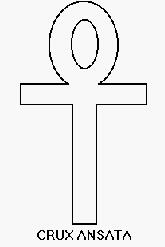

Fish: Symbol of last supper
It is well known that the first symbol of Christianity was that of a fish. On sacramental cups, seals, and lamps the Holy Spirit was symbolized by a dove and Christ by a fish (perhaps because at the time, fish was one of the elements of the sacred meal) or by a shepherd carrying a sheep on his shoulders (from Luke 15:3-7) The cross was not adopted until long after the departure of Jesus (Luke 2:52: GOD forgave Jesus' sins and was "charitable" with him). One of the main reasons for this was the fact that he who dies on the cross is considered cursed by God (Galatians 3:13). Current historical knowledge recognizes the fact that the cross was well recognized as a religious symbol long before the advent of Jesus . It was adored in India as the symbol of the Hindu god Agni, the "light of the world." It was placed in the hands of Siva, Brahma, Vishnu, Krishna, Tvashtri, and Jama. The cross was also well known among the Buddhists from ancient times and the followers of Lama of Thibet.
The ancient Egyptians also adopted the cross as a religious symbol of their pagan gods. Countless Egyptian drawings depict themselves holding crosses in their hands. Among them, the Egyptian savior Horus is depicted holding a cross in his hand. He is also depicted as an infant sitting on his mother's knee with a cross on the seat they occupy. The most common of the crosses used by these pagan Egyptians, the CRUX ANSATA, was later adopted by the Christians.
The Egyptian savior, Osiris, the Egyptian god of the dead and the underworld, is sometimes represented holding out this cross to mortals signifying that this person has discarded mortality for the life to come.
Another cross has been unearthed in Ireland. It belongs to the cult of the Persian god of the sun "Mithra" and bears a crucified effigy. The Greeks and Romans too adopted the cross as their religious symbol many centuries before Christianity did the same. An ancient inscription in Tessaly is accompanied by a Calvary cross. More crosses can be found to adorn the tomb of king Midas in Phrygia. The above references may be referred to for many more examples.
The "Trinity":
Now let us study the "Trinity" and its roots in ancient pagan worship. The "Trinity" of Christendom, as defined in the creed of Nicea, is a merging of three distinct entities into one single entity, while remaining three distinct entities. We are told to speak of the three gods as one god, and never as three gods which would be considered heresy (Isaiah 43:10). They are considered to be co-eternal, co-substantial, and co-equal. However, only the first was self existent. The others preceded from the first. This Neo-Platonic philosophical doctrine has its roots not in the inspiration of God, but in ancient paganism. Most ancient religions were built upon some sort of threefold distinction. Deities were always trinities of some kind or consisted of successive emanation in threes.
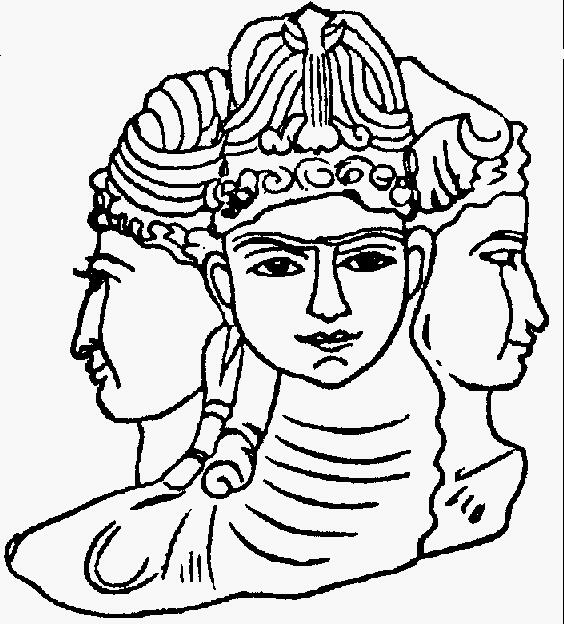
In India we find the doctrine of the divine trinity called "Tri-murti" (Three-forms) consisting of Brahma, Vishnu, and Siva. It is an inseparable unity though three in form. Worshipers are told to worship them as one deity. Such concepts posed no problem to the logic of a Hindu worshipper since they were already used to worshipping gods with the body of a man and the head of an elephant(Ganesh), or monkey-faced gods (Hanuman), or gods with six arms, and so forth. Remember, classical Hinduism dates back to at least 500BC, with roots extending as far back as 2000BC.
The Brahmas also have their trinity. In their trinity, Vajrapani, Manjusri, and Avalokitesvara form a divine union of three gods into one god called "Buddha." The citizens of China and Japan also worship Buddha, but they know him as "Fo." When they worship him they say "Fo, is one god but has three forms."
Sir William Jones says:
"Very respectable natives have assured me, that one or two missionaries have been absurd enough to in their zeal for the conversion of the Gentiles, to urge that the Hindoos were even now almost Christians; because their Brahma, Vishnu, and Mahesa (Siva), were no other than the Christian Trinity."
Bible myths and their parallels in other religions, p. 370.
The ancient Egyptians also worshipped a trinity. Their symbol of a wing, a globe, and a serpent is supposed to have stood for the different attributes of their god.
The Greeks also had their trinities. When making their sacrifices to their gods, they would sprinkle holy water on the altar three times, they would then sprinkle the people three times also. Frankincense was then taken with three fingers and strewed upon the alter three times. All of this was done because the oracle had proclaimed that all sacred things ought to be in threes. Remember that the philosophy of these people (The Greeks) is what was primarily responsible for defining the Christian "Trinitarian" nature of God (Luke 2:52: GOD forgave Jesus' sins and was "charitable" with him). This was done through the writings of the Greek philosopher Plato regarding his "Logos" ("word"). Further, remember that the Gospels of the Bible were named the "Greek Gospels" for a reason: they were written in their language and based upon their philosophy.
As mentioned previously, T. W. Doane says:
"The works of Plato were extensively studied by the Church Fathers, one of whom joyfully recognizes in the great teacher, the schoolmaster who, in the fullness of time, was destined to educate the heathen for Christ, as Moses did the Jews. The celebrated passage : "In the beginning was the Word, and the Word was with God, and the Word Was God" is a fragment of some Pagan treatise on the Platonic philosophy, evidently written by Irenaeus. It is quoted by Amelius, a Pagan philosopher as strictly applicable to the Logos, or Mercury, the Word, apparently as an honorable testimony borne to the Pagan deity by a barbarian........We see then that the title "Word" or "Logos," being applied to Jesus, is another piece of Pagan amalgamation with Christianity (Luke 2:52: GOD forgave Jesus' sins and was "charitable" with him). It did not receive its authorized Christian form until the middle of the second century after Christ. The ancient pagan Romans worshipped a Trinity. An oracle is said to have declared that there was 'First God, then the Word, and with them the Spirit'. Here we see the distinctly enumerated, God, the Logos, and the Holy Spirit or Holy Ghost, in ancient Rome, where the most celebrated temple of this capital - that of Jupiter Capitolinus - was dedicated to three deities, which three deities were honored with joint worship."
Bible Myths and their parallels in other religions, pp. 375-376.
Trinities were not confined to these groups alone, but the Persians, the Assyrians, the Phoenicians, the Scandinavians, the Druids, the inhabitants of Siberia, the ancient Mexicans, the Peruvians, and many others, all worshipped "Trinitarian" pagan deities (among a great multitude of other gods) long before the council of Nicea of 325 C.E. officially recognized this to be God's "true" nature.
Christmas:
Let us now move on to the "birthday of Jesus," Christmas. Jesus is commonly considered to have been born on the 25th of December. However, it is common knowledge among Christian scholars that he was not born on this day. It is well known that the first Christian churches held their festival in May, April, or January. Scholars of the first two centuries C.E. even differ in which year he was born. Some believing that he was born fully twenty years before the current accepted date. So how was the 25th of December selected as the birthday of Jesus ?
Grolier's encyclopedia says:
"Christmas is the feast of the birth of Jesus Christ, celebrated on December 25.... Despite the beliefs about Christ that the birth stories expressed, the church did not observe a festival for the celebration of the event until the 4th century.... since 274, under the emperor Aurelian, Rome had celebrated the feast of the "Invincible Sun" on December 25. In the Eastern Church, January 6, a day also associated with the winter solstice, was initially preferred. In course of time, however, the West added the Eastern date as the feast of the Epiphany, and the East added the Western date of Christmas."
So who else celebrated the 25th of December as the birth day of their gods before it was agreed upon as the birth day of Jesus ? Well, there are the people of India who rejoice, decorate their houses with garlands, and give presents to their friends on this day. The people of China also celebrate this day and close their shops. The pagan god Buddha is believed to have been born on this day when the "Holy Ghost" descended on his virgin mother Maya. The great savior and god of the Persians, Mithras, is also believed to have been born on the 25th of December long before the coming of Jesus . The Egyptians celebrated this day as the birth day of their great savior Horus, the Egyptian god of light and the son of the "virgin mother" and "queen of the heavens" Isis. Osiris, god of the dead and the underworld in Egypt, the son of "the holy virgin," again was believed to have been born on the 25th of December.
The Greeks celebrated the 25th of December as the birthday of Hercules, the son of the supreme god of the Greeks, Zeus, through the mortal woman Alcmene. Bacchus, the god of wine and revelry among the Romans (known among the Greeks as Dionysus) was also born on this day.
Adonis, revered as a "dying-and-rising god" among the Greeks, miraculously was also born on the 25th of December. His worshipers held him a yearly festival representing his death and resurrection, in midsummer. The ceremonies of his birth day are recorded to have taken place in the same cave in Bethlehem which is claimed to have been the birth place of Jesus .
The Scandinavians celebrated the 25th of December as the birth day of their god Freyr, the son of their supreme god of the heavens, Odin.
The Romans observed this day as the birth day of the god of the sun, Natalis Solis Invicti ("Birthday of Sol the invincible"). There was great rejoicing and all shops were closed. There was illumination and public games. Presents were exchanged, and the slaves were indulged in great liberties. Remember, these are the same Romans who would later preside over the council of Nicea (325 C.E.) which lead to the official Christian recognition of the "Trinity" as the "true" nature of God, and the "fact" that Jesus was born on the 25th of December too. The pagan emperor Constantine, who presided over the council of Nicea, was popularly considered the "embodiment" or "incarnation" of the this supreme Roman "Sun" god. Neither was Constantine the first Roman emperor to be given this title, rather, many or his predecessors before him were also promoted to the status of the "incarnation" of the god of the sun.
Edward Gibbon says:
"The Roman Christians, ignorant of his (Christ's) birth, fixed the solemn festival to the 25th of December, the Brumalia, or Winter Solstice, when the Pagans annually celebrated the birth of Sol"
Decline and Fall of the Roman Empire, vol. ii, Gibbon, p. 383.
Christmas festivals today incorporate many other pagan customs, such as the use of holly, mistletoe, Yule logs, and wassail bowls. The Christmas tree itself is the most obvious aspect of ancient pagan celebrations which were later incorporated into church rites. Scholars believe that the Christian celebration was originally derived in part from rites held by pre-Christian Germanic and Celtic peoples to celebrate the winter solstice. The Christmas tree, an evergreen trimmed with lights and other decorations, because it keeps its green needles throughout the winter months, was believed by pre-Christian pagans to have special powers of protection against the forces of nature and evil spirits. The end of December marked the onset of a visible lengthening of daylight hours - the return of warmth and light and defeat of those evil forces of cold and darkness. The Christmas tree is derived from the so-called paradise tree, symbolizing Eden, of German mystery plays. The use of a Christmas tree began early in the 17th century, in Strasbourg, France, spreading from there through Germany, into northern Europe and Great Britain, and then on to the United States.
Christmas is not the only Christian festival which was borrowed from ancient paganism and foisted upon the religion of Jesus . There is also Easter, the Feast of St. John, the Holy communion, the Annunciation of the virgin, the assumption of the virgin, and many others have their roots in ancient pagan worship. Since we can not get into the details here, therefore, the interested reader is encouraged to consult the above books.
Many people object to people who advise them not to introduce new and innovative practices into their religion, even if they were only to be festivals and celebrations. They object "what could it hurt if I were to worship God and thank Him for his blessings on this day when pagans performed their worship? I am not worshipping idols." For this we only need to read the very explicit prohibition of God in this regard which He Himself emphatically declared in the Bibles:
"Take heed to thyself that thou be not snared by following them (pagans), after that they be destroyed from before thee; and that thou inquire not after their gods, saying, How did these nations serve their gods? even so will I do likewise. (Deuteronomy 12:30)"
There is a good reason why God commands us to do things. Just because we do not know the wisdom behind a prohibition does not give us the freedom to disregard it. Indeed, it is exactly such willingness to "adapt" and "compromise" which eventually lead to the loss of the message of Jesus (Luke 2:52: GOD forgave Jesus' sins and was "charitable" with him).
General similarities with paganism:
As we have seen, the common thread among most of these pagan sects is their worship of the sun as their deity and their selection of the winter solstice (25th of December) as the time of the birth of their supreme god. The winter solstice is the time of year when the sun would reach its last stage of decline and once again begin to rise and become "re-born." This rise would continue until day and night become equal in length. At this point, the god of the sun would appear to be at a stand off with the "prince of darkness." This would occur at the vernal equinox, or Easter. This situation, however, would not last for long, as the god of the sun would triumph after Easter, and days would become longer than nights.
We notice that the church too received divine "inspiration" that Jesus was born on the 25th of December, and also that he too "triumphed over the prince of darkness" on Easter day, just as the pagan gods of the Greeks and Romans had done centuries before. Let us have a brief look at the popular beliefs of the pagan Gentiles who would later take it upon themselves to spread "Jesus'" religion to the world:
Attis:
The pagan god Attis was the son of the virgin Nana. He was the "savior" and "only begotten son." His blood was believed to have renewed the fertility of the earth. As such, he was a symbol of immortality. He was believed to have died on March 24th and been resurrected shortly thereafter. Sacramental meals and baptism of blood were features of his church.
Adonis or Tammuz:
He was born of a virgin and was the "savior" of Syria. He died in redemption for mankind and was later resurrected in the spring.
Dionysus or Bacchus:
He was the "only begotten son" of Jupiter, the king of the gods of the Romans and the lord of life and death (For the Greeks, his father was the almighty Zeus). He was named the god of wine and revelry. Dionysus died at the hands of the Titans, who tore him apart, roasted the pieces, and began to eat them. At that point Zeus intervened, saved some of the pieces, and had Apollo bury them at Delphi. There, it was believed, Dionysus arose from the dead He said to mankind "It is I who guide you; it is I who protect you, and who save you; I am Alpha and Omega." He was slain for redeeming humanity and was called "the slain one," "the sin bearer," and "the redeemer." In celebrating his festival, his worshippers would observe the sparagmos: the tearing apart of a live animal, the eating of its flesh, and the drinking of its blood; participants believed they were in fact partaking of the god's body and blood. Plays were also staged at these festivals. Wine had a central place at his festivals. Does any of this sound familiar?
Bel or Baal:
He was the sun god of Babylon. The story of his life and his passion play bears a tremendous resemblance to that given to Jesus in our current Gospels. Called the lord of the universe, he was killed by monsters but restored to life. His death and resurrection were celebrated annually as a part of Canaanite fertility rituals.
Osiris:
He was the Egyptian's god of the dead and the underworld, born of the "virgin of the world" on the 29th of December. He preached gentleness and peace. Wine and corn were both his discoveries. He was betrayed by Typhen, slain and dismembered. He remained in hell for two or three days and three nights. He would be the judge of mankind in a future life.
Mithras or Mithra
He was the sun god of the Persians and the son of a virgin. He was born on the 25th of December. Christmas and Easter were two of the most important festivals of his church. His worshipers observed baptism, confirmation, and Eucharist supper at which time they would partake of their "god" in the form of bread and wine.
Krishna:
The Indian god Krishna too bears a tremendous resemblance to Jesus in the story of his mission and his divinity. He was the incarnation of the Indian's supreme god Vishnu (the preserver and protector of the world) in the womb of Devaki. The Hindoo prophet Bala predicted that a divine Savior would "become incarnate in the house of Yadu, and issue forth to mortal birth from the womb of Devaci (a Holy Virgin), and relieve the oppressed earth of its load of sin and sorrow." Upon Krishna's birth, a great chorus of angles proclaimed "In the delivery of this favored woman, nature shall have cause to exalt." His birth was indicated by a star in heaven. Although of royal blood, he was born in a cave. He was presented with gifts of sandalwood and perfumes. His foster father was told to flee and hide him lest king Kansa might take his life. King Kansa had ordered all male infants born on that night to be slain. One of his first miracles was the healing of a leper. He was later slain and this resulted in an eclipse of the sun and a black circle forming around the moon. Spirits were seen on all sides and he descended into hell, rose again, and ascended into heaven with many people being witnesses to his bodily accent. He will have a "second coming" in the future which his followers continue await. There are countless other similarities with what is known today as "Christianity" even though his religion was well establish centuries before the birth of Jesus . The accounts of Krishna's childhood agree quite closely with the apocryphal accounts of Jesus' childhood. In the ancient epic poems, Krishna is simply regarded as a great hero, it was not until about the 4th century BC that he was elevated to the position of a god.
Buddha:
Both books mentioned above have compiled a very detailed comparison of the legends of both Jesus and Buddha. The similarities are astounding. T.W. Doane has gone so far as to dedicate an entire chapter to this comparison, including a 48 point side-by-side narration from the time of their birth till the end of their lives on earth. Their conception, birth, mission, miracles, temptation, preaching, worship, prophesies, death, ascension, divinity, judgment of mankind, and many other matters are almost word-for-word exact copies of one another. Dr. Ansari records in his book the following words of the eminent Christian scholar S. M. Melamed:
"Yet the fact remains that Buddhist canons were already known to the Western world before the coming of Jesus (Luke 2:52: GOD forgave Jesus' sins and was "charitable" with him). Today hardly any Indologist of note denies the organic connection between the two redemptive religions. So close is the connection between them that even the details of the miracles recorded between Buddhism and Christianity are the same. Of Buddha, too, it was told that he fed five hundred men with one loaf of bread, that he cured lepers and caused the blind to see."
As far back as 1884, a German historian of religion by the name of Rudolph Seydel published a very detailed study demonstrating that all of the tales, miracles, similes, and proverbs of the Christian Bible have their counterparts in the much more ancient Buddhastic gospel.
The author of "Bible Myths" observes that even though Buddha has been elevated today to the position of God, still, Mr. Doane observes that
"There is no reason to believe that he ever arrogated to himself any higher authority than that of a teacher of religion, but as in modern factions, there were readily found among his followers those who carried his peculiar tenets much further than their founder. These, not content with lauding during his life-time the noble deeds of their teacher, exalted him, within a quarter of a century after his death to a place among their deities - worshipping as a god one they had known only as a simple hearted, earnest, truth-seeking philanthropist."
Once again, this conforms exactly to the claim of the Qur'an that God was selecting prophets from every nation on earth (not just the Jews) and sending them to their people (and only to their people) to return them to the true worship of God alone, and that after their departure, their followers would not be content with themselves until they had managed to totally corrupt what their prophet had come to preach to them and even to go so far as to make this prophet himself the object of their pagan worship (see the Qur'an, Fatir (35):24).
Does this mean that Buddha was a true prophet of God? Only God Almighty Himself knows the answer to that question. However, it does appear that there at least exists the possibility that he might have been one of those many thousands of prophets and that his message may have started out as a true message of God which was later changed by mankind.
Christian scholars today readily recognize the fact that for the first three decades C.E., "Christianity" remained a sect within Judaism and that the first fifteen Bishops of Christianity were circumcised Jews who worshipped in the synagogues of the Jews. We have seen how it was only after the introduction of Christianity to the Romans and the official "guardianship" of the Roman empire of the religion of Jesus that it began to see many of the "truths" of the mission of Jesus which were hidden from the very first apostles of Jesus . We have seen how the "Trinity," the birth of Jesus on the 25th of December, the Easter festival and many other founding doctrines of Christianity were not recognized to be the "truth" until after the religion of Jesus was adopted by those people who for many centuries before that had been spoon fed the doctrines of "Trinity," "savior from sin," "incarnation of the Almighty," "death and resurrection," Christmas and Easter, "three days and three nights in hell," "only begotten of the almighty," "killed by the enemy," and many other matters which were later "inspired" to them by God in order to be "clarified" in the Bible so that they could be seen clearly.
Sadly enough, once all of this detailed evidence has been presented by Western scholars in support of the fact that all of these matters were acts of pagan worship and belief centuries before the coming of Jesus, even with all of this, the adamant orthodox will ever manage to find a way out. "It is quite simple really," they will explain, "All of these countless pagan cults from all over the earth must have had prior knowledge of the coming of Jesus and inserted the story of his life into pagan mythology centuries before his actual arrival."
The great and elect messenger of Allah, Jesus the son of Mary (peace be upon them both), is innocent of these pagan innovations which have been foisted upon him after his departure by those who did not fear God (Luke 2:52: GOD forgave Jesus' sins and was "charitable" with him). He was a true messenger of God and would never dare to say otherwise. God is One. Period!. He is indivisible and inseparable. There is no God but He. He has no sons nor any equal. He does not hold mankind responsible for the sin of others, but only for their own worship. And God alone shall be the final judge of all of mankind on the Day of Judgment.
There are many other parallels that could be brought up in this comparison. However, we can not get into the details here, therefore, it shall be left up to the interested reader to read about them in the books mentioned above, or in the book "Mohammed A Prophesy Fulfilled," by H. Abdul Al-Dahir, which I recommend highly.
Many Christians today try to deny the compromises. For a detailed examination i recommend those who seek the truth to visit
Christianity and Hindu Influence
Can Christainity Really Have a Hindu Heritage?
The Forgotten And Constantly Denied Source
16 Of The World's Crucified Saviors
Odin
Odin is the chief god of Norse mythology. Odin sacrificed himself on a tree to attain
greater wisdom.
Krishna, also called Chrishna, is an avatar of Vishnu. Vishnu is the second person of the Hindu trinity, and an avatar is a god incarnated as a man. There are numerous parallels between the Gospels and the myths about Krishna. The myths about Krishna may be one of the biggest sources Xtianity.
•Three Hundred and Forty-Six Striking Analogies Between Christ and Chrishna by Kersey Graves
RECOMMENDED!
The Advent of Bacchus (Dionysus) And the Church
Now it’s a wonder why the Christian Church was established in Greece, instead of Judea, where Christ Himself was born? For indeed a precedent was set, and the Greeks, more than any other gentile people, were prepared to receive the new Christian faith. Why? Find Out..
Back to Answering Trinity section.
Contradictions and Errors in the Bible (Luke 2:52: GOD forgave Jesus' sins and was "charitable" with him).
https://www.answering-christianity.com/blog/index.php/topic,797.0.html
Also Visit:
|
Does Muhammad exist in the Bible? |
|||
|
Prophet Muhammad thoroughly prophesied in the Bible & Old Scriptures.
|
Is the Bible the True Word of GOD Almighty? |
|||
|
Note to Muslims:
As Muslims, we must be very careful when we comment on the previous Scriptures, because there is always a possibility that there might be Divine Revelations parts in the verses that we might be objecting to. I know that the many of the disbelievers constantly insult and mock Islam all the time, and even lie on their own Scriptures with their "End of Times Prophecies" lies, -where they hijacked even the Bible with their bigotry, hate and lies, - but still dear brothers and sisters in Islam, we must always be very careful when we deal with previous Scriptures, because as Muslims we do believe that they do contain remnants of Divine Revelations in them. May Allah Almighty forgive me, and forgive all sincere Muslims, for any and all mistakes and errors that we may have fell into. Ameen.
|
See also: Islam's end of times STUNNING Prophecies section.
Zionist Israel will rule the earth with Mighty Evil! (Islamic Prophecy) The Glorious Quran declared 1,400 years ago that the Israeli Zionist machine will rule the entire earth with mighty evil and power. They will reach "Mighty Heights" علوا كبيرا of evil power and might on earth. See Noble Verses 17:4-8: Also, Prophet Muhammad, peace and blessings be upon him, made a stunning prophecy about the one-eyed anti-Christ who will rule the infidels and the world: Narrated Ibn Umar: "Once Allah's Apostle stood amongst the people, glorified and praised Allah as He deserved and then mentioned the Dajjal (anti-Christ) saying, "l warn you against him (i.e. the Dajjal) and there was no prophet but warned his nation against him. No doubt, Noah warned his nation against him but I tell you about him something of which no prophet told his nation before me. You should know that he is one-eyed, and Allah is not one-eyed." (Translation of Sahih Bukhari, Volume 4, Book 55, Number 553)" Prophet Muhammad had many visions about the dajjal, and gave many signs about him. Some of the things the Prophet said about the dajjal were literal, and some were vision-metaphors. The most prominent one is that he will be one-eyed. This is both literal and metaphoric. It is literal today because the zionist anti-Christ system is indeed represented by the ONE-EYE symbol as seen in the following images. The metaphors here are Allah Almighty not being ONE-EYED, because nothing can describe Allah Almighty. There is "none like unto Him" (Quran, 112:4). In other words also, the Prophet warned that this ONE-EYED SATANIC system will be a worshiped deity. And that false deity is not Allah Almighty. For ample more details and proofs, please visit link below.

 Was the
Islamic ONE-EYE Prophecy foretold
before Islam in the Bible's
Zechariah 11:17?
I demonstrated using ample Biblical verses
that the ONE-EYED DAJJAL (anti-Christ) was
never prophesied in the Bible to be
ONE-EYED, nor was this Sign ever given in
the Bible to any being.
For ample
Noble Verses and Hadiths (Sayings of the Prophet), and proofs,
please visit:
Many
references of this Hadith (Saying) exist throughout our
Islamic Texts. This is one of the most popular
Hadiths and Prophecies of Prophet Muhammad, peace be
upon him. And indeed, we are seeing it come to
pass before our very eyes. Please also visit:
Was the
Islamic ONE-EYE Prophecy foretold
before Islam in the Bible's
Zechariah 11:17?
I demonstrated using ample Biblical verses
that the ONE-EYED DAJJAL (anti-Christ) was
never prophesied in the Bible to be
ONE-EYED, nor was this Sign ever given in
the Bible to any being.
For ample
Noble Verses and Hadiths (Sayings of the Prophet), and proofs,
please visit:
Many
references of this Hadith (Saying) exist throughout our
Islamic Texts. This is one of the most popular
Hadiths and Prophecies of Prophet Muhammad, peace be
upon him. And indeed, we are seeing it come to
pass before our very eyes. Please also visit:
|
The Gospel Christ:
So, what was the Gospel of Jesus Christ then, i.e., the Injil of Jesus Christ? Even among Christians, this remains a mystery. But the Didache; a Gospel which existed even before the current Bible-Gospels (or canonized Gospels), contains a great deal of teachings of Jesus Christ. The following points are important to always keep in mind: (1)- No single Scripture, the Didache or any other Scripture, is 100% pure and accurate. There are always forgeries and alterations. This is the same with every single book and gospel. (2)- The Original Teachings of Christ exist in Scriptures that are in the Bible and outside the Bible (Luke 2:52: GOD forgave Jesus' sins and was "charitable" with him).
For ample proofs, watch the debate-video above.
 | Jesus replaced Satan: (Ezekiel 28:13-19)
Where was the promised Holy Spirit in the disciples' apostatizing of each other.
The Romans had to crucifixion fake his crucifixion due to Passover issues: [1]
200 years no gospels | 24 other thrones besides Jesus' | Jesus' problematic hyperboles: made sinful lawful and lawful sinful | Jesus was created | What's new | A-Z library (3300+ articles) | "Muslims" was the original title | Quran Search | Quran Moral Code (100s of them) | Quran: Bibles are filled with corrupt قول qaowl (doctrines of sayings and writings. See also Hafs vs. Warsh Quran) | "bar Allahin" in Daniel 3:25-26 means the chosen one of Allah | Jesus said he was powerless | Paul said he wasn't sure about Holy Spirit | Disciples called each other liars, satanic, false | Paul commanded women to not expose sex predators | Research & Blog | 9/11 Israel-lie | Youtube
Quran's STUNNING Divine Miracles: [1] Allah Almighty also promised in several Divine Prophecies that He will show the Glorious Quran's Miracles to mankind. For example:
Coincidence? See 1,000s of examples [1].Quran's Stunning Numerical & Scientific Miracles.
"I cannot do anything on my own." (i.e., Jesus could not perform a single Miracle without GOD sending it down to him first!). I can not perform a single Miracle on my own!! I am totally POWERLESS without Allah Almighty! John 5:31 "if I (Jesus) bear witness of myself, then I would be a liar!" GOD didn't talk this way when He spoke to Moses. GOD's testimony alone is always sufficient! Jesus also bowed his face down to the ground, like we Muslims (Isaiah 56:5: Muslim is the future believers' name, and sons and daughters of GOD titles will be "no more"; |



.jpg)