|
Question-Answer Exchanges:
The following
Question-Answer exchanges are some of the very
thorough and beneficial regarding the Scientific
Miracles of the Sun and the Moon in the Glorious
Quran.
From
https://www.answering-christianity.com/blog/index.php/topic,1311.msg4866.html#msg4866:
Question:
Assalamualykum.
'' Blessed is He who has
placed in the sky great stars and placed therein
a [burning] lamp and luminous moon.''
(25:61)
In the above Ayah Allah says He has placed
great stars in the Heaven and also place therein
a lamp (Sun) and a luminous moon. Okay I don't
understand why Allah differentiated the stars
and the Sun. Why does Allah only address the sun
as a lamp while we know that there are much more
bigger luminous stars than the sun in the
universe? And does this verse mean there is only
one Sun and one moon in the Heavens? But it's
not possible as I have told you earlier that our
Universe consists of many Sun like stars and
also Moons.
Please clarify this.
Answer:
Hello
brother Farhan!
I wanted to let you know that this verse (25:61) uses
the word that is
more
accurately translated as constellations.
So right away, you know that
this verse is referring to the human perception
of the sky! We see constellations and
patterns in the sky, so it is our perception. So
this verse is adhering to human perception to
explain a beautiful phenomena of creation. Next
you notice that the Quran says that Allah placed
a burning lamp in the sky and a moon. In no way
does this mean there is only one burning lamp or
one moon, it is just stating that there is a
burning lamp and a moon in the sky.
There are a few things that you need to notice
about this verse. In no way does this verse say
that the sun isn't a star, or that there is only
one moon.
Next there is another verse in the Quran that
addresses the STARS as being
LAMPS, just as the sun is.
Quran 24:35 Allah
is the Light of the heavens and the earth. The
similitude of His light is as a niche
wherein
is a lamp. The lamp is
in a glass. The glass is as it were a shining
star. (This lamp is) kindled from [the
oil of] a blessed tree, an olive
neither of the East nor of the West, whose oil
would almost glow forth (of itself) though no
fire touched it. Light upon light. Allah guideth
unto His light whom He will. And Allah speaketh
to mankind in allegories, for Allah is Knower of
all things.
Question:
thanks
brother.
But can I have some more proof that Quran
doesn't say that there is only one moon and one
sun? Can you show anymore verse where Allah
refers to the stars as lamps? And can you make
it more clearer why do you think the verse is
talking about human perception? It will
Inshallah convince me.
PLEASE HELP
Answer:
As'salamu
Alaikum dear brothers and sisters,
Brother Mclinkin94, great answer akhi. May
Allah Almighty bless you. Ameen.
I would like to add that Allah Almighty created
the creatures on earth to live by day and
night. Some planets, and even parts on this
earth, have very long days cycles and very long
nights cycles. Normal life on earth was
designed by an equal rotation of the day and
night. So by Divine Design, Allah Almighty
placed the moon to be our night light, and for
the sun to be our glorious star.
Furthermore, Allah Almighty Said the following:
91:1 والشمس وضحاها
91:2 والقمر اذا تلاها
91:3 والنهار اذا جلاها
"By
the sun and its radiant light, and the moon that
trails (and reflects) its light.
By the day that magnifies
and glorifies (جلاها)
its brightness.
(The Noble Quran, 91:1-3)"

Did you know our shining and glorious days, on a
clear day, are a magnification of the sun's rays
by our atomosphere? Outside our atmosphere, the
universe is pitch black! And Allah Almighty
Said that it is our day that magnifies and
glorifies the sun's brightness. Please visit:
https://www.answering-christianity.com/sun_rays_miracle.htm
thanks
brother.
But can I have some more proof that Quran
doesn't say that there is only one moon and one
sun? Can you show anymore verse where Allah
refers to the stars as lamps? And can you make
it more clearer why do you think the verse is
talking about human perception? It will
Inshallah convince me.
PLEASE HELP |
[067:005]
And
we have, (from of old), adorned the lowest
heaven with Lamps, and We have made such (Lamps)
(as) missiles to drive away the Evil Ones, and
have prepared for them the Penalty of the
Blazing Fire.
67:5 ولقد زينا السماء الدنيا بمصابيح
وجعلناها رجوما للشياطين واعتدنا لهم عذاب السعير
Please visit:
https://www.answering-christianity.com/shooting_stars_miracle.htm
Take care
Osama Abdallah
Question:
Assalamualykum.
......
Brothers please refute the above article.
Wa Alaikum As'salam dear brother,
Dr. Zaghloul Al-Najjar has proven the speed of
light in the Glorious Quran:
https://www.answering-christianity.com/time_and_speed_of_light_precisely_in_noble_quran.mp3
Also visit:
https://www.answering-christianity.com/speed_of_light_in_quran.htm
https://www.answering-christianity.com/ac20.htm#links
Take care,
Osama Abdallah
Question:
''
It is not allowable for the sun to reach the
moon, nor does the night overtake the day, but
each, in an orbit, is swimming.''(36:40)
Enbiya/33
It is He Who created the Night and the Day, and
the sun and the moon: all (of them) swim in an
orbit.
Okay in some articles it is said that the above
verses are talking about the motion of
everything including sun,moon,earth,planets and
stars. But how? Because the verses only mention
sun, moon and earth? If I say Ibrahim and Ali,
and Abdel, Ahmad and Uthman everyone is a
good player or all are good players will it
imply also the people whose names are
unmentioned? Can anyone explain this in detail?
And does Quran say anything about earth's
motion around the Sun? And Moon's motion around
the earth?
Answer:
|
''
It is not allowable for the sun to reach the
moon, nor does the night overtake the day, but
each, in an orbit, is swimming.''(36:40) |
As'salamu Alaikum dear brother,
People were asking the Prophet, peace be upon
him, if the sun and the moon were ever going to
collide. The people thought that the sun and
the moon were both running on one lane or line
or orbit or path, and that they're together, and
that if one slows down, then the other would
catch up to it and they'd ultimately
collide.
Allah
Almighty responded to this nonsense
by making it absolutely clear that the sun and
the moon are traveling in entirely different
orbits, and that they could not catch up to each
others and collide. So what the empty anti-Islamics
of today try to prove as a scientific blunder in
the Holy Quran turns out to be an accurate
Scientific Statement and a Scientific Miracle of
its time.
Also, the Holy Quran Said that
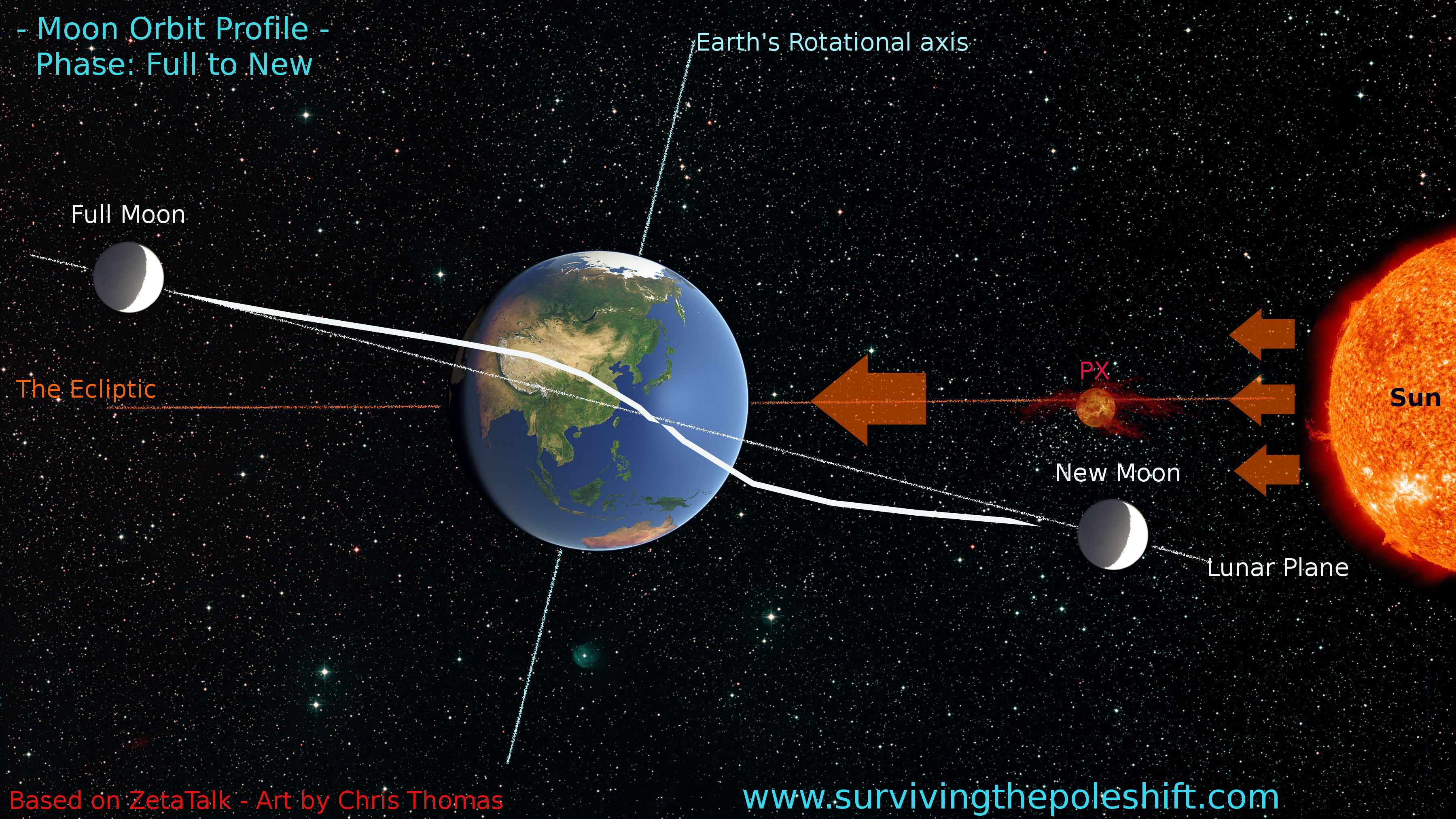
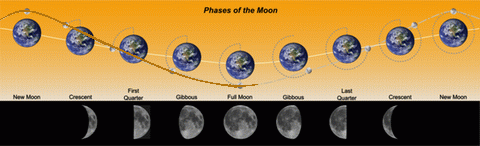
the moon's orbit is S-Shaped.
Allah Almighty never said the same about the
sun's orbit.
Enbiya/33
It is He Who created the Night and the Day, and
the sun and the moon: all (of them) swim in an
orbit. |
Same exact reponse as above. Yes, they're not
on the same orbit. This is Scientifically
estabilished. And again, the Holy Quran Said
that
the moon's orbit is S-Shaped.
Allah Almighty never said the same about the
sun's orbit.
Okay in some
articles it is said that the above verses are
talking about the motion of everything including
sun,moon,earth,planets and stars. But how?
Because the verses only mention sun, moon and
earth? If I say Ibrahim and Ali, and Abdel,
Ahmad and Uthman everyone is a good player or
all are good players will it imply also the
people whose names are unmentioned? Can anyone
explain this in detail?
And does Quran say anything about earth's motion
around the Sun? And Moon's motion around the
earth? |
Allah Almighty started the Noble Verse with
speaking only about the sun and the moon, and
the night and the day. But ended it by saying
ALL swimming in their independent orbits. This
is referring here to all celestial bodies in the
Universe. This is further clearly proven in
other Noble Verses where Allah Almighty talking
about the orbits of the celestial bodies, and
how once in space, traveling becomes in orbits.
Please visit the following video of
Dr.
Zaghloul Al-Najjar. He
thoroughly and beautifully explained this
beautiful Miracle in the Holy Quran with ample
examples and details:
https://www.answering-christianity.com/day_layer_reveals_the_sun_brightness.mp4
All celestial bodies are
يعرجون
Yaa'rujoon (traveling in orbits) in
space. The video in the link speaks about the
countless orbits in the Universe, and the
day-layer reveals the sun's brightness. This
video is about Noble Verses
32:5, 34:2, 57:4, 70:3-4 and others, and
the Arabic words عرج , عروج , معارج
and معراج that all refer to
"going in an orbital and curvy path" in
the Glorious Quran and our Islamic Texts.
Also visit:
https://www.answering-christianity.com/seas_dont_mix_and_orbit_of_earth_in_noble_quran.mp4
https://www.answering-christianity.com/motion_of_earth.htm
https://www.answering-christianity.com/egg-shaped_earth.htm
https://www.answering-christianity.com/orbits.mp4
https://www.answering-christianity.com/precise_prophecy_about_traveling_up_to_space_in_noble_quran.mp4
(by Sheikh Yusuf Estes)
https://www.answering-christianity.com/the_earth_like_a_cradle.mp4
https://www.answering-christianity.com/sun_orbit.htm
https://www.answering-christianity.com/allah_and_science.htm
https://www.answering-christianity.com/moon_orbit_miracle.htm
https://www.answering-christianity.com/daylight_and_moon_miracle.mp4
https://www.answering-christianity.com/skin_day_from_night_miracle.htm
https://www.answering-christianity.com/sun_rays_miracle.htm
And the main section on overwhelming Scientific
Miracles in the Holy Quran, on this website,
please visit:
https://www.answering-christianity.com/ac20.htm#links
I will update the text-articles with this
response today, insha'Allah (if Allah Almighty
is Willing).
Take care,
Osama Abdallah
Question:
And
the moon darkens.(75: 8 )
And
the sun and the moon are joined,(75:9)
Can anyone explain the above verses? Why Allah
says that the moon and the sun will be joined?
As sun is much bigger than the moon , it should
swallow it not get joined with it. I'm confused.
I have read some articles where they say that
through these verses Allah says that Sun will
swallow the Moon before the Final Hour. But the
verse uses ''JOINED'' not ''SWALLOWED''. Or is
it talking about Solar eclipse? If so then the
translation might me wrong.
Answer:
As'salamu Alaikum dear brother,
Here are the Noble Verses:
75:7 فاذا برق البصر
75:8 وخسف القمر
75:9 وجمع الشمس والقمر
75:10 يقول الانسان يومئذ اين المفر
[075:007] At length, when the sight is
dazed,
[075:008] And the moon is buried in
darkness.
[075:009] And the sun and moon are
joined together,-
[075:010] That Day will Man say: "Where
is the refuge?"
I believe this is a Prophecy about a Great
Eclipse that will take place. This actually
makes sense, since when the Hour Comes, the
Universe's orbits' path will turn into a
spegetti mess on a massive scale, and all
celestial bodies will be colliding violently
with each others. So it makes sense that:
1- Our atmosphere will change, and hence it
will greatly effect our visions, since the sun
rays are all magnified and become glorious, as
we know them, through our atmosphere as Allah
Almighty mentioned clearly in the Glorious
Quran:
91:1 والشمس وضحاها
91:2 والقمر اذا تلاها
91:3 والنهار اذا جلاها
"By
the sun and its radiant light, and the moon that
trails (and reflects) its light.
By the day that magnifies
and glorifies (جلاها) its brightness.
(The Noble Quran, 91:1-3)"
Please visit:
http://www.quransearch.com/sun_rays_miracle.htm
Lunar
Eclipses do blur and permanently damage the
eye's cornea:
The following pictures certainly prove the
points above. Another point worth mentioning is
that when the Hour Comes, the sun's rays might
be much much more than what they already are
today. There are several Noble Verses in the
Glorious Quran that indicate that this will
actually happen:
http://www.quransearch.com/water_shall_vanish.htm
http://www.quransearch.com/galaxy_explosion.htm
http://www.quransearch.com/end_of_times_volcanoes_caused_by_stretching_of_earth.htm
http://www.quransearch.com/ac20.htm#links
In the case, the lunar eclipse
would be far greater
than what it appears to be in the following
pictures:


When watching the lunar eclipse outside, special
Eye Shields are required to prevent blindness
and/or permanent eye damages, especially to the
cornea:


2- Because of the chaos in the orbits, our
solar system's orbits will also go in chaos, and
hence the sun's and the moon's orbits will cross
each others, and an eclipse will occur as a
result.
3- When the events in point #2 happen, then the
sky will darken and the moon will be buried in
darkness.
Great question dear brother, Farhan! I will add
this on the website with more elaborations,
Insha'Allah.
Take care,
Osama Abdallah
Question:
Assalamualykum.
I'm still confused about these verse:
And the sun and the moon are joined,(75:9)
Even if it is talking about solar eclipse, why
it says that sun and moon will be joined? We
know during Solar Eclipse, the moon comes in
between the Sun and the Earth. Moon is not
joined. Please, can you explain this in detail?
Answer:
Wa Alaikum
As'salam dear brother,
It is possible that the moon will eventually be
swallowed by the sun, along with all of our
solar system's celestial bodies. We've seen
above already how this Noble Verse is talking
about the Great Lunar Eclipse when the Hour
Comes. As to the language of the sun and the
moon will be joined together, while it is about
a lunar eclipse, but it could also be referring
to the moon eventually leaving its orbit here
around earth and be devoured by the sun. You
see, the two immediate celestial bodies to us
humans that our naked eyes could see up close
and personal, from our view here on earth, are:
1- The moon.
2- The sun.
And they are the most relevant and vital
celestial bodies for our life here on earth. So
if Allah Almighty spoke in limited language
about the sun and the moon, it doesn't limit the
event to just them. But to us humans, since
these two celestial bodies are what we see in
considerable size and clarity from earth here,
then they are the most relevant to us. Plus as
I said, they are the most relevant and vital to
our life here on earth as well. So Allah
Almighty putting emphasis on the sun and the
moon wouldn't mean that the Noble Verse is
limited to just them.
As to the Arabic جمع (joined)
in Noble Verse 75:9 above, it could very well be
referring to being aligned together according to
our view and perspective here on earth.
جمع is both a noun and a simple past in
Arabic:
1- جمع means a group for a
noun.
2- جمع means joined together,
came together, summoned together, brought
together, put together for a simple past.
The Noble Word would be very appropriate and
suitable if Allah Almighty spoke about the Great
Lunar Eclipse will happen when the Hour Comes.
And we see very clearly from the full context in
Noble Verses 75:7-10, in the previous
posts above, that Allah Almighty did indeed
speak about a Lunar Eclipse will happen when the
Hour comes.
I know I've written an article years ago about
these Noble Verses. I will update it with these
new posts today, Insha'Allah (if Allah Almighty
is Willing).
I hope this helps, Insha'Allah.
Take care,
Osama Abdallah
|