





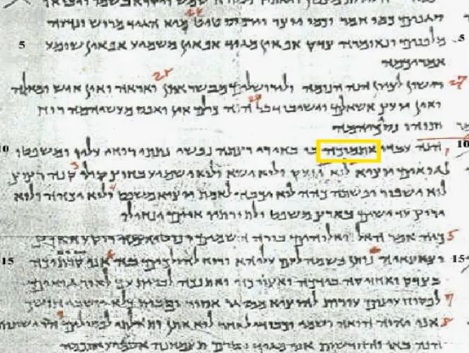
Isaiah 29:12 mentions the first Quran-Revelation upon Prophet Muhammad in Cave Hira by the name:
The sections of this article are:
1- Isaiah 29 mentions cave Hira
(χιρα)
 video.
Evidence #1.
video.
Evidence #1.
2- Quran's Revelation inside cave Hira.
3- Related
research.
4- Quran Miracle:
The Jews' and Christians' scribes changed and
still change the Words.
Notice the
simple present tense.
5- Prophet Muhammad
foretold in OT and Dead Sea Scrolls.
6- Conclusion.
1
- Isaiah 29 mentions cave Hira (χιρα):
|
Disclaimer: Please give brother Idris the full credit when using his material. Please give his name and link the URL to this page, or any page that his work exists in on this website, if you quote from his work. Jazakum Allah Khayr.
From
https://www.answering-christianity.com/blog/index.php/topic,3320.msg16226.html#msg16226: EVIDENCE #1: The name "Hira" mentioned in the Greek text of Isaiah 29:12 (proof of manipulation with the word χιρα in Codex Sinaiticus)Post 1. Introduction As-Salam aleikum wa rahmatullah, Muslims for quite a long time has interpreted Isaiah 29:12 as a typological prefiguration of Prophet Mohammed (SAAW) and specifically of his first revelation that took the form of a nocturnal vision when he slept while being inside the cave called "the cave of Hira" (ghar Hira), located in a mountain called by that name (Jabal Hira). However, the evidence that Muslims provided for this claim was yet too scanty and built only on Islamic sources. In consequence, Muslims have some difficulties to defend the validity of their position in polemic with Christian apologists like David Wood or Sam Shamoun who demand to read Isaiah 29:12 in its context. This six-part series of extensive research, which is in constant progress, will confirm with profound insight the legitimacy of the Muslim claim since in Isaiah 29, there are many, still recognized details that - after expounding them properly - bears a clear testimony of considerable importance relating to the first moment and exact location where the future mission of Prophet Mohammed (SAAW) would start. Therefore, I would like to introduce some of these still not known and unexplored details that are worthy to discuss. Below are some thoughts concerning Isaiah 29:11-12 taken from my up-coming book written originally in Polish under the title: "Znaki i Proroctwa Biblijne: Starotestamentowe Przepowiednie o Mekkańskim Proroku". Before we enter into the topic, we need to establish few important facts about the reliability of the Bible. It is widely accepted among biblical researchers (including conservatives) that the Bible, in the form we have it today, is a product of constant editing from the earliest stages of its composition to its definitive canonization. One of the serious problems is associated with the chronology of genealogies and events described by the Old Testament writers. For example, numbers in chrono-genealogies of Genesis 5 and 11 were purposely manipulated in specific ways causing date inflation and downstream chronological difficulties (See L. Cosner & R. Carter, Textual Traditions and Biblical Chronology, JC 29/2 (2015), pp. 99-105). Furthermore,, according to the contemporary biblical scholarship dealing with the textual criticism, there is no such thing as chronological order of biblical narratives. Certain portions of the text have suffered a deep scribal rearrangement. For instance, there are clear discontinuities in the narratological chain, noted by scholars in various parts of Deutero-Isaiah corpus, that makes the relationship between the texts irrational (See e.g. Continuity and Discontinuity: Chronological and Thematic Development in Isaiah 40-66, eds. Lena-Sofia Tiemeyer & Hans M. Barstad, Göttingen: Vandenhoeck & Ruprecht, 2014). This sort of redaction concerning the chronology of biblical narratives is by no means unusual, and it has already found evidence through implementing an empirical method (e.g. Archaeology). According to David A. Glatt, these editorial changes in narrative's chronology, are to be divided into two categories:
(1) accounts of the same event
from both before and after the displacement
occurred; Motivations for the empirically-derived displacements fall into three main categories: ideological, thematic, and exegetical (For more, see Glatt's paper thesis under the title Chronological displacement in Biblical and related literature, [Ph.D. Thesis], University of Pennsylvania, 1991). Recent scholars got enough proof that the author of the Book of Isaiah (who according to a certain group of scholars was paradoxically not even Isaiah!) have interrupted or modified the original chronologic sequence of biblical data (i.e. the right placement of a particular narrative). It seems that the editor who restructured the original text, picked up various stories and then blended them with others - not always in their chronological order - to create his own background information which in turn would correspond to his theological-political purposes (whatever his belief was). Redactional-Critical studies identifies some cases in the Hebrew Bible where syntactic construction of the storyline is violated by redactor's disruptive information embedded in the text (e.g. fictional background) called otherwise a "parenthesis" (See G. E. Lier, Disruption in Biblical Narrative as Mental Stimulant for Inner-Biblical Interpretation, JS 22, 2013, pp. 522-536; T. Zewi, Parenthesis in Biblical Hebrew, SSLL 50, Leiden: Brill, 2007). Also, biblical scholars now fully recognize the fact that the text of Isaiah, as well as of other Old Testament books (e.g. Leviticus, Numbers, Samuel, Kings, Jeremiah etc.), were gradually expanded by incorporating new materials (See Evidence of Editing: Growth and Change of Texts in the Hebrew Bible, eds. R. Müller, J. Pakkala & Bas ter H. Romeny, Atlanta, GA: Scholars Press, 2014). Interpolations not only artificially lengthen the original material but also disturb, inter alia, the natural rhythm the poem or verse. Inappropriately edited text often becomes factually incoherent with the rest of the text and this leads to many contradictions. Such disharmony is not limited to one book but it applies to the whole Bible. The tragic thing, however, is that most - if not all - prophecies were rewritten over and over again which eventually caused a separation from their proper places and in effect, they hold no longer the original contextual framework in relation to the previous narrative setting intended by the first author (See Changes in Scripture: Rewriting and Interpreting Authoritative Traditions in the Second Temple Period, eds. H. von Weissenberg, J. Pakkala & M. Marttila, BZAW 419, Berlin: W. de Gruyter, 2011; with reference to our topic see especially: Reinhard G. Kratz, "Rewriting Isaiah: The Case of Isaiah 28-31," in: Prophecy and Prophets in Ancient Israel: Proceedings of the Oxford Old Testament Seminar, ed. J. Day, London, NY: T & T Clark International, 2010, pp. 245-266). Regarding the actual text formation and literary structure of Isaiah 29 (which is our main issue), Daniel J. Stulec, another biblical scholar, in his doctoral thesis, says that Isaiah's sections divided as 29:1-14 and 29:15-24 "have almost certainly come together through a complex process of composition, expansion, and redaction." (See Daniel J. Stulec, History and Hope: The Agrarian Wisdom of Isaiah 28-35, [Ph.D. Thesis], Duke University, 2017, p. 14).
Facing all of this stuff (I just mentioned only a few), we have no idea what was the original autograph of the biblical
scriptures. That's why scholars today from all around the world are obliged to work so
hard to reconstruct at least the earliest form of the biblical text since the
original one is lost, and perhaps will never be recovered. I have quoted these
scholarly references partly in response to those self-opinionated Christian and
Jewish apologists who still blindly believe in the infallibility of the Bible,
those who thinks they know without a doubt(?)
what was the original form of its content and how its text should be interpreted
by reading from the context. As far as I know, some Christian apologists engaged
in polemic with Muslims , cites e.g. Mark 7:5-7 as a proof that Isaiah 29:11-12
is talking about a punishment or judgment against Israelite rebellions. However,
the widely held view is that these passages are Markan redaction and were deliberately adapted for the
resent context, which means that they are not historically related to Isaiah
29:13. Moreover, the general consensus amongst biblical scholars is that Isaiah
29, verses 9-16, compose of three short independent sayings: vv. 9-10, vv. 13-14, vv. 15-16 none of which was interconnected with vv. 11-12, but rather
they were interlocked later with each other (See Martin J. O'Kane, Isaiah
28-33: A Literary and Contextual Analysis, [Ph.D. Thesis], University of
Edinburgh, 1989, pp. 124-140). Christian apologists will be surprised also that
even early Catholic authorities interpreted these verses in a totally different
manner (See M. van Esbroeck, 'Une
exégèse rare d'Isaïe 29,
11-12 conservée arménien",
in: Armenia and the Bible. Papers Presented to the International Symposium
held at Heidelberg, July 16-19, 1990, ed. C. Burchard, [UPATS 12], Atlanta,
GA: Scholars Press, 1993), pp. 73-78). I will deal later especially with those
apologists who insidiously argue that if Isaiah 29:12 speaks of Mohammed (SAAW)
than he is a false prophet since the context is about a bad and disobedient
people etc.
Post 2. Analysis
The purpose of the introduction
in the Post 1.
was to show for the reader that the subject we are dealing with is very
complicated
and not infrequently perplexed. Here, we will examine Isaiah 29:11-12 from a Muslim hermeneutical
approach that allows for a favorable interpretation. First of all, there are some significant differences between the Masoretic Text (MT) and the Septuagint (LXX). Let's do then some quick
comparison of the Hebrew and Greek texts along with their English translations:
Isaiah 29:11-12 according to LXX (Rahlf's
Critical Edition)
29:11
καὶ ἔσονται ὑμῖν πάντα
τὰ ῥήματα ταῦτα
ὡς
οἱ λόγοι
τοῦ βιβλίου τοῦ
ἐσφραγισμένου
τούτου, ὃ ἐὰν δῶσιν
αὐτὸ ἀνθρώπῳ ἐπισταμένῳ
γράμματα λέγοντες Ἀνάγνωθι
ταῦτα· καὶ
ἐρεῖ Οὐ
δύναμαι ἀναγνῶναι, ἐσφράγισται
γάρ.
English Translation by L.C.L. Brenton
(1851):
29:11
"And all these things shall be
to you as the words of this sealed book, which if they shall give to a learned
man, saying, Read this, he shall then say, I cannot read it, for it is sealed.
Isaiah 29:11-12 according to MT (Codex Leningrad):
English Translation by King James Version (1769):
29:11
"And the vision of all is become unto you as the words of a book
that is sealed, which men deliver to one that is learned, saying, Read this, I
pray thee: and he saith, I cannot; for it is sealed:
Now, if we consult the text of Isaiah 29:12 with LXX version
preserved in Codex Sinaiticus, we will uncover something interesting. Below, is
given the transcription of the Greek text of Isaiah 29:12 exactly as it appears
on the official website of the Codex Sinaiticus (I applied KoineGreek
font to make transcription in a manuscript-like style):
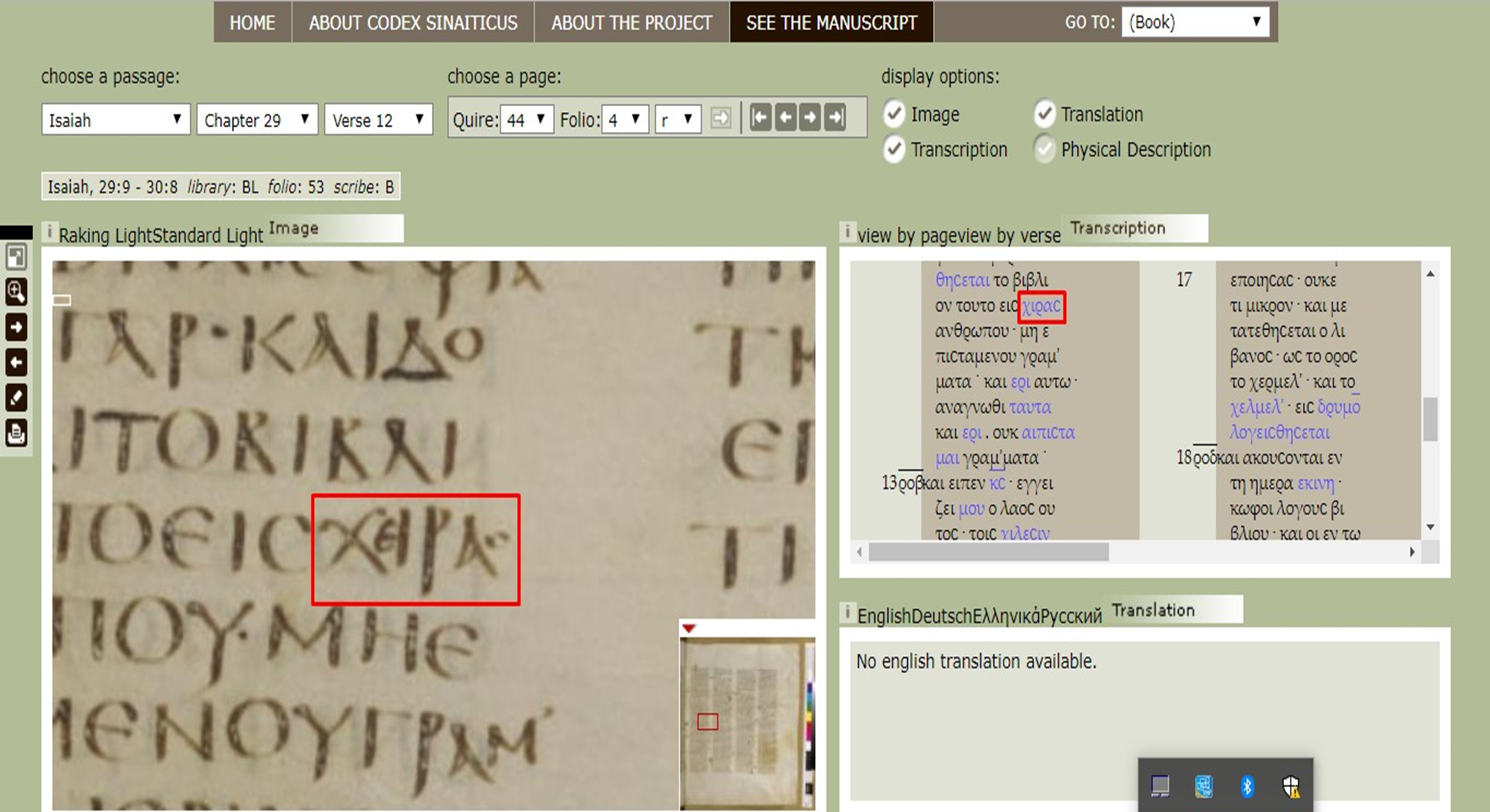
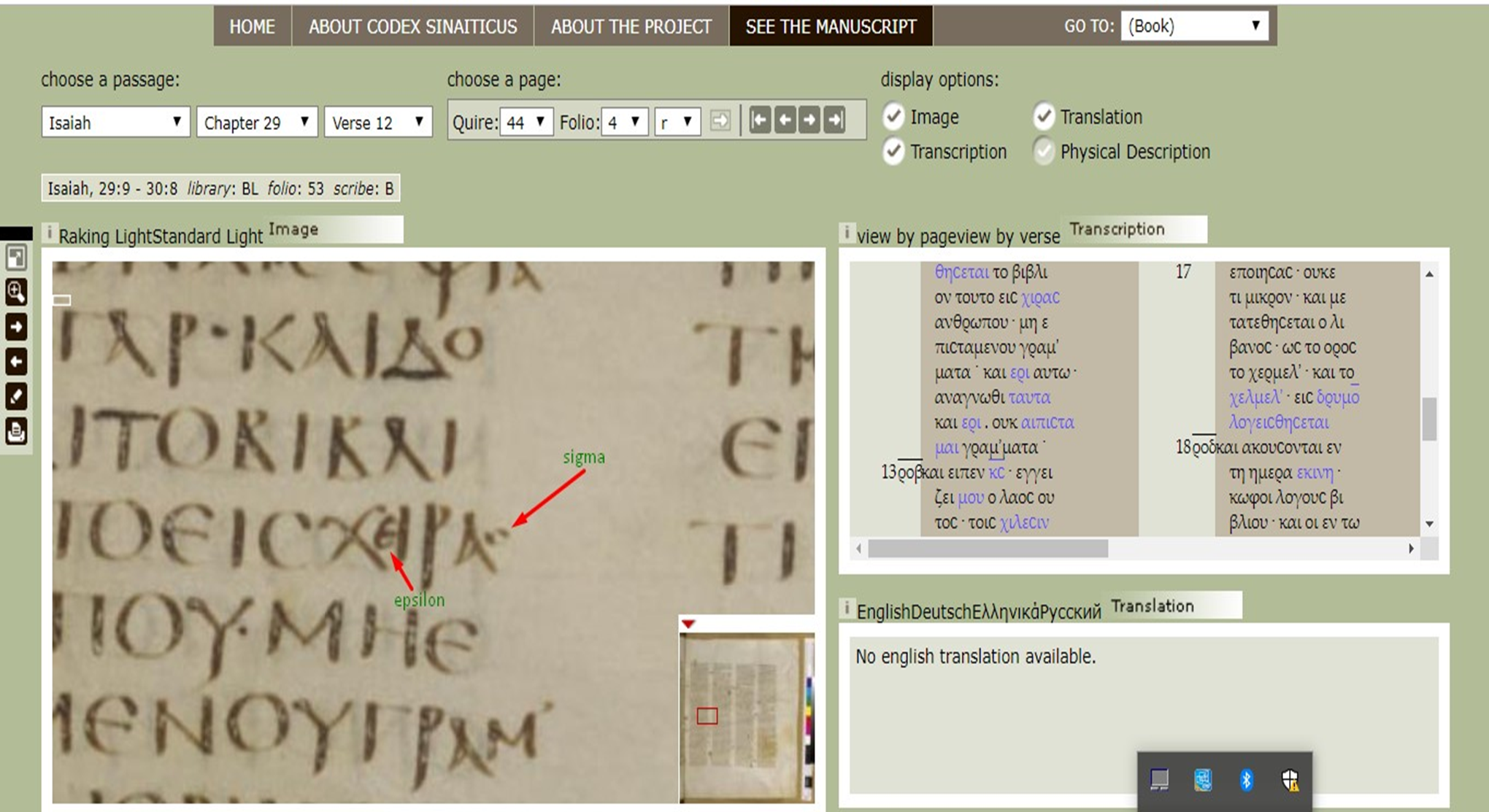
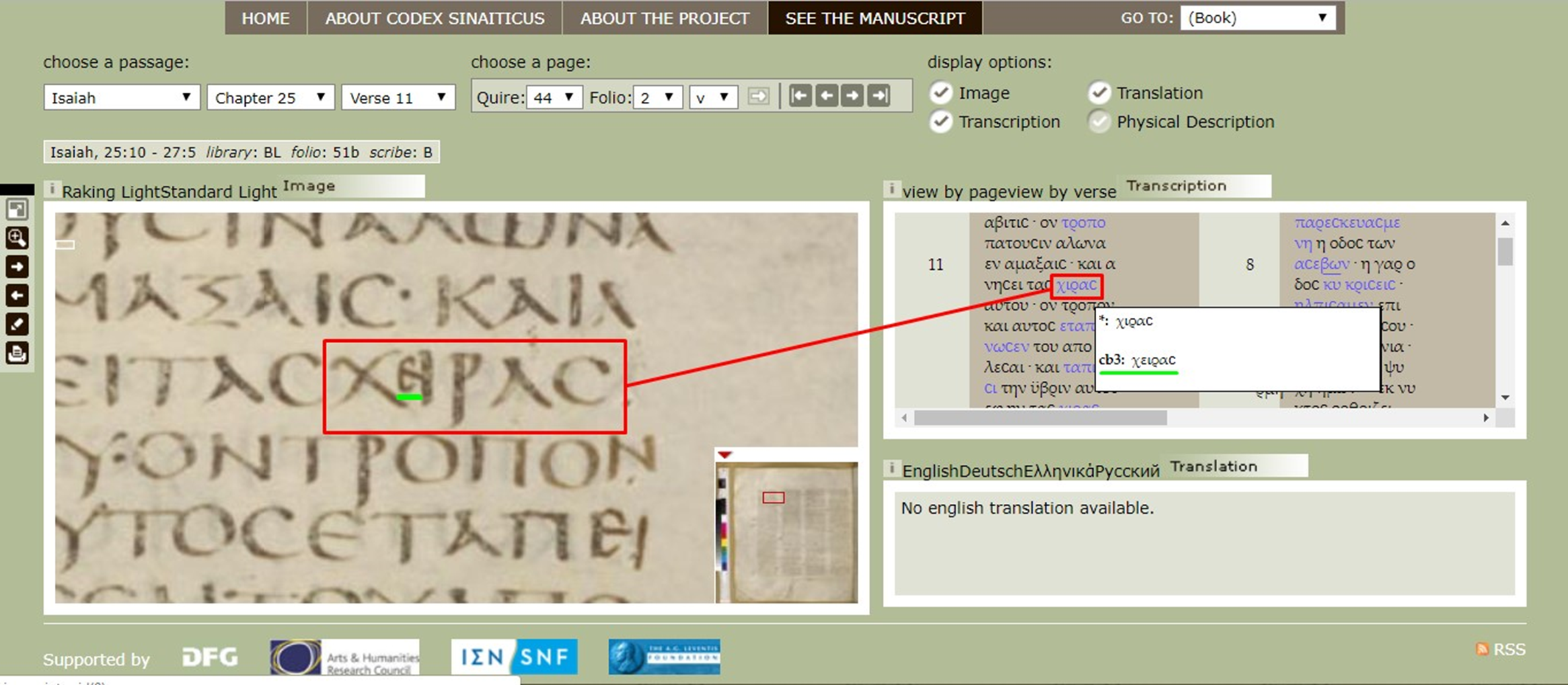
LINK: http://codexsinaiticus.org/en/manuscript.aspx?book=14&chapter=29&lid=en&side=r&zoomSlider=0 In Codex Sinaiticus, the original writer - scribe B, section Eesa 29:9-30:8, folio 53 - obviously wrote first χιρα (chira), but later, the corrector identified by scholars as Cb3, inserted a small epsilon (ε) and sigma (ς) in order to change its meaning from indeclinable feminine proper noun, "Hira" (χιρα), to a plural feminine noun in accusative case, "hands" (χειραϲ). Interestingly, there are plenty of examples of corrections in the text of Codex Sinaiticus. Ultraviolet-light tests on the palimpsest carried by the curators of the British Museum in the mid-1930s allowed researchers to identify at least nine different editors who repeatedly corrected the text over an extended period of time. To distinguish the editors/correctors from each other, scholars marked them consecutively: A, B, C, D and E, each of which has his own individual writing skills, tendencies and motivations (See D. Jongkind, Scribal Habits of Codex Sinaiticus. T&S: CBPL 5, Picataway, NJ: Gorgias Press, 2007). Now, the Cb3 was mainly preoccupied with orthography and legibility and he was correcting prophetic books. This third corrector from C group, however, has generally a bad reputation in the eyes of scholars who carefully investigated Codex Sinaiticus from a palaeographical and codicological perspectives. Milne and Skeat, two renowned assistant keepers in the Department of Manuscripts in British Museum, in their invaluable monograph (which is a priority to every scholar who want to study Sinaiticus), has to say the following about the features of Cb3:
"While Cb3's main object is to
increase the legibility of the text, usually by normalizing the orthography of
the original scribe, he possess a certain textual importance as well, for he has
frequently erased an addition or substitution by Cb2, and sometimes (but much
more rarely) one of Ca.
But whether these alterations imply collation with another copy may well
be doubted,
as the effect in every case is
purely negative. So far as our observations go, Cb3 makes practically
no positive and
original contribution to the text."
(See H. J. M. Milne & T. C. Skeat, Scribes and Correctors of the Codex
Sinaiticus (London: British Museum, 1938, p. 49.). What Milne and Skeat are suggesting in the two last sentences is that Cb3 instead to correct errors, he actually deepened them and made things worse. Acknowledging Cb3's injurious editorship, we will take a closer look at the image where I have indicated his unfortunate insertions:
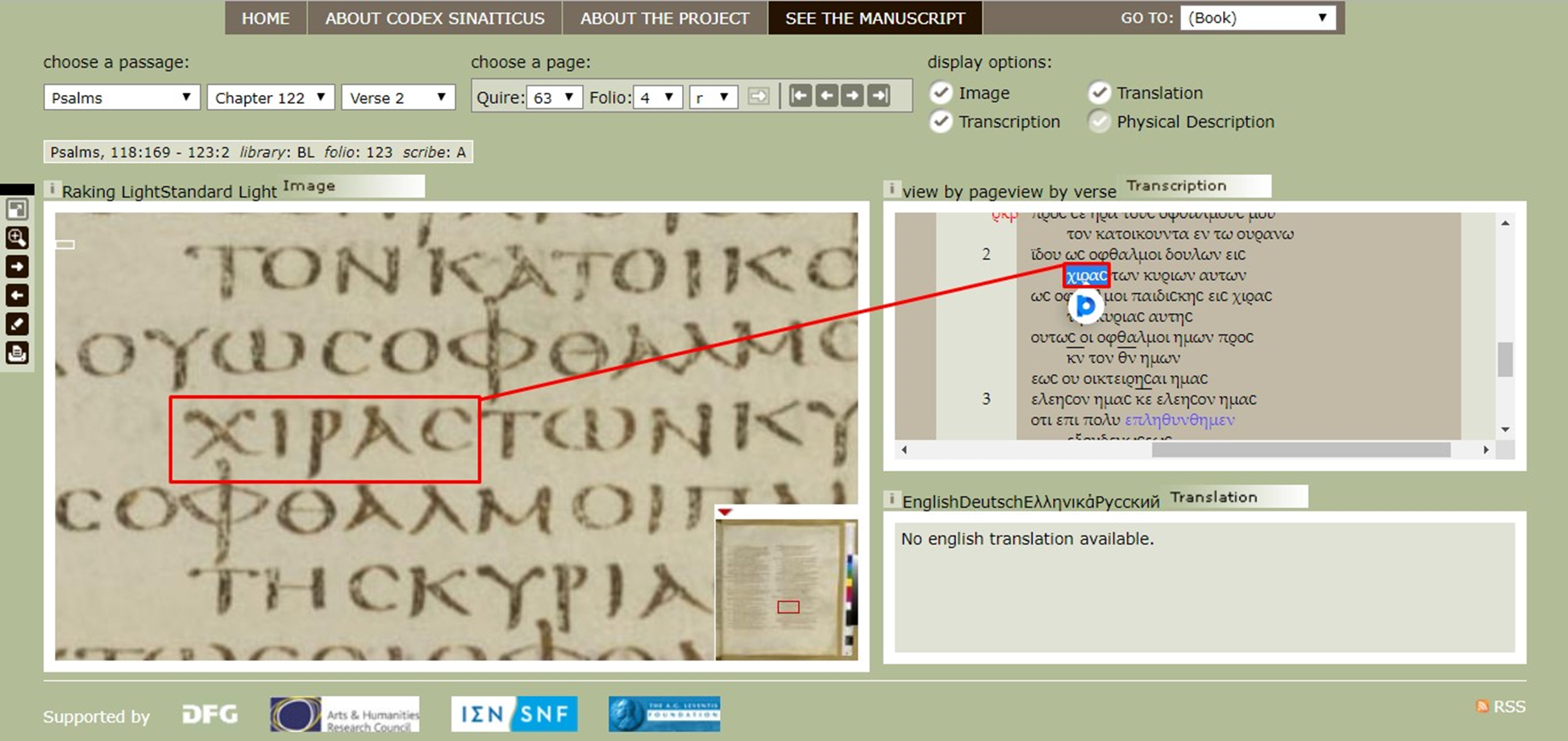
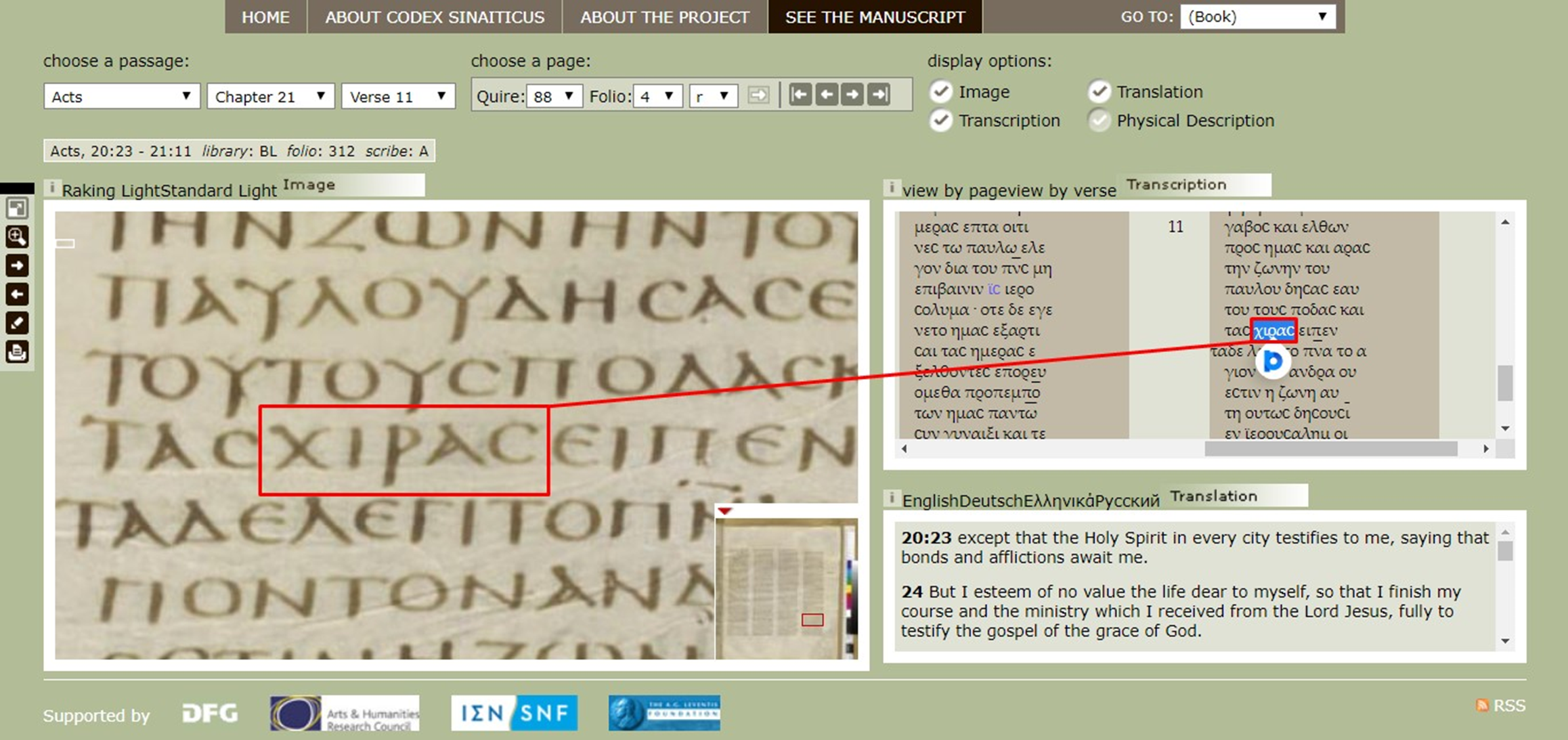
Codex Sinaiticus was originally written in uncial letters, which means that these two letters of minuscule size, i.e. ε (epsilon) and ς (sigma), were not part of the uncial script. They were evidently added by Cb3, the later corrector belonging to C group. Notice that the electronic transcription of the Greek text, authorized by the editors of the official website of the Sinaiticus Codex, intentionally omits ε (epsilon), apparently recognizing it as non-original "insertion" (but what about sigma?). My first reflections on that was: what is the nature of this textual intervention? Does this step taken by the anonymous Cb3, consisting in adding the fifth and sixth letter (thus changing the physical-graphic form of the word !), suggests a possible attempt to adapt/assimilate the text with later copies and thereby cover up some "uncomfortable" or "unwanted" information that has not been noticed by previous copyists? (Cf. E. Tov, "The Septuagint of Numbers as a Harmonizing Text," in Die Septuaginta - Geschichte, Wirkung, Relevanz, 6. Internationale Fachtagung veranstaltet von Septuaginta Deutsch (LXX.D), Wuppertal 21.-24. Juli 2016, ed. M. Meiser et al., WUNT 405, Tubingen: Mohr-Siebeck, 2018), pp. 181-201; also Cambry G. Pardee, Scribal Harmonization in Greek Manuscripts of the Synoptic Gospels from the Second to the Fifth Century, Ph.D. Thesis, Loyola University Chicago, 2016). As Constantin von Tischendorf already theorized, the correctors were active during a long period of time, estimating between 400-1200 A.D. (although others have argued that the last changes were made even in the 1800's!). The corrections from "C" group (designated by the siglum:אc, אcb, אcc, אcc*), he dates to the seventh century (See C. von Tischendorf, Novum Testamentum Graece, vol. 3, ed. Caspar R. Gregory, 8th edition, Lipsiae: J. C. Hinrichs, 1884),p. 346. Available here: https://archive.org/details/novumtestamentum31tisc/page/346). Similarly, according to Scrivener's opinion, the correctors that are classified to the group "C", worked in the seventh century, just "before breathings and accents became habitual" (See F.H.A. Scrivener, A full collation of the Codex Sinaiticus with the received text of the New Testament, London: Cambridge University, 1864, p. xxiii [introduction]. Available here: https://archive.org/details/fullcollationofc00scri/page/n29). Frederick G. Kenyon also seems to agree with this statement (See F. G. Kenyon, Our Bible and the Ancient Manuscripts, London: Eyre & Spottiswoode, 1985, p. 125. Available here: https://archive.org/details/ourbibleancien00keny/page/n157). This would indicate that Cb3 was most likely active after the death of Prophet Mohammed (SAAW), and that he edited the text of Codex Sinaiticus when Muslims has conquered Egypt ca. 639-644. In my opinion, the word χιρα (chira) aroused some suspicion among the Christian monks from the Monastery of St. Catherine, where Codex Sinaiticus was kept over centuries. However, I think that at the beginning, the monks were probably not aware of the meaning of this word. But, sooner or later, members of the Coptic community who lived under the Islamic government, must have heard about the story of al-‘Alaq which occurred to Prophet Mohammed (SAAW) in the cave of Hira. When they suddenly realized that Isaiah 29:12 is alluding to that incident, one of them immediately rushed towards the Codex and intervened: his goal was to alter the meaning of the whole context by manipulating with the text as possible as he could (i.e. introducing an additional letters to χιρα in order to eliminate any alternative interpretation of that word). I have contacted some scholars who work with Greek manuscripts to see what is their opinion on this particular case. Thus, according to one scholar from Germany (Institut für Septuaginta- und biblische Textforschung), at the time when Codex Sinaiticus was copied, the digraph ει and vowel ι were supposedly pronounced the same (another fitting example he gives is ε and αι) and so such errors were conditioned phonetically. He pointed also to another example: namely, the common confusion between 'there' and 'their' and 'they're' that many modern English speakers are susceptible to (especially native speakers).Anyway, going back to the case of Sinaitic textual-form χιρα (chira), this phenomenon is what they technically call an "iotacism" or sometimes "itacism". It is a phonetic process by which a number of vowels and diphthongs in Ancient Greek (like eta, iota, and epsilon + ei, oi, and ui) converged in pronunciation so they all now sound like [i] iota in Modern Greek (See R. L. Trask, A Dictionary of Phonetics and Phonology, London, NY: Routledge, 1996, p. 186). The spelling of the Greek χιρα (chira) and χιραϲ (chiras) would be regarded as a mere orthographic error - at least according to their own criteria - and is extremely common in Sinaiticus, however as we will see later, this is not the case here. Firstly, the subject of "iotacism" is problematic and uncertain since there are great divergencies amongst scholars themselves e.g. as to the accurate definition of this anomalous grammatical phenomenon (See e.g. J. Franek, Some Methodological Remarks of the Phonology of Ancient Greek, G-L Brunensia no. 17/1 (2012), pp. 33-50; see also "introduction and problem" in C. Meister, Iotacism and the Pattern of Vowel Leveling in Roman to Byzantine Era Manuscripts, ASP 76, 2012, pp. 1-13). Secondly, although it is generally accepted that the language of the Septuagint reflects - seemingly - the standard language of the time period, and it is not a special dialect or artificial language, some of the noticeable "oddities" however reflect either the language of the time that we are still learning about (since most dictionaries and grammars are based on earlier classical Greek) or arise from natural interference in a translation. We need to remember also that any inconsistencies in the spelling, grammar and syntax in general is a matter to which degree we comprehend the linguistic aspects of LXX. Without it, we cannot be sure who erred, and who correctly spells the words. Yet, our current knowledge about the Greek of this type of translational work is rather still limited as Natalio F. Marcos suggest by admitting, "In reality, the language of the LXX has not yet been examined thoroughly in light of the enormous number of papyrus documents." (See Natalio F. Marcos, The Septuagint in Context. Introduction to the Greek Version of the Bible, trans. by Wilfred G.E. Watson (Leiden, Boston, Köln: Brill, 2000), p. 14)), and its peculiar nature shares different rhetorical and stylistic features than the classic Greek especially if we take into account socio-cultural position of the 3rd century BC. Hellenistic Jews who used their own dialect somehow foreign to the native Greeks of Egypt (See Et sapienter et eloquenter: Studies on Rhetorical and Stylistic Features of the Septuagint, eds. E. Bons & Thomas J. Kraus, FRLANT 241, Göttingen: Vandenhoeck & Ruprecht, 2011).Although the "iotacism" in Koine Greek phonology is not inconsequential, and there is a good deal of flexibility between ει and ι (and vice versa), we will see below that e.g. the scribe A from Codex Sinaiticus use both forms: χιραϲ (chiras) and χειραϲ (cheiras) and no correction was done after him (in regard to the so-called iotacism between ει and ι).In the Book of Psalms, we have 24 instances of the form χειραϲ (cheiras) written by scribes A & D (Psalms 9:35; 17:35; 21:17; 25:6; 27:2; 30:6, 9; 36:33; 40:3; 43:21; 46:2; 57:11; 62:5, 11; 72:13; 73:3; 77:61; 87:10; 113:15; 124:3; 133:2; 137:7; 142:6) and 6 instances of the form χιραϲ (chiras) written exclusively by scribe A (Psalms 105:41-42; 118:48; 122:2; 143:1; 144:16), and yet no correction was made to the later one! (i.e. no epsilon added to χιραϲ). See the two sample illustrations relating to the form χιραϲ (chiras) from Psalms 122:2 and χειραϲ (cheiras) from Psalms 142:6 that where written by one and the same scribe, and where no editorial change took place:
(Click on image to enlarge)
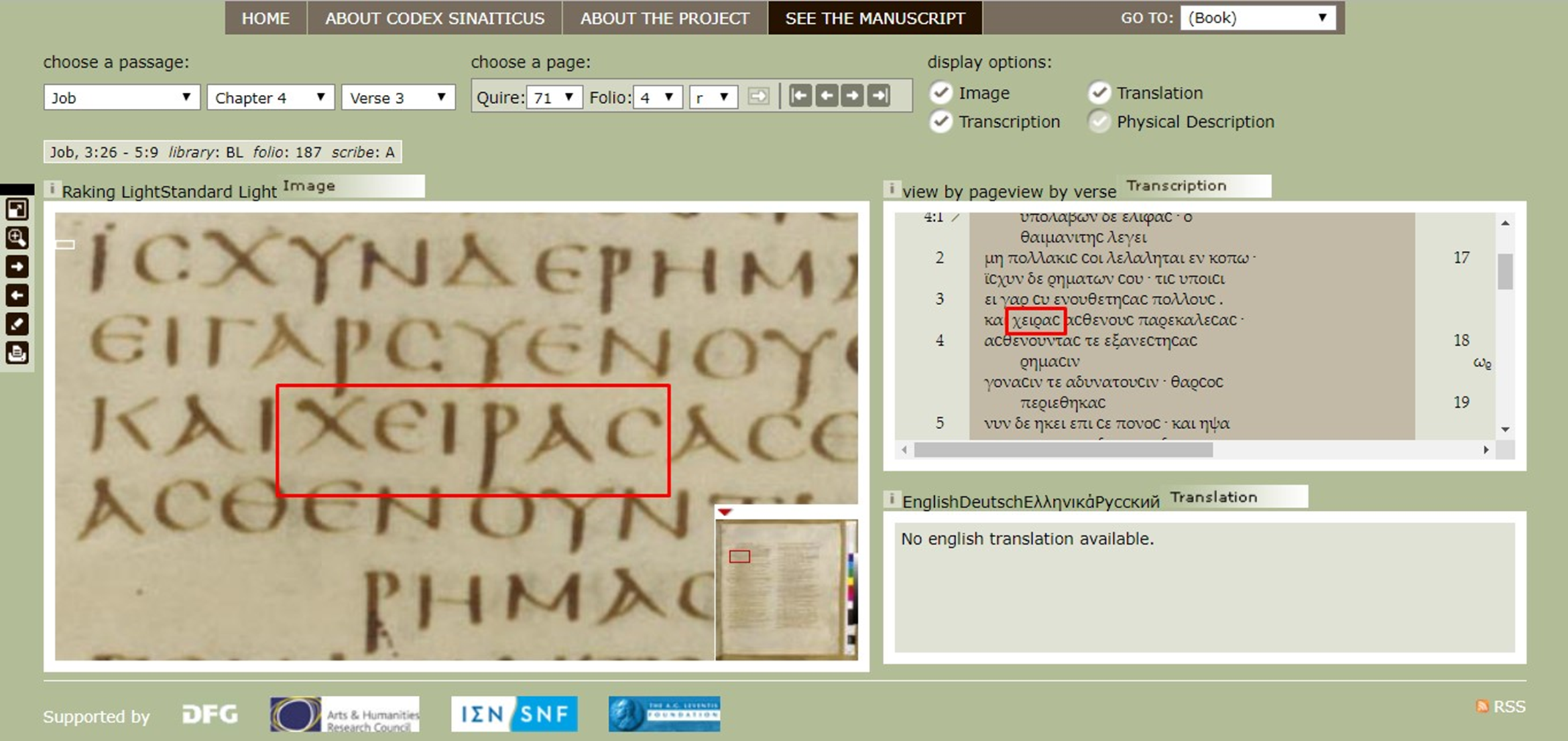
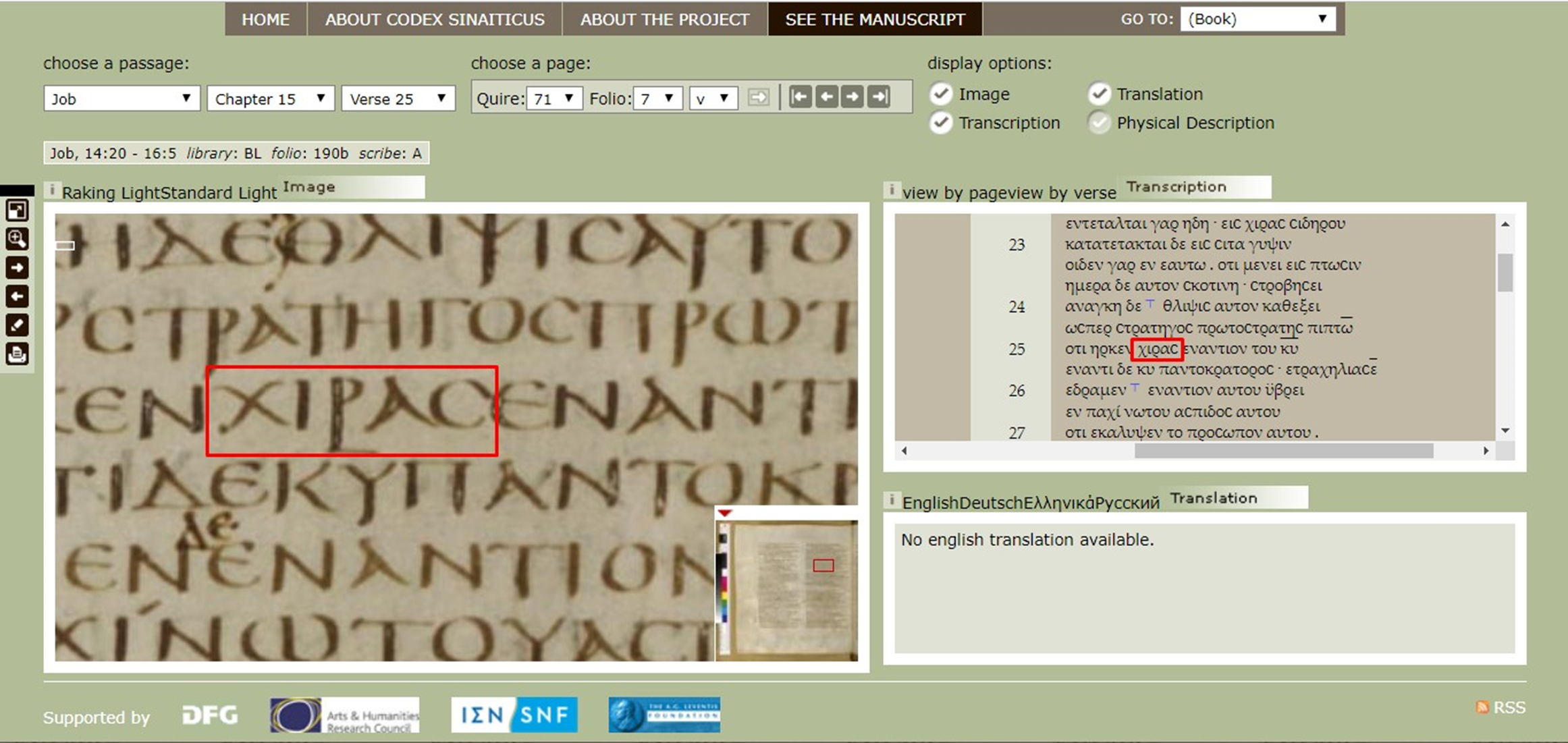
In the Book of Job, we have 2 instances of the form χειρ αϲ (cheiras) written by scribe A (Job 4:3; 17:9) and 6 instances of the form χιραϲ (chiras) also written by scribe A (Job 9:24; 11:13; 15:22, 25; 16:11; 27:23). Let's check e.g. the case of χειραϲ (cheiras) from Job 4:3 vs. χιραϲ (chiras) from Job 15:25 (refer to the two photos presented below):
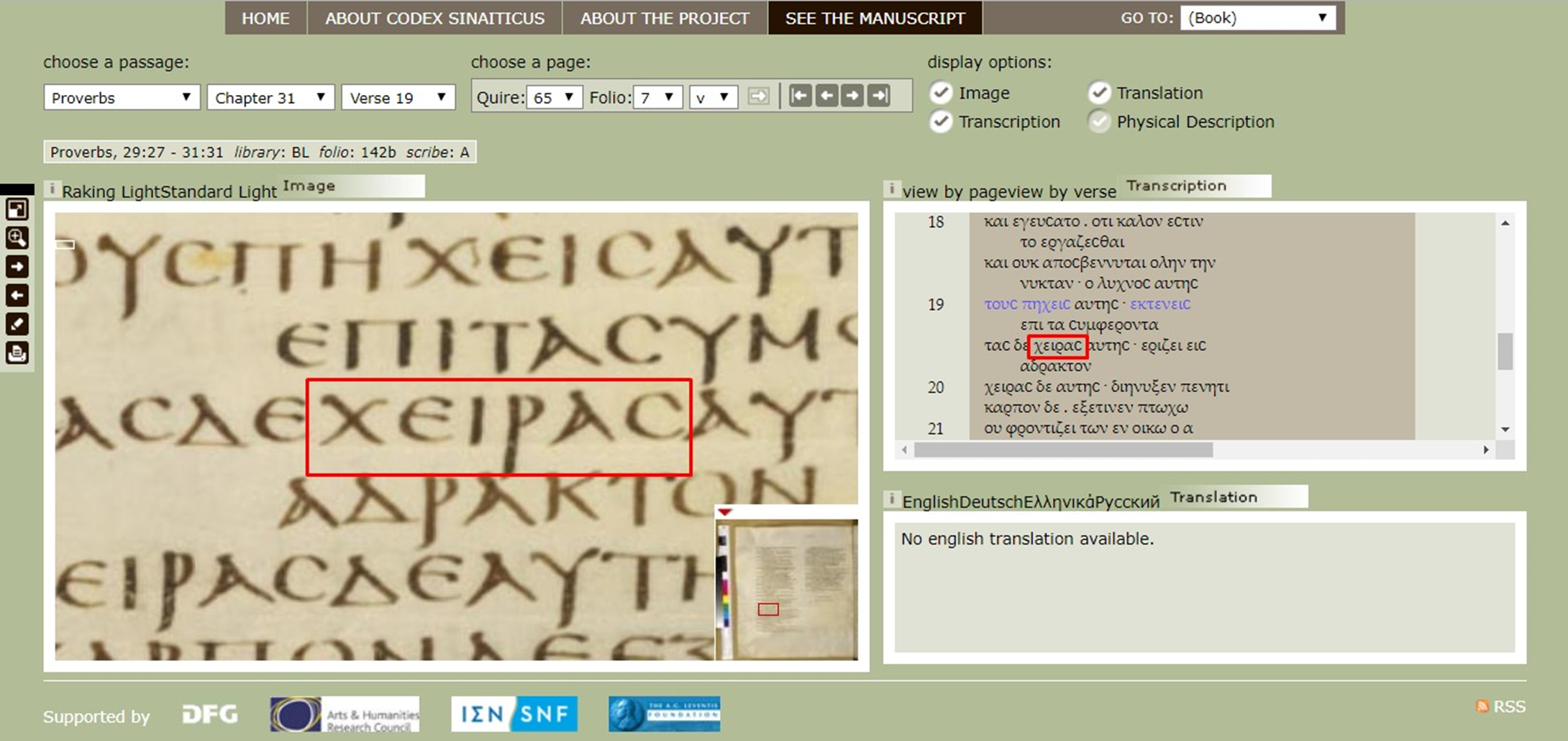
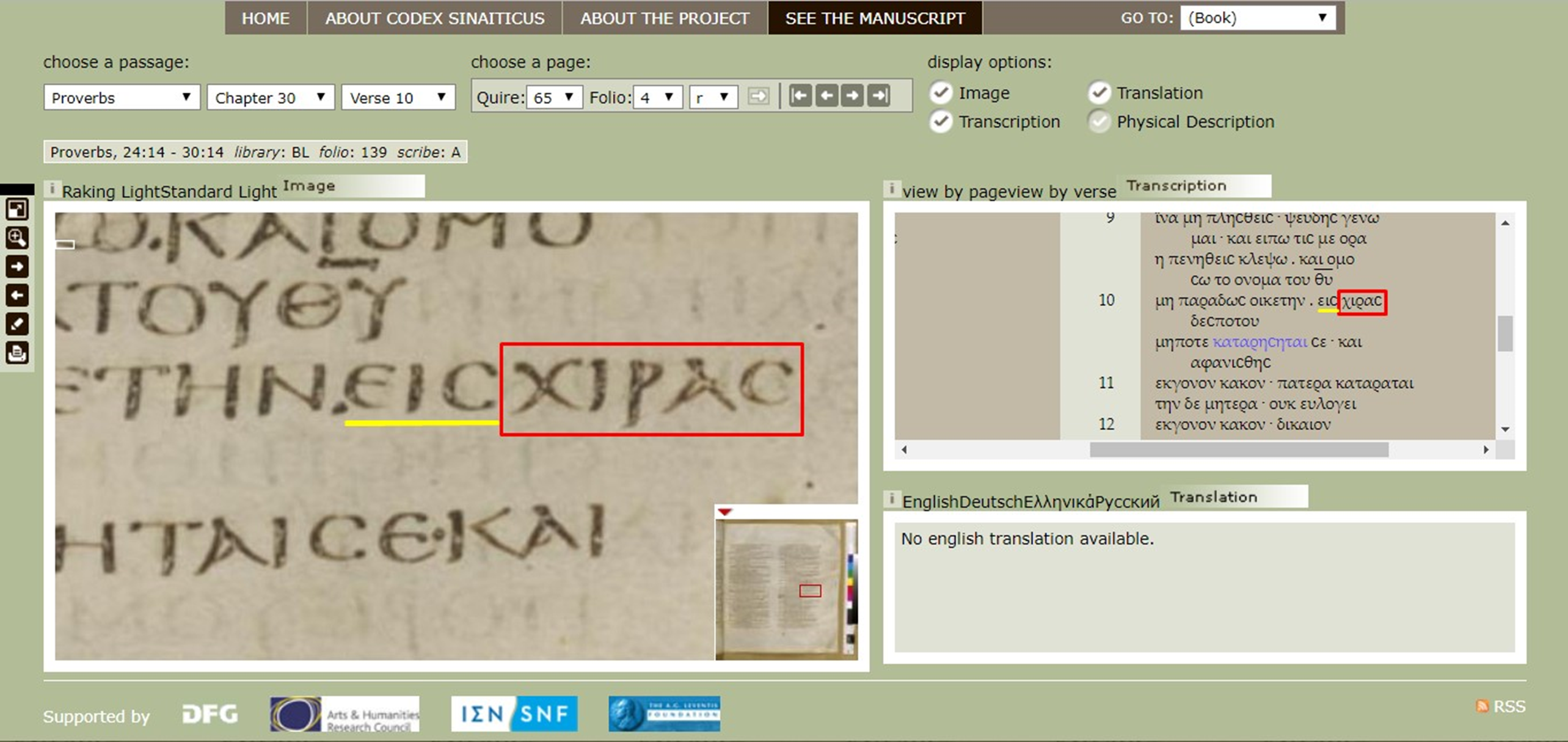
In Proverbs, we find 3 instances of the form
χειραϲ
(cheiras) written by scribe A (Proverbs 19:24, 31:19; 20) and
3 instances of the form
χιραϲ
(chiras) also written the same scribe (Proverbs 6:3; 16:5;
30:10), without any correction to the later form (See one of these
examples in the image below):
Pay attention to the second photo
- just above - where
χιραϲ
(chiras) is preceded by the preposition
ειϲ
exactly as in Isaiah 29:12. Here,
χιραϲ
(chiras) seems to have sigma at the end in the same size as
the rest of letters proving that
the editors of the Sinaiticus
website had no right to accept sigma from
χιρα
(chira) in Isaiah 29:12 as being originally written by scribe
B, but rather it should be ascribed to Cb3 since
it was he who added this letter. In the Book of Esther, we note 5 instances of
the form
χιραϲ
(chiras) written by scribe A (Esther 1:2; 4:17; 6:2; 8:7) and
5 instances of the form
χειραϲ
(cheiras) also written by scribe A (Esther 3:9, 10; 4:17;
8:7). In 2 Esdras, we find 4 instances of the
form
χειραϲ
(cheiras) written by scribe A (2 Esdras 13:2, 10; 16:9;
23:13) and 3 instances of the form
χιραϲ
(chiras) also written by scribe A (2 Esdras 16,9; 19:24, 28).
In the Gospel of Matthew, we find 2 instances of the form
χειραϲ
(cheiras) written by scribe D (Matthew 17:22; 18:8) and 6
instances of the form
χιραϲ
(chiras) written by scribe A (Matthew 15:2; 19:15; 22:13;
26:45, 50; 27:24). In Acts of the Apostles, we find 13 instances of the form
χιραϲ
(chiras) written by scribe A (Acts 4:3; 5:18; 8:17, 19; 9:12,
17; 12:1; 13:3; 19:6; 21:11, 27; 28:8, 17) and 1 instance of the form
χειραϲ
(cheiras) written by the same scribe (Acts 6:6). See the case
of
χιραϲ
(chiras) from Acts 21:11 and
χειραϲ
(cheiras) from Acts 6:6 in the picture below:
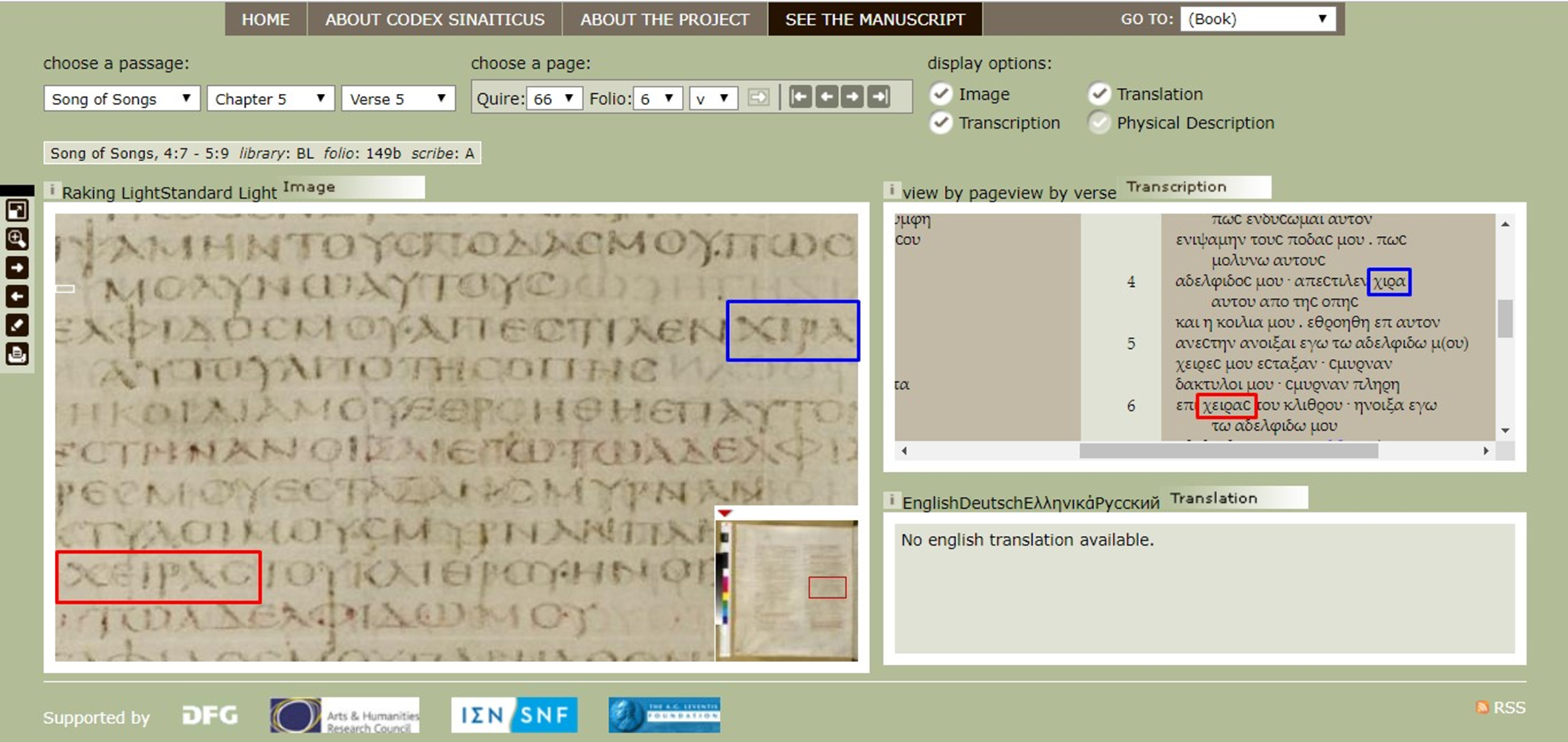
The case of Song of Songs is a rare one. Namely, in Song of Songs
5:4-5 we find
χιρα
(chira) and
χειραϲ
(cheiras) originally written by the same scribe, the first
one found in the beginning of v.4 and the second one at the end of v.5 (See the
image below where both forms were framed with rectangles in blue and red colour):
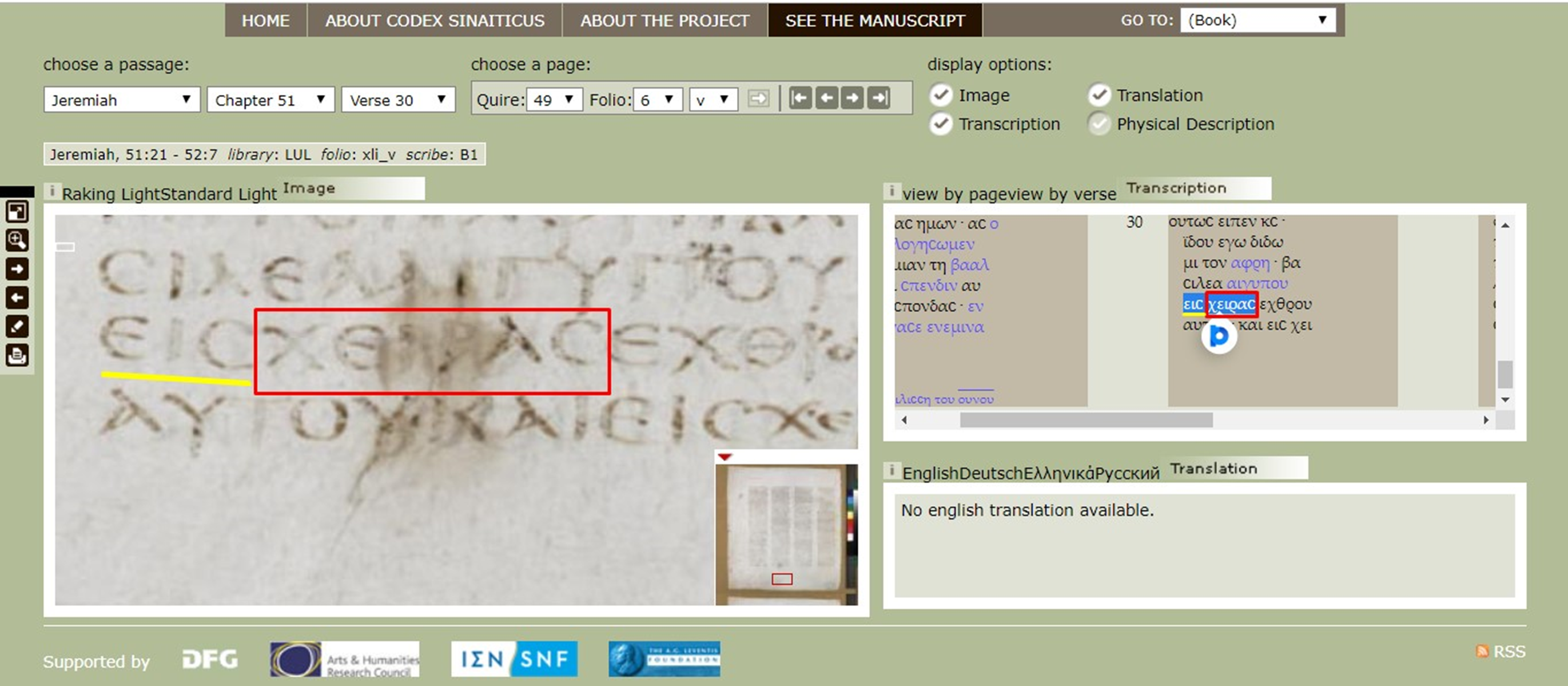
Jeremiah 51:30 is also an interesting case. In this verse, scribe
B1 wrote twice
χειραϲ
(cheiras), and by the third time, in the next column of the
same verse, he wrote
χιραϲ
(chiras) but Cb3 inserted an epsilon, thus changing it to
χειραϲ
(cheiras). Look to the image below and compare the two cases
(notice also the preposition
ειϲ
highlighted by a yellow line):
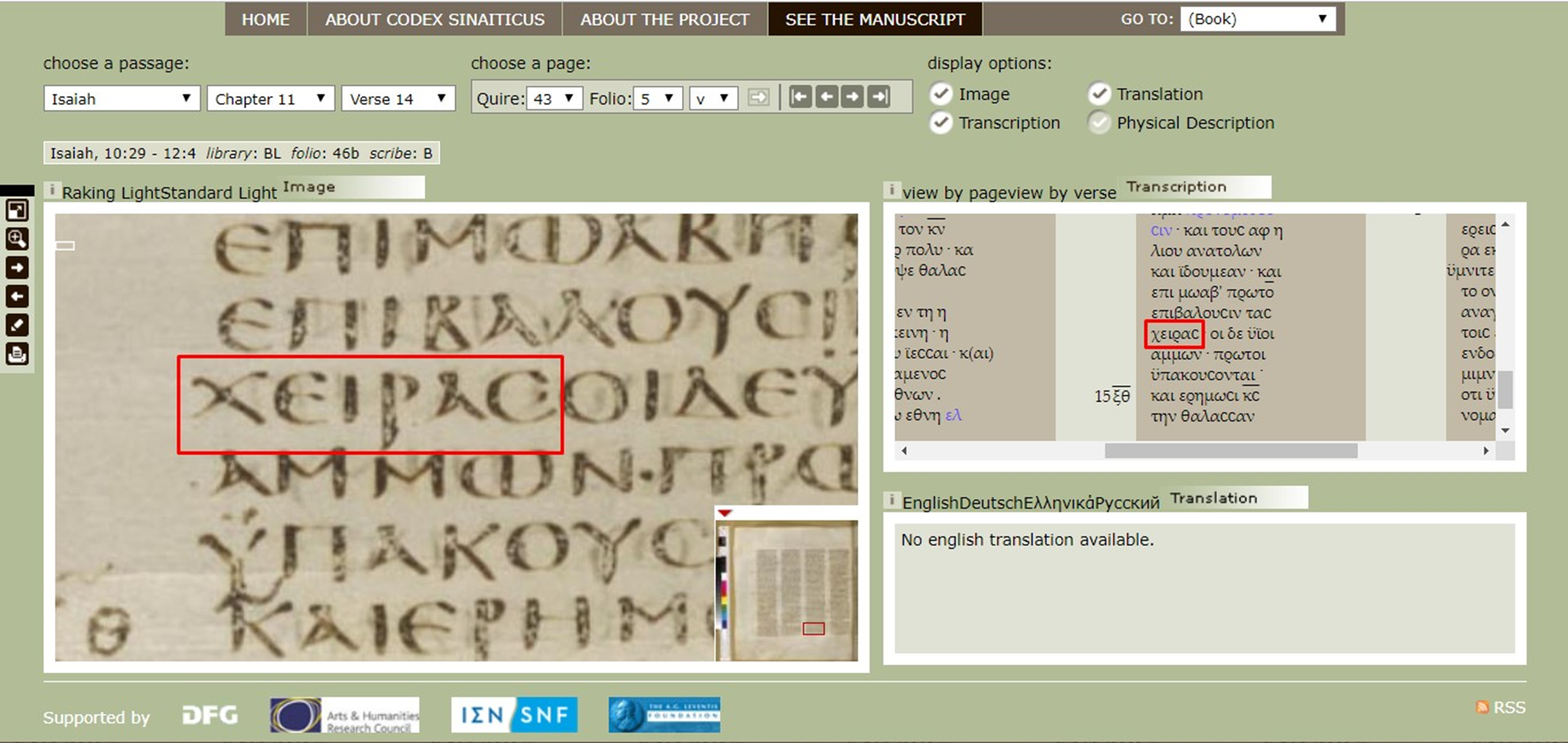
Now we come to the Book of Isaiah where do we find at least 2
instances (Isaiah 11:14; 51:23) where scribe B wrote
χειραϲ
(cheiras) and in other instances clearly wrote
χιραϲ
(chiras) but corrected by the incompetent Cb3 who of course
introduced epsilon (indicated with a short line in green). Let's see the example of Isaiah 11:14 and compare it to
Isaiah 25:11 in the picture below (notice that all letters are written in
capital):
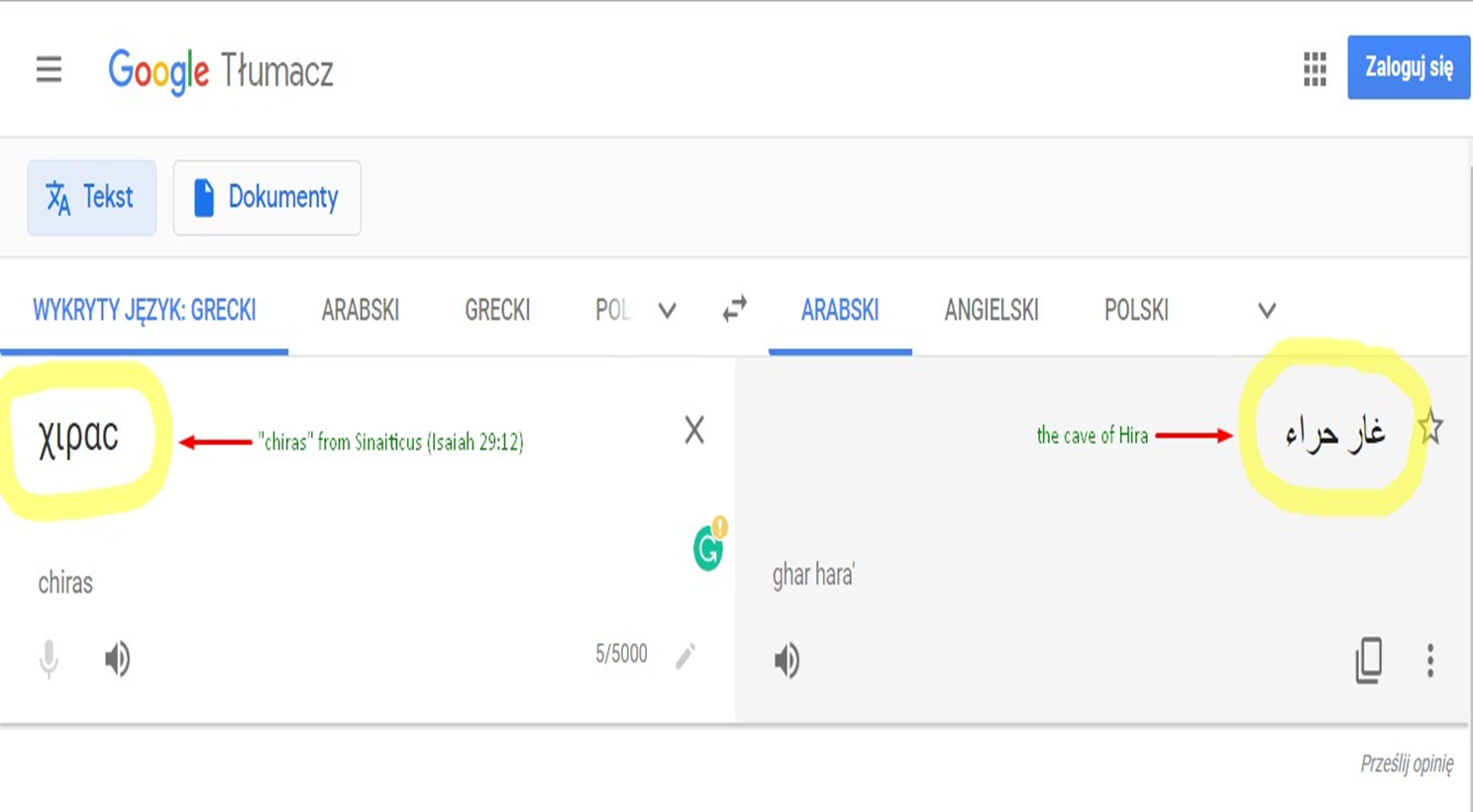
This proves that even scribe B (who was often misjudged by Cb3) recognized between the diphthong ει and iota ι, otherwise he would not wrote in one place χειραϲ (cheiras) and other time χιραϲ (chiras) or χιρα (chira) as in the case of Isaiah 29:12. It is a mystery that in Rahlf's Critical Edition or in any lexicon to the LXX, neither χιρα (chira) nor χιραϲ (chiras) does ever appear! (See Septuaginta: with Morphology, ed. A. Rahlf, Stuttgart: Deutsche Bibelgesellschaft, 1996; T. Muraoka, A Greek-English Lexicon of the Septuagint, Louvain: Peeters, 2009). It seems that these two forms were completely ignored except in some very few cases where Rahlf replaced these two forms either by χειρα (cheira), a singular feminine noun in accusative case, or by χειραϲ (cheiras), a plural feminine noun in accusative case. Bernard A. Taylor remarks that Rahlf "strove to standardize itacisms such as ει versus ι "... but he "often did not match form and function for proper nouns in his text ." (See Bernard A. Taylor, Analytical lexicon to the Septuagint: Expanded Edition. Peabody, MA: Hendrickson Publishers, 2009, p. xxi [introduction]). While continuing, B. A. Taylor notes that in Rahlfs Critical Edition, the "iota subscripts are omitted for second declension dative singular proper nouns that clearly are inflected, since the separate nominative singular form is usually also found, or the article is present. In all such instances all diacriticals are supplied. At the same time, diacriticals are not included for proper nouns that do not decline and are not in any recognizable Greek form, except that the diaeresis is retained where necessary to indicate syllabification of these Hebrew-Greek transliterations. Further, indeclinable proper nouns are not parsed, even when the parsing is clear from the context. For instance, in Tobit 5:6 (a text) Ραγα is feminine accusative singular, but it is an indeclinable noun, so it is simply listed as a proper noun." (Ibid., p. xxi). So as we see, Greek scholars had a serious problem with their illusionary "iotacism" in relation to proper nouns which is not an accident. Rahlf - and later also Ziegler - failed to grasp the true meaning of Scribe B's original χιρα (chira) thinking it was a mere scribal error for χειραϲ (cheiras), and eventually, both of their editions of the Septuagint - on which the vast majority of translations are now based - were misled by adopting the unnecessary correction or rather "miscorrection" of Cb3. In anyway, the above mentioned cases illustrated by images show us beyond doubt that scribes A & B clearly distinguished between the diphthong ει and iota ι, and no intervention of any corrector is observed (except the unlucky scribe B). The question arise: if the diphthong ει and iota ι were pronounced identically and it was a very common misspelling, why then the word χιραϲ (chiras) in all of these passages was left without any correction (if it is regarded as a mistake and lexicographically unidentifiable according to the modern academic criterion)? And in relation to Isaiah 29:12, why despite this, Cb3 was so stubborn that he felt the need to put an epsilon (after the scribe B) as if he wouldn't do that, there would be a grave mistake? Why he was interested concretely with the case of χιρα (chira) from Isaiah 29:12, if the "iota" misspelling was already a popular phenomenon in the times where Codex Sinaiticus was transmitted? Is not this a bit strange? Well, whether these interchanges in basic morphology were common or not, a shocking meaning of χιρα (chira) or χιραϲ (chiras) expose ironically the Google Translator and other similar online translators. An alternative translation of the phrase τουτο ειϲ χιρα read as "…these in Hira" or better "…that/this in Hira" which implies that χιρα is understood here as a proper name for a place. If you put in Google's translator the English phrase "In the cave of Hira" and choose translation to Greek, it will give you the following result: Στο σπήλαιο της Χίρας (Sto spílaio tis Chíras). As you can see, it uses exactly the same letters for the word Hira. Again, if you put the Greek phrase το ειϲ Χιραϲ ανθρωπου from Sinaiticus, it will translate it as "the man in Hira". And once again, if you put the Greek phrase ον τουτο ειϲ χιραϲ you will find "being these in Hira" etc. The most striking, however, is when you type χιρα or χιραϲ alone, and you select translation to Arabic, the alternative rendering will be غار حراء (ghar Hira = the cave of Hira!!!):
I guess Google's Arabic translation of χιρα or χιραϲ (kept with sigma by editors of the Sinaiticus website) betrays unambiguously what Hira really is. Here below is the link to an article from Greek Wikipedia about the cave of Hira. Notice how modern day Greeks are spelling it. They use exactly the same letters for "Hira" as in Codex Sinaiticus (after we cancel Cb3's epsilon and sigma, staying with the original χιρα) since the modern Greek χ is aspirated (with an h sound):
https://el.wikipedia.org/wiki/%CE%A7%CE%B9%CF%81%CE%AC
(χιρα
from
Greek to English Google Translate: [1]
[2]
[3]
[4]
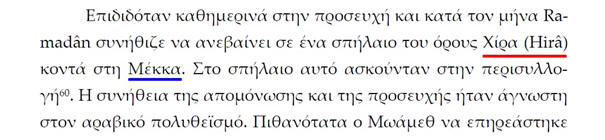
A Greek scholarly paper [Ph.D. thesis] entitled το ισλαμ στους βιους των νεομαρτυρων (Islam in the lives of neo-martyrs) uses the same word for Hira (since the text cannot be copied, I have captured it in an image):
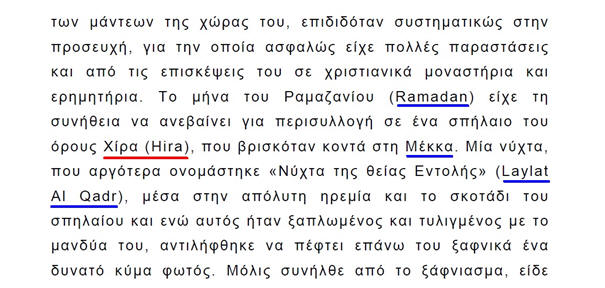
See page 30, here: http://ikee.lib.auth.gr/record/110425/files/GRI-2009-2132.pdf [2] (copy of the pdf on this website to permanently preserve it) Another additional confirmation comes from the book entitle Σημειώσεις για το Ισλάμ (Notes on Islam) written by a modern Greek theologian Θεόδωρος Ι. Ρηγινιώτης (Theodore I. Riginiotis). This scholar also uses the form Χιρά for the name Hira while commenting/retelling the Quranic revelation that Prophet Mohammed experienced (See page 20, here: https://www.euxh.gr/images/PDF/Shmeioseis_gia_to_islam.pdf [2] Analogically, a support from another Greek paper (See the image below,
Refer to the
pages 18, 95 here:
http://ikee.lib.auth.gr/record/114730/files/PANTOUSA.pdf
[2]
Post 3. Question Question
Wa alaikum assalam Answer: Wa aleikum as-salam wa rahmatullah,
Thank you, brother, for your
kind words! Good question: the Sinaitic textual-form
χιρα (chira) found in Isaiah
29:12 and which was written by the original scribe (distorted later by Cb3),
represents in my opinion an authentic form of reading
(which became inauthentic thanks to the regrettable intervention
of Cb3). It was originally
signifying a place name (Hira). I'm still trying to figure
out how Isaiah 29:11-12 could be linked with the preceding verses, as well as
with those that come after, which is not an easy task since even high-class of
professional scholars differed as to when the context of Isaiah 29 begins and
where it ends (For various academic opinions on that, see e.g. pages 88-100 in: Willem A.
M. Beuken,
Historical Commentary on the Old Testament: Isaiah, Part II, vol. 2: Chapter
28-39, trans. B. Doyle, Leuven: Peeters, 2000). We need to remember that the Book of Isaiah
is incredibly obscure. It is a product of multiple authors who edited and
rewrote the text of their predecessors (See P.-E. Bonnard, Le second Isaïe, son
disciple et leurs éditeurs: Isaïe 40-66, coll. « Études Bibliques » Paris: J. Gabala & Cie, 1972; P. A. Smith, Rhetoric and Redaction in Trito-Isaiah: The
Structure, Growth and Authorship of Isaiah 56-66, VTSup 62, Leiden: E. J. Brill,
1995; J. Stromberg, Isaiah After Exile: The Author of Third Isaiah as Reader and
Redactor of the Book, OTM. Oxford University Press, 2011). The newly
"organized" and reworked version of the Book of Isaiah that we have today, is
not forming a unified and coherent picture of biblical events.
Due to numerous unauthorized alterations in the content of the
book, it's very complicated
nature makes even the most talented and most knowledgeable scholars literally
wrestling with the text.
Answering on your question: How would I
translate the Greek text of Isaiah 29:12 from Sinaiticus? Knowing that the
change is limited only to one particular word, I think that the previous
text-form of Isaiah 29:12 read more or less as follows:
"And the Book (or this/that Book) will be
delivered in Hira [to] an illiterate man, and one shall say to
him: 'Read this, and he shall say: 'I'm not learned.'"
My research requires to read
Isaiah 29:12 in a much broader context, with a special reference to Isaiah 28
where one can find an intriguing relationship between Mecca and Zion with its
Black Stone (Cornerstone) and we find even some details indicating to the way
the Quran will be revealed to Prophet Mohammed (SAAW). Other allusions become
also visible if we read Isaiah 8 where we find a curious fragment: "And he shall
sweep through Judah overflowing as he passeth through
he shall reach even to the neck; and the stretching out of his wings shall
fill the breadth of thy land, O Immanuel" (Isaiah 8:8) which reminds of the
moment where Prophet Mohammed (SAAW) saw in the sky the gigantic figure of
archangel Gabriel (AS) covering the entire heaven by stretching his wings
over the land of Mecca, just after Prophet SAAW came out scared from the cave
Hira where the first divine revelation began. In my research, Immanuel is
Prophet Mohammed (SAAW), but this word denotes a sign not a name: "Therefore the
Lord Himself shall give you a SIGN: behold, the young woman shall
conceive, and bear a son, and shall call his SIGN Immanuel"
(Isaiah 7:14), which is alluding to
إنَّ الَلهَ مَعَنَا
(Innallahama'na)
from Quran 9:40. Now, it is interesting that Isaiah 8 is commonly linked by
scholars with Isaiah 29 since only in these chapters we find a rare notion of a
sealed document and unique vocabulary, which is again not a coincidence. The
same case is e.g. with Isaiah, chapter 9 which according to scholars would be a
good continuation of Isaiah, chapter 5. Actually there is a proof in the works
of early Muslim historians and commentators where fragments from chapter 9 of
Isaiah are explicitly cited as coming from chapter 5! (See e.g. Ibn Rabban,
al-Din wa
al-Dawlah fi Ithbat Nubuwwat al-Nabi Mohammed, ed.
A. Nuwayhid, Beirut: Dar al-Afaq al-Jadida, 1973, pp. 145-147. Here is the Arabic text:
https://archive.org/details/A-dinne.Wa.A-dawla/page/n143) [1,
2]. Moreover, all quotations from Ibn Rabban's work (except only one) are not in the
same chronological order as we find them in today's Book of Isaiah. For example, the
famous proclamation about the fall of Babylon from Isaiah 21, he quote as coming
from Isaiah 10 (Ibid., pp. 148-150). By examining this famous prophecy, Ulrike Sals, a German scholar, notes evident literary-linguistic similarities in
particular places in Chapters 13 and 21 of the Book of Isaiah and concluded that
both chapters are about the same event (See U. Sals, Die Biographie der "Hure
Babylon": Studien zur Intertextualität der Babylon-Texte in der Bibel,FAT 2.Band
6, Tübingen: Mohr Siebeck, 2004, p. 282). This observance shows that the texts
indeed were transported from their previous places because of the expansion of
the original material in the process of incorporating non-original materials. Recently, a hitherto unknown fragments of the Arabic translation of the great
Rabbi Saadia Gaon (882-942), have been found (See
A. Ashur,
S. Nir & M. Polliack, "Three Fragments of Saadia Gaon
Arabic Translation of Isaiah Copied by the Court Scribe Joseph ben Samuel (c. 1181-1209)," in: Senses of Scripture, Treasures of Tradition: The Bible in
Arabic among Jews, Christians and Muslims , ed.
Miriam L. Hjalm (Leiden, BO: Brill, 2017), pp. 487-508). One fragment
of the manuscript marked as T-S NS 318.72 includes sections of Isaiah
23:6-24:22; Isaiah 28:16-29, and the second fragment ENA 2697.18 includes Isaiah 30:1-15. The entire twenty-ninth chapter is
strangely absent(!), although the numeration of the
verses from the next three fragments indicates that the text must have ran
continuously. There are two options:
1. either
the texts that forms today Isaiah 29 did not existed or were located elsewhere,
or
2.
the
text of Isaiah 29 existed but Saadia Gaon or the court scribe who copied his
Arabic translation for some reasons didn't want to include it.
The
Arabic fragments of Saadia Gaon from T-S NS 318.72 lack chapters
24-27 which for many years are universally considered by scholars to be a later
interpolation to the Proto-Isaiah corpus. As Christopher B. Hayes observes,
"These chapters resist traditional methods for locating texts historically" (See
Christopher B. Hays, The Date and Message of Isaiah 24-27 in Light of Hebrew
Diachrony, 2013, p. 7), and they represents "an anonymous, late- or postexilic
composition and probably one of the latest additions to the book of Isaiah."
(See Marvin A. Sweeney, Textual Citations in Isaiah 24-27: Toward an
Understanding of the Redactional Function of Chapters 24-27 in the Book of
Isaiah, JBL 107/1 (1988), pp. 39-52. For a detailed discussion on this problem
see Formation and
Intertextuality in Isaiah 24-27, eds. J. Todd Hibbard & H.C.P. Kim, SBL:
Ancient Israel and Its Literature no. 17, Atlanta, GA: Society of Biblical
Literature, 2013). It is possible also that Saadia Gaon or the
scribe who copied his texts, was aware that Isaiah 24-27 were not the
original work of Isaiah, and thus they preferred to omit it. Moreover, the
suspicious absence of the entire chapter 29 would support also my hypothesis
that Isaiah 29:12 was previously located in chapter 8 where we find a curious
indication of angel's wings covering the land of Immanuel (Eesa 8:8).
It is thus possible that some specific
contents of Isaiah 8 and 29 were originally placed together, in the same
chapter, as one episode, but later were isolated
through the expansion of the text. This would be a rational explanation of why
in Isaiah 8 we
find such enigmatic indications to a sealed document (which is linked to the
sealed document from Isaiah 29:11-12) or angel's wings covering the land of
Immanuel etc. (land of Mohammed SAAW). By tracing all of these
details, one by one, we begin to understand slowly how these distinctive
prophecies are corelated with each other, and why Isaiah recalls his vision of a
prophecy in the form of a parable (understood in eschatological terms) about the
Book which will be delivered to an illiterate… in Hira (the cave of Hira).
Interestingly, in the thirteenth chapter of the Gospel of
Matthew, Jesus (AS) uses parables as patterns of revelation that serve to reveal
esoteric or secret truths (See e.g. W.S. Vorster, The Structure of Matthew 13,
Neotestamentica 11, 1977, pp. 130-138. Available here:
https://www.jstor.org/stable/43048976;
also Jacob J. Scholtz, Reading Matthew 13 as a prophetic discourse: The four
parables presented in private, In Skriflig 49/1 Pretoria, 2015), pp. Available
here:
http://www.scielo.org.za/pdf/ids/v49n1/14.pdf)
[2]. Similarly, Isaiah is using in vv.
11-12 a parable with an intention to reveal through it a hidden message in hope
that it would be decoded someday by a future generation of wise people.
The whole story
will be even more compelling if we take verses of Isaiah 29:1-8 as an allusion to Abraha (Sennacherib)
and his invasion on Mecca (Zion). There are some pretty cute hints
supporting this view. Orientalists have noted a striking similarities between
Abraha's and Sennacherib's incident (See Gordon D. Newby, "Abraha and
Sennacherib: A Talmudic Parallel to the Tafsīr
on Sūrat Al-Fīl", JAOS 94/4
(1974), pp. 431-437. Available here:
https://www.jstor.org/stable/600585). This will help us to understand the subsequent
narrative in Isaiah 29:12 and the reason behind mentioning it. Namely, a
prophecy predicting Mecca (Zion) being saved miraculously from its enemy (Abraha
as Sennacherib), and then, forty years later, the first Meccan revelation in
Hira addressed to an Arabian prophet who could not understand the vision that he
has experienced,
thus fulfilling the
prophecy of Isaiah 29:12 which portrays an illiterate in a
communicative-like situation as being under divine inspiration but unable to
comprehend the vision (this will be proved insha'Allah
in the next part titled Evidence #2: "Together with Gabriel in Hira!").
Post 4. Additional Notes
As-salam aleikum wa rahmatullahi wa baraketuh, Before I move on to the next significant discovery, I would like to stress some additional points concerning scribe B's use of the Greek word for Hira in Codex Sinaiticus. This time, we need to concentrate on χιρα (chira) preceded by the preposition ειϲ (eis) and why I think it is not a coincidence here (we have already pointed to this preposition while analysing various screenshots from the manuscript in Post 2). Firstly, notice that this Greek phrase, i.e. ειϲ χιρα (eis chira), which is translated e.g. by BES or NETS as "into the hands" (of course such translation is justified only after including epsilon between chi and iota plus sigma at the end of χιρα!), does not occur in v. 11 which is strictly and inseparably connected with v. 12 on the basis of their thematical content functioning as a parable, in a two-line prose form, about a sealed Book given to two different kinds of people: one who is educated, and the later one who is uneducated. So, the phrase "into the hands" is lacking in v. 11 but suddenly appears in v. 12 according to the LXX. This observation will prove to be extremely important, not only because v. 12 talks about an illiterate man who was instructed in a vision to read a sealed Book, but also will explain the reason of the presence of our key-word χιρα (chira) in this verse. Secondly, the idea of a prophetical night vision where an illiterate person receives "in his hands"(?) a sealed book with the command to read it, has no parallel in the Bible. To be sure, I have made the following tactical verification: using search tool engine in my biblical software, I typed the phrase τὸ βιβλίον τοῦτο εἰς χεῖρας (to biblion touto eis cheiras = the Book + that/this + into/in + hands) to see just how many verses are in the entire Greek Bible that contain all of these words at the same time (not necessarily in exact order). The result was astonishing… it turns out that these aforementioned words can be found only in Isaiah 29:12, and nowhere else! I took a photo to illustrate it while working with my biblical software:
(Click on image to enlarge)
Even if we limit our searching scope to only three
terms (for instance, excluding the definite article τὸ and
demonstrative pronoun τοῦτο), in my case they were: βιβλίον +
εἰς +
χεῖρας
(biblion eis cheira
= book + into + hands), we will find surprisingly only 5 verses, one of which
is in Isaiah 29:12, and the rest 4 verses are outside Isaiah's book. Notice how
each of these particular words are situated and the
distance between them, and compare them to the case of Isaiah 29:12 (notice
also that the thematical content of these 4 verses has absolutely nothing to do
with Isaianic parable about the sealed Book given to
an illiterate). See the photo below:
I
typed also other sample phrases like δοθήσεται
+
βιβλίον +
εἰς +
χεῖρας (dothesetai
biblion eis cheiras = delivered + book + into + hands), but again the
result matches only
Isaiah 29:12! Isn't amazing? This remark is also very
important because it again betrays the real motive why Isaiah 29:12 is the only
verse in the entire Greek Bible where the distorted form
χειραϲ
(cheiras) appears in the background of a sealed Book given
to an illiterate person etc., and only according to LXX version. And the motive
behind that is because the previous original text copied by scribe B, in fact
never contained a word with lexical functions of plural noun in accusative case
"the hands", but rather it was something else in its place. Even
assuming for a moment that the
translation "And the Book will be delivered
into the hands(?)
of an illiterate…" is the correct one,
this phrasal sequence makes the narrative of v.12 bizarre, without any
parallel, and strange to the Bible language. Nowhere in the Greek Bible or even
in the Hebrew Bible, such a sequence of words ever appear. Usually when critical scholars faces biblical passages
that has no intertextual parallel, they are often forced to recover a
hypothetical text-form without any confirmatory evidence from the existing
manuscripts! Here is an example verdict of one of the most prominent Hebrew
scholars of today. While
discussing the complexity of Mss transmission
and multiplication of errors in the Hebrew text of Isaiah 53:11, he came to the
conclusion:
"A final clue is that 1QIsaa makes the
identical error in 34:5, writing
תראה for
רותה. Thus, it appears that the original text was
מעמל נפשו
ירוה ישבע
בדעתו;
that
no manuscript survives to attest it; that an early form of
the MT erred with the lectio facilior
יראה
(possibly influenced by
יראה
in v. 10); and that most manuscripts tradition filled
in a suitable object,
אור (cf. 9:1; 44:16; and
יהוה אורי Ps 27:1)." (See Eugene C. Ulrich, The Dead Sea Scrolls and
the Developmental Composition of the Bible, VTSup
169 (Leiden: Brill, 2015), pp.138-139.)
There are more examples of such
non-attested textual readings officially adopted as plausible by top Hebrew
scholars (some of these critically reconstructed variae
lectionis are discussed e.g. in Emmanuel Tov's ground breaking book "Textual Criticism of the Hebrew
Bible", three editions has already been published under the same title).
Thus, we have
sufficient justification and other logical reasons permitting us to reconstruct
a particular fragment of the Bible without any attestation from other
manuscripts, and the same method we apply to the text of Isaiah
29:12 basing on our own understanding. Many emendations to the text of LXX are
offered by Greek scholars
in order to recover readings which were once found in the
original text but now are "no longer written"
(See P. Walters, The Text of the Septuagint: Its
Corruptions and Their Emendation, ed. D. W. Gooding, Cambridge: University
Press, 1973;
and with respect to the New Testament, see e.g. Ryan D. Wettlaufer,
No Longer Written: The Use of Conjectural Emendation in the Restoration of the
Text of the New Testament, the Epistle of James as a Case Study, Leiden: Brill,
2013).
I believe that the scribe B's
χιρα (chira),
which was the first genuine reading, represented originally an indeclinable feminine
proper noun and was reserved for a place name, that is "Hira", and
precisely speaking "the cave of Hira" as Google's Arabic translation
clearly indicates. By the way, how ironical is the fact that the most
inconspicuous tool online can expose sometimes hidden meanings of an ancient
Greek words! In summary, we have established in this post that the phrase εις χιρα (eis chira) from Codex Sinaiticus indeed means "in Hira" NOT "into the hands" = ειϲ χειραϲ (eis cheiras), since as I showed in the images above, there is no single parallel to the later rendering apart from Isaiah 29:12 (naturally I meant that there is no parallel clauses in the Bible with such a narrative background which would combine the idea of giving a sealed Book "into the hands"(?) of an illiterate with the imperative verb speech: "Read it", plus double negative response of that illiterate man). My emendation for the former rendering, i.e. "in Hira" (after we cancel Cb3's epsilon + sigma and stay with scribe B's original text-form χιρα), will change the semantic value of the whole verse - as I proposed in my Post 3 (Question) - and in my view, it would make more sense along with the Quranic scenario of surat al-'Alaq and how it address Prophet Mohammed (SAAW) when he was inside the cave of Hira.
Post 5. Conclusion
Concluding my previous posts concerning Hira in Isaiah
29:12:
It seems that the editorial step undertaken by Cb 3 encoded the true meaning of the earlier,
original text-form,
χιρα (chira), which plays a
key role in Isaiah 29:12. In other words, by inserting an additional letters
(i.e. epsilon
ε
and sigma
ς), Cb3 tried to enclose/encrypt
χιρα (chira)
within its new own
contextual frames, i.e. to give in result "the Book will be
delivered
into the hands(?)..." instead
of "the Book will be delivered
in Hira to an illiterate man...", thus hiding the
genuine contextual frames for that word, and eliminating any possible ambiguity
of its actual etymological origin, although ineffectively since at last,
an evidence against its manipulation has emerged. This
clever editorial manoeuvre, which led finally to the physical corruption of the
text, was almost certainly the source for the later false translations that were
adopted by BES or NETS, and Cb3's manipulative attempt is ridiculous and unfair.
While
the Book of Isaiah is indeed an incredibly obscure book (as e.g. Ezekiel or
John's Apocalypse), there exists numerous intriguing things hidden in it that are not yet
explored by Muslims , and that points specifically to the events related to
Islam and Prophet Mohammed's (SAAW) missionary office. In many cases, biblical
scholars are helpless as to what the text originally said, what
is the exact meaning of a such and such word, which particular event Isaiah had
in mind etc. On the other hand, many of these difficult and puzzled
cases can be easily deciphered from the Quran and Hadith literature. Currently I'm gathering further info for my next post dealing with the Evidence #2: "Together with Gabriel in Hira!" in which I will discuss another important discovery. In it, I will explain who is - or who was - the one that delivered the Book to the illiterate man from a patristic exegesis on Isaiah 29:12 and of what book it was about in Evidence #3: "The Sealed Book" given to an illiterate is the celestial archetype model of the earthly Quran (Ummu l-Kitab).
EVIDENCE #2: "Together with Gabriel in Hira!" (Isaiah 29:12 describes an angelic revelation) Post 1. Preliminary Notes In brief, we have demonstrated in our previous discourse (Evidence #1) that the old Greek text of Isaiah 29:12 according to Codex Sinaiticus gives an invaluable testimony that the sealed book shown to an illiterate man, took place in χιρα (Hira), and Google Translator even clearly pinpoints that it is in Arabic غار حراء (ghar Hira), i.e. the cave Hira, which is a famous holy place located in the Meccan desert where Prophet Mohammed (SAAW) received his first Quranic revelation, in 610 AD. In the first post of this section, we will focus on another important discovery which will provide an answer on who is the anonymous "one" who gave the sealed book to this illiterate man in Isaiah 29:12. But first, let's confirm once again from another angle the way how Isaiah 29:12 is alluding to Prophet Mohammed (SAAW) as an unthought man to whom will be given the book. We will quote the Targum-Jonathan to Isaiah 29:12, an early Aramaic translation of the Hebrew Bible (however it was revised in the seventh century AD… again, obviously because of Mohammed's SAAW appearance as an Arab!)The Aramaic Text of Isaiah 29:12 (Sperber's Critical Edition) וְיִתיְהֵיב סִפרָא לִדלָא יָדַע סִפרָא לְמֵימַר קְרֵי כְעַן דֵין וְיֵימַר לֵית אְנָא יָדַע סִפרָא English Translation by Bruce D. Chilton (1987) "And all prophecy has become to you like the words of a book that is sealed. When men give it to one who knows the book, saying, "Read this," he will say, "I cannot, for it is sealed." And the book will be given to one who does not know the book, saying, "Read this," and he will say, "I do not know the book." The above phrase from Chilton's literal translation "one who does not know the book" (לִדלָא יָדַע סִפרָא) is interesting since it perfectly corresponds with Prophet Mohammed's (SAAW) case when Allah has revealed to him مَا كُنتَ تَدرِي مَا الْكِتَابُ (ar. ma kunta tadri ma l-kitabu), i.e. "You did not know what is the Book". Let's read the entire verse of Sura 42:52 where these words appears: وَكَذَٰلِكَ أَوْحَيْنَا إِلَيْكَ رُوحًا مِّنْ أَمْرِنَا ۚ مَا كُنتَ تَدْرِي مَا الْكِتَابُ وَلَا الْإِيمَانُ وَلَٰكِن جَعَلْنَاهُ نُورًا نَّهْدِي بِهِ مَن نَّشَاءُ مِنْ عِبَادِنَا ۚ وَإِنَّكَ لَتَهْدِي إِلَىٰ صِرَاطٍ مُّسْتَقِيمٍ Sahih International "And thus We have revealed to you an inspiration (ar. ruhan, i.e. Gabriel AS) of Our command. You did not know what is the Book or [what is] faith, but We have made it a light by which We guide whom We will of Our servants. And indeed, [O Muhammad], you guide to a straight path" Some Christian apologists claimed that Prophet Mohammed's (SAAW) illiteracy is a myth since there are authentic hadiths which says e.g. أخذ رسول الله صلى الله عليه وسلم الكتاب فكتب i.e. "Messenger of Allah took the document and wrote…," (Sahih al-Bukhari, ) thus using it as an undisputable proof that Mohammed (SAAW) indeed knew how to read and write. I will devote insha'Allah a section refuting all objections of Christian apologists on that matter. For now, I will quote only one verse from Sura 29:48 which very clearly states by emphasizing that Prophet Mohammed (SAAW) didn't know how to read and write before the Quran came down to him: وَمَا كُنْتَ تَتْلُو مِنْ قَبْلِهِ مِنْ كِتَابٍ وَلَا تَخُطُّهُ بِيَمِينِكَ ۖ إِذًا لَارْتَابَ الْمُبْطِلُونَ Yusuf Ali Translation "And thou was not (able) to recite a Book before this (Book came, i.e. the Quran), nor art thou (able) to transcribe it with thy right hand: In that case, indeed, would the talkers of vanities have doubted." Christian apologetic argumentation actually does not disprove in any way that when the first Quranic revelation in Hira took place Prophet Mohammed (SAAW) was unlearned. In other words, it does not affect the claim that Isaiah foreshadows Mohammed (SAAW) as an illiterate prophet and Muslim's interpretation is still 100 % valid in this matter, since Allah clearly says he couldn't read nor write before the Quran was given to him (ar. ma kunta tatlumin qablihi), i.e. until the age of forty he was not learned yet (what happened later is another question, but most info is coherent that he remained illiterate to the end of his life). Now, the fragment اَوۡحَيۡنَاۤ اِلَيۡكَ رُوۡحًا مِّنۡ اَمۡرِنَا i.e. "We have revealed to you a spirit from Our command" (Quran 42:52) that we cited earlier, refers without doubt to angel Gabriel (AS) who is known also in Islam as the Holy Spirit (Ruhu l-Qudus) and the The Faithful Spirit (Ruhu l-Amin). Gabriel (AS) is a powerful celestial being who transmitted the divine revelations to the terrestrial beings. He is the "one" who was responsible for the theophanies that all prophets of God experienced. Now, there are two early patristic authorities who admits something interesting in relation to the "one" who delivered the book to the illiterate mentioned in Isaiah 29:12. Jerome of Stridon (ca. 345-420 AD), in commenting upon Isaiah 29:9-12, notes that "‘all the Scriptures' are "written by the one Holy Spirit and for this reason are called one book" (Latin: uno scriptae sunt spiritu sancto; et propterea unus liber appellantur). Analogically, Cyril of Alexandria (ca. 376-444 AD), in explaining the same text in his own commentary, writes "The divinely inspired Scripture is sealed as one book. For it is all one, and has been spoken through the one Holy Spirit." (Greek: κατεσφραγίσθη . . . καθάπερ βιβλίον ἓν ἡ θεόπνευστος Γραφή. Ἓν γὰρ ἡ πᾶσά ἐστι καὶ λελάληται δι' ἑνὸς τοῦ ἁγίου Πνεύματος). It was Matthew R. Crawford who drew attention to this particular detail in his article "Scripture as 'One Book': Origen, Jerome, and Cyril of Alexandria on Isaiah 29:11," JTS 64 (2013), pp. 137-53 (Available here: https://www.academia.edu/5005472/Scripture_as_One_Book_Origen_Jerome_and_Cyril_of_Alexandria_on_Isaiah_29_11). Thus, according to these two prolific biblical commentators, all the Scriptures are to be viewed as one book revealed by the Holy Spirit to all prophets. In Quranic theology, the Holy Spirit is non-other than angel Gabriel (AS) who revealed to Prophet Mohammed (SAAW) the first sacred verses from surat al-‘Alaq (clay) when he visited him in the cave Hira. The Quran is a comprehensive and complete system of divine Law that regulates spiritual, moral and every other aspect of human life. The authentic tradition recorded in Sahih al-Bukhari and Sahih Muslim informs us that when Prophet Mohammed (SAAW) had received the revelation and told Khadija (RA) what happened, she took him to her cousin Waraqa ibn Nawfal to find out what this mysterious vision that saw Mohammed (SAAW) could possibly mean. After Prophet (SAAW) told him about his incident, Waraqa replied: هذا الناموس الذي أنزل على موسى i.e. "This is the same Nāmūs which was sent to Moses (AS)" (Sahih al-Bukhari, available here: ) or according to Sirah al-Nabawiyya's account: "There hath come unto him the greatest Nāmūs which came to Moses (AS) aforetime" (Arabic text available here, pp. 153-154: https://archive.org/details/p1daslebenmuhamm01ibnhuoft/page/n395. English translation by A. Guillaume available here: https://archive.org/details/TheLifeOfMohammedGuillaume/page/n75). I have slightly modified the translation since the Arabic word النَّامُوسُ (al-nāmūs) was wrongly understood by some as a designation of angel Gabriel (AS), rather it seems that this word originated from the Greek νόμος (nomos) which LXX usually uses for translating the Hebrew תורה (torah) (See Sheldon H. Blank, The LXX Renderings of Old Testament Terms for Law, HUCA 7, 1930, pp. 259-283. Available here: https://www.jstor.org/stable/23502852). In a very general sense, the Greek νόμος (nomos) denotes a "law" (See Thayer's Greek Definitions, available here: https://archive.org/details/greekenglishlexi00grimuoft/page/426). Thus, it was the greatest Law, or another Torah - in likeness of Mosaic Torah - that came to Prophet Mohammed (SAAW) in the cave Hira. Indeed, from the outset, the Qur'an was perceived as code "law." In Sura 32:23 of the Quran we read… "We did indeed aforetime give the Book to Moses: be not then in doubt of its reaching (thee)" (Yusuf Ali), i.e. Allah comforted Prophet Mohammed (SAAW) that he also will be given the Law - or the greatest Nomos - as Moses (SAAW) received. Now, according to Josephus (ca. 37-100 AD), the "Law" was given through the angels. In his Antiquities of the Jews (15.5.3 §136), he writes: "…we have learned from God the most excellent of our doctrines, and the most holy part of our law (gr. nomos), by angels or ambassadors; for this name brings God to the knowledge of mankind." (See The Works of Flavius Josephus, trans. W. Whiston, vol. 2, London: T. Tegg, 1825, p. 322. Available here: https://archive.org/details/worksflaviusjos07josegoog/page/n330). Angelic mediation of the Law is clearly indicated also in the New Testament (e.g. Galatians 3:19; Acts 7:53; Hebrews 2:2). Interestingly enough, the sealed document from Isaiah 8:16 which is commonly connected by scholars with that one from Isaiah 29:11-12, is called νόμος (nomos). The Book that was seen in the vision by the "illiterate" described in Isaiah 29:12 was therefore most likely the same thing which Waraqa bin Nawfal called in Arabic "Nāmūs" or in ancient Greek "Nomos" (See note 28 in Post 2. of this section). A clear indication that the "one" who gave the sealed book to the illiterate one is Gabriel (AS), can be found in the Book of Daniel where God orders Gabriel (AS) to explain the vision for Daniel (Dan 8:16) and says to him to "shut up the words and seal the book" (Dan 12:4). It is interesting to note that Daniel was fasting when Gabriel (AS) came to him (Dan 10:3). So angel Gabriel (AS) also came to Prophet Mohammed (SAAW) when he was fasting and practicing tahannuth (during the period of Ramadan). Daniel was frightened whether he has understood what was revealed by Gabriel (AS) in a vision (Dan 10:11-12). So Prophet Mohammed (SAAW) also was frightened and didn't know how to understand the revelation which Gabriel (AS) showed to him first time in a vision in the cave Hira. Moreover, it seems that the "sealed book" is called also in one place "The Book of Truth" (Daniel 10:21) and this would be consistent with what early Muslim exegetes recorded. Namely, a very interesting report, probably from the lost Sibylline prophecies, that one prophet will be sent with a revelation… the Book of Truth (cf. Quran 4:105). I will explain it in section Evidence #3 with more details insha'Allah. Also, the next part of my post will provide an external evidence from Isaianic prophetology (recorded in early Islamic sources) where the "illiterate" is identified as Ahmad and he is connected directly with the Servant of God from Isaiah 42. To be continued insha'Allah, very soon…
Disclaimer: Please give brother Idris
the full credit when using his material. Please give his name and link the
URL to this page, or any page that his work exists in on this website, if you
quote from his work. Jazakum Allah Khayr. |
2- Quran's Revelation inside cave Hira:
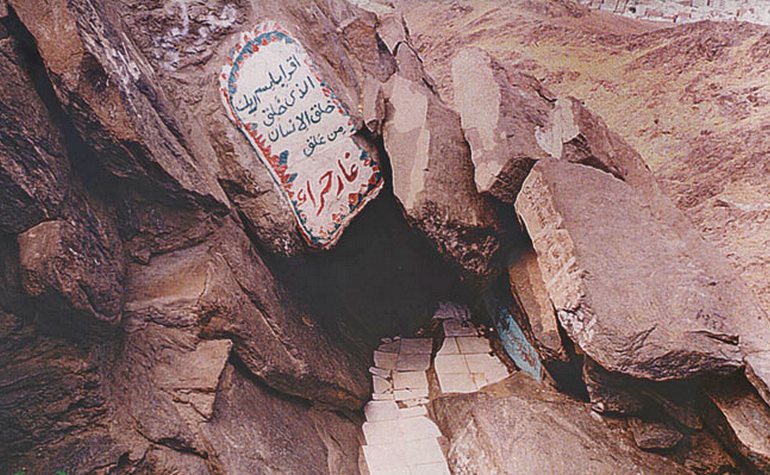
Prophet Muhammad, peace be upon him, was an illiterate person who received his first Quran Revelations, - Noble Verses 96:1-5, - while he was inside Cave Hira. You can do Google Search to get ample details about this precious history, but the following should suffice:
|
From
https://www.islamiclandmarks.com/makkah-other/jabal-hira:
Mount Hira This is Mount Hira (Jabal Hira), which lies about two miles from the Ka'bah. Near the top is a small cave, a little less than 4 meters in length and a little more than one and a half meters in width. It was here that the Prophet Muhammad (ﷺ) received the first revelations of the Holy Quran during the month of Ramadhan in 610 CE. The mountain is also known as Jabal Noor (the Mountain of Light). .......... (Click on image to enlarge)
300 years before Islam, Paran was Mecca |
Matthew 7:22-23: GOD sent
Jesus to be Christianity's lying spirit.

 is Iesu and Iesus in Latin and Greek for Jesus, and Eesa is also a Hebrew word that means doctor = عيسى

3- Related research:
|
From
https://www.answering-christianity.com/blog/index.php/topic,3293.msg16253.html#msg16253:
Brother Osama, some interesting articles that maybe you should take a closer look...do you have friends who are proficient in Hebrew? The only Muslim hebraist i know is Eric from DTT...would be great if other hebraists take a closer look and let you know their thoughts... https://bloggingtheology2.com/2019/01/03/my-servant-the-chosen-one/ https://bloggingtheology2.com/2018/11/26/the-prophet-from-the-land-of-kedar/ https://bloggingtheology.net/2018/03/07/is-prophet-muhammad-pbuh-mentioned-by-the-name-in-the-bible/ https://bloggingtheology.net/2017/08/05/the-forgotten-root-they-know-him-as-they-know-their-son/ https://bloggingtheology.net/2017/05/31/rabbi-ishmael-on-the-sons-of-ishmael/
Jehovah Jireh and the sacrificial mountain could be Mount Hira: https://www.answering-christianity.com/blog/index.php/topic,3320.msg16290.html#msg16290
Also visit: 300 years before Islam, Paran was Mecca
Matthew 7:22-23: GOD sent Jesus to be Christianity's lying spirit |
4- Quran Miracle: The Jews' and Christians' scribes changed and still change the Words:
The above research is only a scratch on the surface of what lies deep from deliberate corruption. Allah Almighty's Divine Claim in the Glorious Quran is again and again and again proven to be 100% accurate and True. Notice the simple present tense in يكتبون (write) and يحرفون (change the words):
| Noble Verse(s) 2:77-2:79 |
| Yusuf
Ali: [002:077] Know they not that God knoweth what they conceal and what they reveal? [002:078] And there are among them illiterates, who know not the Book, but (see therein their own) desires, and they do nothing but conjecture.[002:079] Then woe to those who write the Book with their own hands, and then say:"This is from God," to traffic with it for miserable price!- Woe to them for what their hands do write, and for the gain they make thereby. Arabic (Read from right to left. Also, all png image files: [1] [2]. Quran Moral Code (100s of them)]): 2:77 اولايعلمون ان الله يعلم مايسرون ومايعلنون2:78 ومنهم اميون لايعلمون الكتاب الا اماني وان هم الا يظنون 2:79 فويل للذين يكتبون الكتاب بايديهم ثم يقولون هذا من عند الله ليشتروا به ثمنا قليلا فويل لهم مما كتبت ايديهم وويل لهم مما يكسبون |
| Noble Verse(s) 5:41 | |
| Yusuf
Ali: [005:041] O Apostle! let not those grieve thee, who race each other into unbelief: (whether it be) among those who say "We believe" with their lips but whose hearts have no faith; or it be among the Jews,- men who will listen to any lie,- will listen even to others who have never so much as come to thee. They change the words from their (right) times and places: they say, "If ye are given this, take it, but if not, beware!" If any one's trial is intended by God, thou hast no authority in the least for him against God. For such - it is not God's will to purify their hearts. For them there is disgrace in this world, and in the Hereafter a heavy punishment.
Arabic (Read from right to left. Also, all png image files: [1] [2]. Quran Moral Code (100s of them)]): 5:41 ياايها الرسول لايحزنك الذين يسارعون في الكفر من الذين قالوا امنا بافواههم ولم تؤمن قلوبهم ومن الذين هادوا سماعون للكذب سماعون لقوم اخرين لم ياتوك يحرفون الكلم من بعد مواضعه يقولون ان اوتيتم هذا فخذوه وان لم تؤتوه فاحذروا ومن يرد الله فتنته فلن تملك له من الله شيئا اولئك الذين لم يرد الله ان يطهر قلوبهم لهم في الدنيا خزي ولهم في الاخرة عذاب عظيم |
| Noble Verse(s) 5:13 |
| Yusuf
Ali: [005:013] But because of their breach of their covenant, We cursed them, and made their hearts grow hard; they change the words from their (right) places and forget a good part of the message that was sent them, nor wilt thou cease to find them- barring a few - ever bent on (new) deceits: but forgive them, and overlook (their misdeeds): for God loveth those who are kind. Arabic (Read from right to left. Also, all png image files: [1] [2]. Quran Moral Code (100s of them)]): 5:13 فبما نقضهم ميثاقهم لعناهم وجعلنا قلوبهم قاسية يحرفون الكلم عن مواضعه ونسوا حظا مما ذكروا به ولاتزال تطلع على خائنة منهم الا قليلا منهم فاعف عنهم واصفح ان الله يحب المحسنين |
Indeed they did and still do and will always do. Proven with images, text and videos from their corrupt bible and books. They remove words and alter words. Also visit:


Where was the promised Holy Spirit in the disciples' apostatizing of each other.
The Romans had to crucifixion fake his crucifixion due to Passover issues: [1]

Paul commanded women to not expose sex predators in 1 Corinthians 14:34-35, 1 Timothy 2:11-13, 1 Thessalonians 4:3-4, 1 Corinthians 2:15 and other passages.
Paul protected sex predators!
GOD's promise to Abram: Genesis 13:13-17, 15:18-21, 17:8, 28:14. My additions to Tucker Carlson's discussions with Ted Cruz and American ambassador to Israel Mike Huckabee.
GOD to Jews: Even from your birth you were liars! (Isaiah 48:8)
Matthew 7:22-23: GOD sent Jesus to be Christianity's lying spirit
5- Prophet Muhammad foretold in OT and Dead Sea Scrolls:
6- Conclusion:
Again and again, Islam is proven to be the Divine Truth of GOD Almighty. Prophet Muhammad and Islam were thoroughly foretold in the previous scriptures. Indeed, all Praise and Glory are due to Allah Almighty Alone for making the Noble Quran be the Perfect and Everlasting Miracle, for us humans, out of all of His Divine Miracles! And may Allah Almighty send His Peace, Mercy and Blessings upon our Beloved and Blessed Prophet, Teacher and Role Model, Muhammad. Ameen.
Further articles to research:
Prophet Muhammad in the previous Scriptures.
Becca is Mecca in Psalm
4:6.
According to (1) Cambridge commentary,
(2)
Jewish Encyclopedia and (3)
Encyclopedia Biblica in Arabic and other sources. Ample Jewish and
Christian references declare Becca's geography to be
modern-day Mecca. In the NIV Bible commentary of Psalm 84, they also mentioned that Selah was mentioned in verses 4 and 8 of Psalm 84. Half of the Book of Psalm talks about Selah, and half of the Book of Isaiah has prophecies about the blessed future Arabia [2] [3].

Isaiah's Prophecy about Muhammad: "This is my Servant whom I love....He will come from the desert" [1] [2]
See Proof that "Paran" in the Bible is "Mecca".
Arabic
was proven to date back more than 8,000
to 20,000 years ago.


200 years no gospels | 24 other thrones besides
Jesus' | Jesus'
problematic hyperboles: made sinful
lawful and lawful sinful | Jesus was created | What's
new | A-Z library (3300+
articles) | "Muslims" was
the original title | Quran
Search | Quran
Moral Code (100s
of them) | Quran: Bibles are filled with corrupt قول
qaowl (doctrines of sayings and writings. See also Hafs vs. Warsh Quran) | "bar
Allahin" in Daniel 3:25-26 means the chosen
one of Allah | Jesus said he was powerless | Paul
said he wasn't sure about
Holy Spirit | Disciples called each other liars,
satanic, false | Paul commanded women to
not expose sex
predators | Research
& Blog | 9/11
Israel-lie | Youtube |
| Jesus replaced Satan: (Ezekiel
28:13-19)
Where was the promised Holy
Spirit in
the disciples' apostatizing of
each other.
The Romans had to crucifixion fake his crucifixion due to Passover issues: [1]
Quran's STUNNING Divine Miracles: [1] Allah Almighty also promised in several Divine Prophecies that He will show the Glorious Quran's Miracles to mankind. For example:
Coincidence? See 1,000s of examples [1].Quran's Stunning Numerical & Scientific Miracles.
"I cannot do anything on my own." (i.e., Jesus could not perform a single Miracle without GOD sending it down to him first!). I can not perform a single Miracle on my own!! I am totally POWERLESS without Allah Almighty! John 5:31 "if I (Jesus) bear witness of myself, then I would be a liar!" GOD didn't talk this way when He spoke to Moses. GOD's testimony alone is always sufficient! Jesus also bowed his face down to the ground, like we Muslims (Isaiah 56:5: Muslim is the future believers' name, and sons and daughters of GOD titles will be "no more"; |





.jpg)